By Samuel S. Ready, MLIS
The main article written at this time about deck-building games and library collection development appears to be the one by Robbins for Library Journal in 2012. Robbins recommends deck-building games for acquisition by libraries with robust game collections—but this is only the beginning of the relationship between such games and libraries.
Robbins (2012) does a good job of explaining why trading card games such as Magic: the Gathering are not a great fit for libraries: competitive and commercial, they present a never-ending arms race that is won by spending money buying new cards all the time. Trading is not the same as sharing, and the game is not a closed system. Robbins points out that deck building games are more democratic and self-sufficient, which is true. What Robbins fails to then say is that deck-building games such as those manufactured by Cryptozoic Entertainment are a good fit for libraries because they are in a way a simulation of library collection development.
In trading card games such as Magic: the Gathering, Pokémon, or Yu-Gi-Oh!, a player purchases decks and booster packs of cards and assembles them into a deck (sometimes called a library) which they will then shuffle and draw from to play against one or more opponents who have also cultivated a formidable deck of creatures, spells, and items. The players build their decks before the game, shuffle, and do battle until all but one player has lost all of their life points or run out of cards. That is not what a deck-building game is, though.
In a deck-building game, all players start out with the same cards. The paltry starter cards’ only purpose is to buy better cards (with power points within the game) from stacks of face-up cards, and the game is spent building the deck. When one runs out of cards, one shuffles one’s deck and draws from it again. As different face-up cards become available, players acquire them strategically with points and also purge cards that they feel are slowing them down. The cards are chosen based on the powers they bring to the gameplay and also based on the number of points that the card will be worth at the end of the game. The cards’ various abilities and game mechanics are relevant during gameplay, but ultimately the winner will be the player who has the most endgame points. Once the criteria for ending the game are met, the players will go through their decks and count up the endgame points to determine the winner. Starter cards offer little power during the game and are traditionally worth nothing at the end.
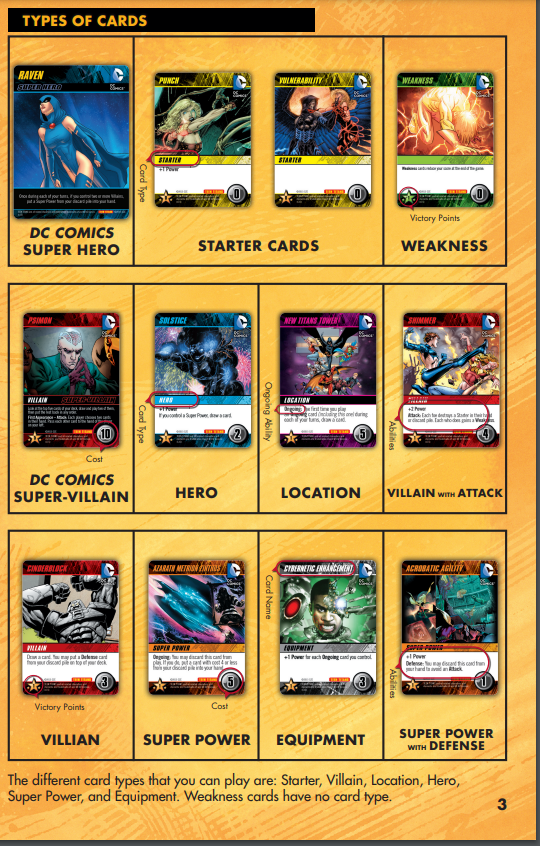
Figure 1.[1] Page from Teen Titans Rulebook, © Cryptozoic Entertainment, 2015. Used under fair use for scholarly critique. Original rulebook available at: https://www.dontpanicgames.com/static/DC_TEEN_TITANS_Rulebook_ENG.pdf
As illustrated in Figure 1, Cards are bought for their cost in power, contribute power to purchase more cards when they are drawn, and are worth victory points in the endgame. Some cards also have abilities during the gameplay.
Let’s review some of the basic elements of the game:
- Acquisition: Players will try to buy the best cards they can with the points their preexisting cards provide them.
- Strategy: There will be a lot of different types of cards (e.g., starter, villain, location, hero, super power, and equipment, per Brady, 2015) with different approaches to the game. A savvy player must think strategically about which types of cards to invest in. The cards need to be good in the moment but also work together. A well-rounded deck is usually not the answer, but rather a specialized deck. Different players will also bring their own play style to the table. There is not just one right answer.
- Maintenance: The players can’t run out of cards, but they can only draw and play so many cards per turn. There’s nothing more annoying than lame starter cards or punishment cards (e.g., Weakness cards, in Brady, 2015) taking up room in the player’s hand. Those slots are valuable. A good player will not just add cards but also purge cards when possible. Players learn to ditch their starter cards as soon as possible, and as the game runs long, they will even throw out cards they picked out earlier in the game when they realize their deck could be leaner and more effective.
- Turnover: A winning player will be someone who is unsentimental about their cards and who cares only about getting strong and compatible cards and observing how often they resurface.
How is this like collection development in a library? The parallels are many. When cultivating an actual library collection, a librarian must assess one’s needs and think strategically. One must acquire good picks that make sense both individually and together. Johnson (2018) says that knowledge of the internal (assessment) and external environments (evaluation) is a must in collection development. In some games such as Cryptozoic Entertainment’s Teen Titans game (R. Brady, 2015), players start out with a character ability (e.g., Red Robin’s ability “If you control two or more Heroes, +1 Power and put an Equipment from your discard pile into your hand” per Brady, 2015) that will often inspire their strategy for the rest of the game (e.g., acquiring mostly heroes and equipment as opposed to other card types). Johnson also understands that all strategy is contextual and that there is not one best philosophy or best material for all libraries everywhere. The adaptability required is very much like a game.
Johnson (2018) reminds us that library acquisitions have moved from a “just in case” philosophy of buying anything good to a more discerning “just in time” approach that reacts to needs in real time. Johnson also notes that librarians must be very aware of the life cycle of materials. In a deck-building game, the life cycle is short but very important. The so-called anti-collection of works not owned is also more real than ever as it consists of physical cards you can see.
A librarian also must sometimes weed books and other resources that no longer make sense in the collection. A library therefore can be seen as a giant deck with thousands of cards, and collection development as a deck-building game that plays out over decades or centuries. It is a team game even in a small library with one librarian responsible for collection development, because the game can take longer than a human lifetime.
Some thinkers such as DiNardo & Snyder Broussard (2019) have proposed using off-the-shelf commercial tabletop games to teach information concepts. MLIS students and other students of librarianship would be wise to play a deck-building game such as Cryptozoic Entertainment’s Teen Titans game (Brady, 2015) in order to experience building a library collection in a microcosm that moves at a dramatically accelerated pace.
Deck-building games are ideal for libraries not just because they don’t require lots of purchases but because they do a surprisingly good job of roleplaying what collection development is like. Many concepts such as acquisitions, strategy, and weeding are implicit in the game, except for a few, such as collaborative collection development, where libraries make a conscious effort to dovetail each other’s collections and not duplicate them (Johnson, 2018). Players in a game that is not co-op are unlikely to work together. This is one area in which librarians think further ahead than even the most strategic gamers. Deck-building games also do not require contract negotiation, marketing, or materials mending, and they do not frown on duplication if it’s a good card. There might be challenges to materials from other players with certain abilities, but not like in libraries.
Playing deck-building games around a character power is not truly the same as running collection development in a library, and it will not teach how to acquire or weed per se, but it might help in shaping the attitudes and opinions that MLIS students have towards such activities (the why). Like a gamer, an MLIS librarian should be strategic and unsentimental about honing the collection. They must lose the trees for the forest and think about the bigger picture, with a healthy dose of game theory. It’s not really about the cards; it’s about the deck. This is an important lesson that some library workers forget at times due to their love of books. An extremely sped up and simplified simulation of collection development could help demonstrate the stakes of their sentiment.
Johnson (2018) writes that collection development is not just an art or just a science. That might be because it is actually best understood as a game. Johnson also writes that purely theoretical education is not sufficient to learn collection development, so MLIS students, get playing!
References
Brady, R. (2015). Teen Titans [board game]. Cryptozoic Entertainment. https://www.dontpanicgames.com/static/DC_TEEN_TITANS_Rulebook_ENG.pdf
DiNardo, C. O., & Snyder Broussard, M.,J. (2019). Commercial tabletop games to teach information literacy. Reference Services Review, 47(2), 106-117. https://doi.org/10.1108/RSR-10-2018-0066
Johnson, P. (2018). Fundamentals of collection development and management, 4th ed. ALA Editions.
Robbins, M. B. (2012). Deck-building games. Library Journal, 137(17), 55.
Acknowledgements
Special thanks to Kieren Fox, MLIS.
Fair Use Justification for Reproduced Game Rule Page
This article includes a single page from the rulebook of Teen Titans to support a scholarly analysis of its mechanics and underlying philosophical structure. The use qualifies as fair use under 17 U.S. Code § 107 for the following reasons:
- Purpose and character: The use is academic and non-commercial, and the page is presented within a broader critical and transformative discussion.
- Nature of the work: The rulebook combines functional elements (game mechanics) with some expressive content. The excerpted page is primarily functional.
- Amount used: Only one page is reproduced—the minimum necessary to make the scholarly point. This does not constitute a substantial portion of the work.
- Market impact: The rulebook is available online for free from an official source, and this article does not substitute for the game or diminish its market. A citation and link to the official source are provided.
For these reasons, this use is consistent with fair use principles.
Notes
[1] The page from Teen Titans reproduced here (Figure 1) is used under fair use to support academic analysis. The full rulebook is freely available from the publisher at: https://www.dontpanicgames.com/static/DC_TEEN_TITANS_Rulebook_ENG.pdf