Kelsey Hammer, Coordinator of Student Engagement & Programming
Julia Feerrar, Head of Digital Literacy Initiatives
University Libraries at Virginia Tech
Introduction
Academic library outreach and engagement often works at the nexus of multiple challenges. Librarians must meet the needs and interests of patron communities, make the most of limited staff time and resources, and navigate competing priorities for time and attention across campus. Over the last several years, our team of teaching librarians at Virginia Tech has sought out multiple opportunities to rethink and restrategize some of our approaches to these challenges.
Prior to the COVID-19 pandemic, our team was feeling increasingly dissatisfied with aspects of our instructional and outreach offerings. In particular, we were concerned about low attendance at open workshops and about the long-term impact of activities like resource tabling at information fairs and other similar events. While many of the students we did connect with were enthusiastic about the content of our offerings, we felt like we were not quite hitting the mark on engagement methods. Students have limited bandwidth for co-curricular offerings, due to the strains of balancing academic work, jobs, social life, and other extracurriculars that are vital to their mental health and well-being. Even the strongest library programming and marketing efforts are operating within that dynamic. As we were prompted to reflect on our practices during the pandemic, in particular, we found that we were ready for a new approach. We aimed to more effectively engage students in digital literacy learning, while also acknowledging their limited bandwidth and supporting their well-being.
As we reflected on our concerns with both workshops and tabling, our team identified a possible solution that could address both areas. This approach, which we refer to as “micro-programming,” combines active learning techniques from the classroom with the flexibility and direct-to-student delivery method of outreach work such as tabling or events. Micro-programming aims to sustain the best parts of in-classroom learning, while being adaptive to community needs and flexible with instructor workloads. It is not a replacement for traditional outreach or instruction, but a programming addition that can reduce pressure on engagement numbers, act as a testing ground for new ideas, and increase meaningful face time between library instructors and students outside of the classroom environment. In this paper, we will identify the principles our team has developed in experimenting with micro-programming and factors to consider for implementing this practice at other institutions.
Background
Virginia Tech is a public land-grant institution that serves around 37,000 students. Within the University Libraries, digital literacy initiatives have been a key area of growth over the last several years. The digital literacy team within the Teaching & Learning Engagement department is composed of four full-time teaching librarians who instruct, research, and engage patrons on digital literacy topics, including information and media literacies. The team’s work also includes foundational instruction, content creation, outreach events, consultations, and research.
Literature Review
The terms outreach (Diaz, 2019; Blummer & Kenton, 2019) and engagement (Appleton, 2020; Eschbach, 2020; Schlak, 2018) have been used in academic libraries to describe a variety of activities that connect the library with its users. Librarians undertaking outreach and engagement work may have a variety of purposes in mind, including sharing information about library services and collections, building relationships, directly or indirectly fostering learning, and creating social experiences (Diaz, 2019). Specific outreach and engagement activities may include library or information literacy instruction (Blummer & Kenton, 2019), use of library social media (Blummer & Kenton, 2019), staffing a library table at campus information fairs (Crowe, 2010), or hosting a variety of specialized programs and events (Blummer & Kenton, 2019; Eshbach, 2020). Just a few examples of large-scale events in academic libraries include game nights (Crowe 2010); research symposia, showcases, and graduate socials (Demeter et al. 2018; Kasten-Mutkus, 2020); learning lunches (Eshbach, 2020), art exhibits (Rose et al. 2020); and wellness events with therapy dogs (Vasudev, 2022).
Academic libraries are increasingly exploring outreach and engagement activities that span both academic and social purposes. Eshbach (2020) emphasizes the unique opportunity libraries have to help students make connections with others on campus, connect with campus resources, and engage in learning that sparks their interest. The library is uniquely positioned to “have a positive impact on student learning and personal development” (Eshbach 2020). Holder and Lannon (2020) also put libraries forth as unique and vital campus resources for supporting and promoting student mental health. Student mental health is a major concern on college campuses as rates of anxiety and depression have more than doubled in the last decade (Ableson et al. 2022). Libraries can provide resources, space, and programming that supports campus mental health efforts (Holder & Lannon 2020). On the lower end of the scale, “library anxiety” is also an issue preventing students from accessing helpful library support. This can include fear about not knowing how to use the library, being “behind” peers in this knowledge, and incurring judgement from staff can affect student’s interactions with the library (Mellon 1986, Gaha et. al 2018). Participating in large events like orientation fairs is a common opportunity for libraries to help decrease anxiety around their services (Parks 2019). Demeter et al. (2018) emphasize the importance of developing partnerships when hosting large events that aim at student connection and support. Similarly, Vasudev describes efforts to connect specifically with particular student organizations and to offer programming that meets their needs (2022).
Libraries looking to offer outreach and engagement activities often face the challenge of competing for time and attention on campus (Vasudev 2022, Witherspoon & Tabor 2021). Attracting participants can be challenging, especially for optional learning events like co-curricular workshops or more academically focused events in general (Demeter et al. 2018, Witherspoon & Tabor 2021). While digging into the intersection between academic and social programming can be a helpful way forward, more exploration is needed on the effectiveness of library programming approaches.
Exploring Challenges
Workshops
For several years, our team taught 4-6 workshops each semester on digital wellness topics like decluttering digital files, disengaging from social media, fact-checking, building an online presence, and digital self-care. These workshops were part of an initial effort at expanding our digital literacy programming in addition to course-integrated and foundational instruction. While many campus partners, course instructors, and students expressed enthusiasm for digital wellness workshops, these workshops were not fully meeting our goals. Workshops were marketed through library social media, email, library calendars, student worker programs, and word-of-mouth. We struggled with no-shows and low attendance overall, as many academic library teaching teams do (Witherspoon & Tabor 2021). We also found that learners often brought highly varying levels of competency on digital literacy topics, making it difficult to plan lessons and adapt in-session.
Informal feedback conversations with participants also reflected increased student interest during hands-on learning activities and decreased interest in informative instruction. Learners preferred time for practical work like deleting emails or organizing files and were less engaged with being presented with information on strategies, context, and goal-setting. While lecture-style portions of class can be valuable, they lose that value when students are disengaged. Undergraduate student attendees also expressed that academic workloads, professional work, and necessary extracurriculars made it difficult to not only attend workshops, but to deeply engage with content in class and in future practice. A new approach would both need to increase the number of learners and better address their engagement, focus, and/or capacity during instruction.
Tabling
In addition to instruction, our team also frequently “tabled” at many university-wide resource fairs and set up smaller versions in our own library. Tabling is a practice where on and off-campus groups market resources to students in high-traffic areas. Incentives are offered in exchange for time and engagement. Low costs, minimal set-up, and high engagement numbers make tabling a popular outreach practice for campus groups. Our team was often dissatisfied with tabling experiences overall, despite often exceeding goal interaction numbers. Facilitators found that interactions we experienced or witnessed at such events were frequently surface level, heavy on information, and forgettable for learners. Students, particularly first-years, arrived already at mental capacity from coursework and campus life. Facilitators, particularly librarians, often immediately listed many resources or asked students broad or complex questions like “What are your goals?” Incentives also overshadowed conversations and connection. Specific, memorable, and deep interactions with students were possible, but we saw them as the exception and not the rule. While tabling increases exposure, we sought a new approach that would tackle more focused and memorable interactions with learners.
Rethinking Our Approach
After reflecting on the challenges and affordances of workshops and tabling, our team set out to try a new approach to student engagement events. This approach, which we have termed “micro-programming,” combines a small slice of active learning from the classroom with the casual, drop-by nature of outreach tabling. Our primary goal with this approach is to support one small but important learning goal that will be valuable to students today and in future practice. Additionally, as a secondary goal, micro-programming events can serve as a gateway to further engagement with the library, such as a workshop, online learning resource, or another event. As discussed further in the case studies below, micro-programming can appear as a specific pop-up event or be embedded in a larger event. Our team has sometimes conceptualized micro-programming as “going small to go big.” By this we mean that we are aiming to greatly reduce the number of learning goals we try to achieve at a given time, to make learning more flexible, scalable, and personalized.
Case Study: Snacks & Sleuthing Outreach Table
One of the ways in which our team has explored micro-programming is through a series of standalone, pop-up outreach tables. Each event in the series pairs an incentive (usually food or library-branded giveaways) with a short, engaging activity. Internally, we refer to this as our “&” series because of those pairings. To facilitate these events, we set up a table in a high-traffic area in the library for a period of about two hours. We try to align with class change times to make the most of foot traffic already in the library; for the most part, we have not done event marketing ahead of time, to keep these events as flexible and easy as possible. One of the most successful versions of this is a fact-checking activity event we called Snacks & Sleuthing.
Snacks & Sleuthing is a low-stakes opportunity for learners to practice fact-checking and lateral reading skills. During the activity, learners select one animal fact “mystery” and use a search engine to find at least one reputable source that helps them evaluate the animal-related claim (see Appendix for lesson plan). The overarching goal of the activity is to emphasize the power in pausing and looking outside of a given information source or piece of media in order to evaluate it. While many learners are initially engaged by the opportunity to guess an answer, we prompt them to move beyond guessing and find a reputable source. We do not provide any short lectures on fact-checking or lateral reading, instead responding directly to student needs and questions as they come up. This approach has led to some highly engaging, on-the-fly conversions with students about fact-checking websites like Snopes, search engine AI overviews, and the nature of credibility. 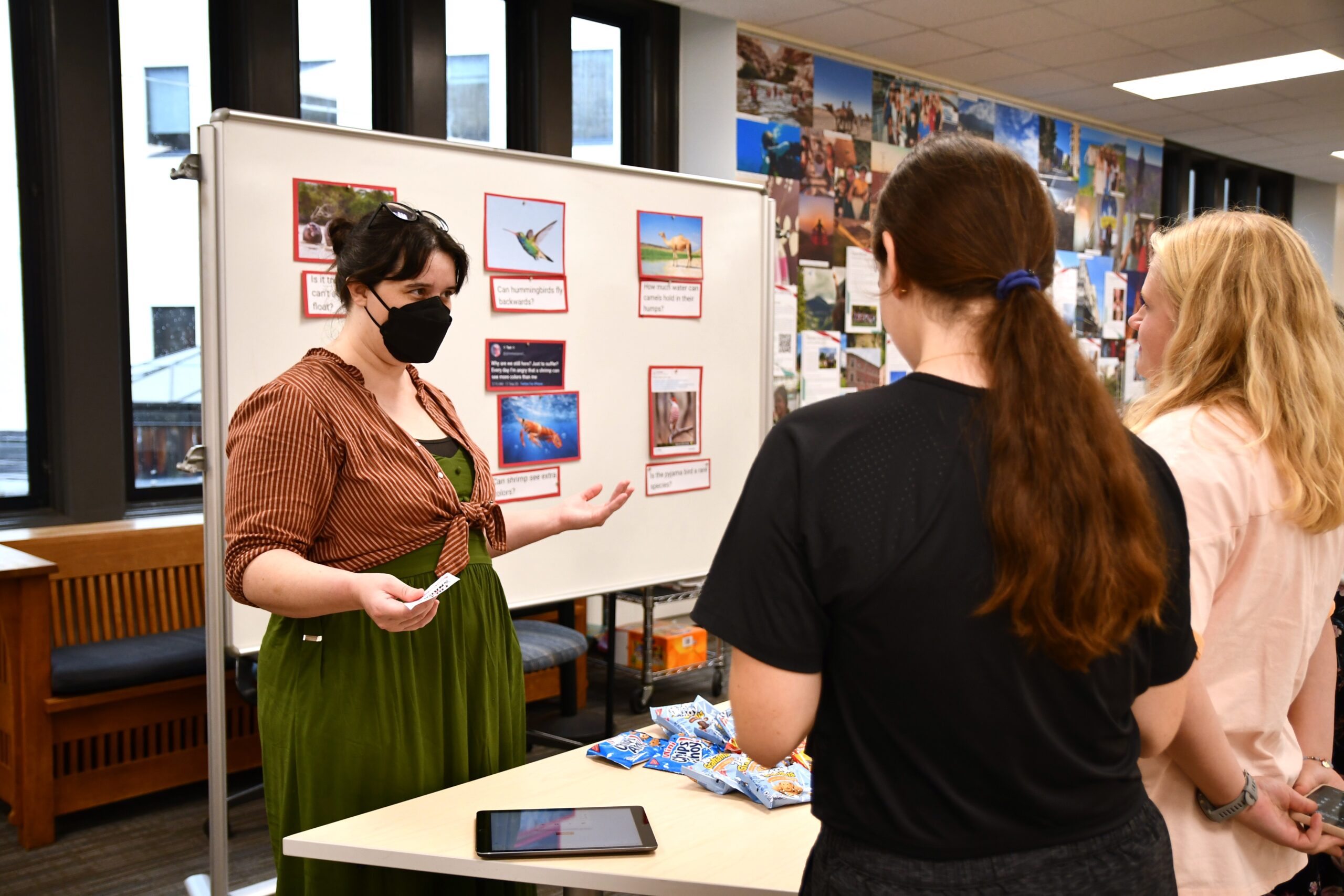 Image 1. A librarian facilitator talks with student participants during Snacks & Sleuthing.
We intentionally designed this event with opportunities for choice in mind. Choosing which animal fact to fact-check has been a compelling and inviting way in for the learners we have interacted with. Some participants have been excited to point out examples they were already familiar with or have some personal connection to. Similarly, participants also seem to enjoy the opportunity to choose their snack at the close of the activity. We have tried to purchase animal-themed snacks that we thought would prompt nostalgia for many participants (i.e. animal crackers, goldfish crackers, animal-shaped fruit gummies, etc.) and these have prompted many positive comments from attendees.  Image 2: Snacks & Sleuthing “ticket” used for promotion during the pop-up event.
In addition to capitalizing on shared love of animals and humorous animal “facts,” we have also taken a more light-hearted approach by theming this event around sleuthing and mysteries. We do this through signage, handouts, and the way we display the animal examples. Misinformation can be a heavy topic and while it can be important to dig into, our priority for this kind of quick interaction is to keep the focus on transferable skills and build positive associations with the library. Some students have actually been surprised to learn that the activity facilitators are from the library, not realizing that the library may offer these kinds of events. Overall, learners have reacted very well. After talking with a facilitator about the goal of the activity, one participant said, “Oh, that’s great! Good luck on your mission!”
Case Study: Digital Wellness “Merit Badge” Outreach Table
Our team has also tested embedding micro-programming into larger events. We participate in numerous campus events each year including therapy dog birthday parties, book fairs, and mental health festivals. A “large” event for our team is one where more than a hundred attendees are anticipated and multiple campus partners are often present. Events typically include food, prizes, and engagement opportunities. As with one-off pop-ups, our team encourages attendees to participate in a short learning activity by offering an incentive. The length of large events varies, but can range from one to five hours. For this reason, tables are staffed in shifts. And while events are marketed ahead of time, the specific learning activities are not. This is not to mislead attendees, but rather to reduce superfluous text on marketing assets. Learning activities are optional and attendees are not likely to attend an event because of them.
One of the most successful versions of an embedded activity is “Digital Wellness Merit Badges.” This activity has been tested multiple times, most notably at Josie the therapy dog’s 6th Birthday Party. Virginia Tech is home to three full-time facility dogs called the VT Therapy Dogs. They work daily in clinical settings with licensed counselors and act as mental health ambassadors on campus. The Library hosts their birthday parties each year with cake, birthday cards, a ball pit, special guests, and learning activities. Parties are held in an open area of the library, hosted for one hour in length, and typically attended by around 300-500 patrons. Learning activities are optional, but are encouraged with a variety of incentives.
Our team has tested numerous micro-programming activities at “dog birthdays” including “Digital Wellness Merit Badges.” This is a low-threshold activity that encourages learners to reflect and goal-set on digital wellness practices. Learners are presented with eight merit badge stickers covering topics like “Take a Break from the News,” “Unsubscribe from Emails,” and “Relax My Body.” Learners choose a badge that celebrates a recent accomplishment or sets a future goal and can take a quiz to receive a badge suggestion. The goal is to remind students that even “small” digital wellness actions are important. Learners can often be overwhelmed with improving their digital wellness, but intentional small actions can make a difference. For example, stretching when you’ve been hunched over your laptop trying to meet a deadline or taking a five minute snack break to stop “doom-scrolling” is better than taking no action at all. During the activity, we do not provide direct instruction on digital wellness, but interactions with students often lead to meaningful discussions about social media, online learning, and media literacy. The stickers also act as future reminders for digital wellness practices.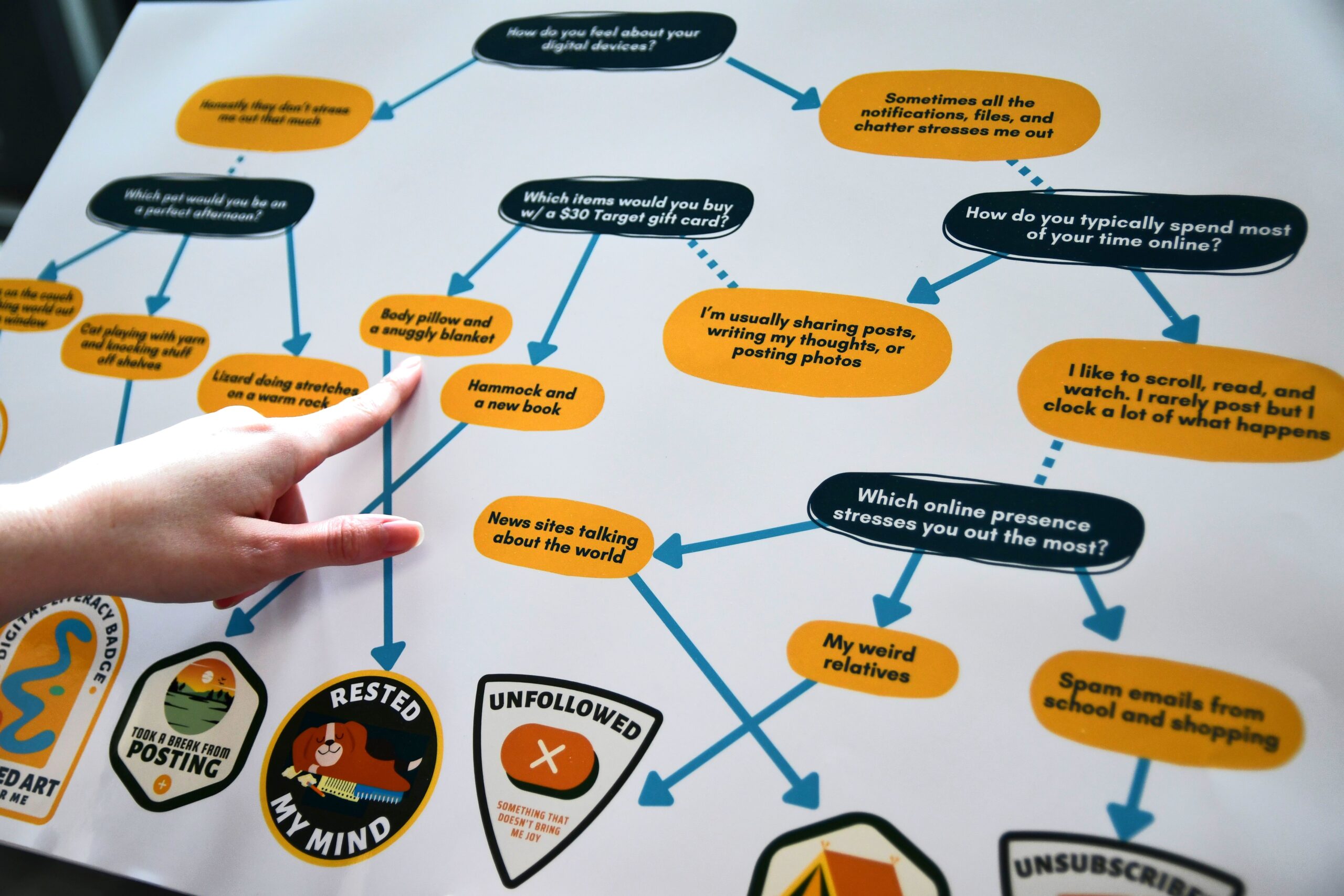 Image 3. Digital wellness merit badge quiz.
In this activity, the element of choice exists through the structure of choosing a sticker. This choice leads to personal reflection and can open up meaningful discussions with others nearby. The high number of options also encourages deeper reflection in this activity. We rarely see students grab a sticker quickly and leave. The quiz element acts as optional scaffolding and is intentionally silly so learners are more likely to reflect on results. We often hear learners saying “I should really have gotten this other badge!” even though they previously were unsure. The quiz is also “follow-the-line” style so learners can participate out-loud with friends or the facilitator if they are open to it.
Connections are created through this shared quiz, but can also be set-up by facilitators as they introduce learners to the activity. We encourage facilitators to share which badges they use themselves as a way to help model the activity, share authenticity, and make clear that this lesson is not prescriptive or judgemental. The stickers in this activity are also designed to mimic nostalgic merit badges with bright and fun imagery. They come in two sizes to fit a variety of uses including water bottles, phone backs, and laptops. In informal assessment, participants have expressed positivity towards the community nature of the quiz, the “cuteness” of sticker options, and the fact that the activity encourages and celebrates progress over perfection.
Micro-programming Priorities
As outlined in the case studies above, three major priorities characterize our approach to micro-programming: active learning, connection, and building positive associations with the library. These priorities are essential to meet our primary goals of supporting fun, but practical in-the-moment education, while also setting learners up for future personal growth and ongoing library relationships. Those looking to explore micro-programming can examine how these priorities may align with goals, lessons, and outreach efforts at their own institutions.
Active learning
In our initial experiments with micro-programming, we wanted to focus directly on the moments of highest student engagement, while scaling down into more flexible bites. Micro-programming interactions need to be significantly shorter than a workshop, but can potentially be longer than many resource-based tabling interactions. Through informal assessment, we found that learners were willing to engage with a table activity for up to five minutes in exchange for a piece of swag. This time frame is enough to accomplish a learning goal and is short enough to engage students walking by.
Those looking to explore micro-programming can pull learning goals for each activity directly from existing classroom activities including gallery walks, reflection/creative writing prompts, real time reactions, quick polls, and hypothesizing. It is important to remember that adjustments may need to be made before, during, and after an event since learning activities may operate differently between classroom and out-of-classroom settings. Designing activities that balance novelty with learning is a rewarding challenge. Assessing events and being careful not to plan too many learning goals is imperative.
Connection
Our next priority for micro-programming is to create activity structures that lend themselves to meaningful connections between learner and facilitator. In our experiences, intentional conversations with learners often lead them to future and deeper engagement with the library, staff, and class projects. These stronger connections would hopefully not only support students academically, but holistically. Through library outreach (particularly post-pandemic) we perceived that students were struggling with social connection. This observation was supported by conversations with campus partners and national research. Renn and Reason (2021) note that a “sense of belonging,” social networks, and intrapersonal skills are important contributing factors for college student health and success. Cerutti et al. (2024) found that the Covid-19 pandemic did affect social skills in first-year students and the researchers describe post-pandemic students as a “cohort reaching for more emotional connection while self-consciously aware of their own impaired social skills…” Additionally in 2023, the Office of the Surgeon General declared loneliness and isolation a national “epidemic” that is particularly impactful on young adults after the pandemic. Knowing that social connection is a vital but increasingly challenging factor for our students led us to make connection a priority in our work. For us, this has meant increasing authentic and grace-filled conversations with learners, providing more tailored resources and engagement opportunities, and enacting a general and natural “warmth,” as explored by Parks (2019).
We have found that connection can be incorporated into micro-programming in a number of ways. The first is to provide opportunities for choice, which we find leads to more engaging conversations with attendees. This can be seen more specifically in our first case study. Second, we choose activities that can be engaged with by a crowd, as well as alone. Almost like setting up a magic trick, we make sure that multiple learners can approach a table to both interact with or just see interactions happening. Participants and those waiting in line often converse about challenges or prizes, even if they are strangers. Allowing learners to also witness the learning interaction before they participate is also good for accessibility as it decreases anxiety around the process, people, and activity at hand. Thirdly, our most recent experiments have been with displaying responses. One example is a reflection wall. As students respond to questions like “Who is someone who inspires you?”, they can see other learners’ answers and their own being held up and celebrated in a public forum.
Positive Associations with the Library
Our final priority is to build positive associations with the library and digital literacy topics. A student remembering advice for email filters is a win, but a student remembering they can ask for help at the library is monumental. If a student trusts or enjoys the library today, what experiences, relationships, and projects might that lead them to tomorrow? In some cases, we have emphasized concrete next steps for students to take if they want to engage with the library further, such as through a resource guide, handout, specific event, or workshop. While we also see value in micro-programming activities in and of themselves, strategizing these next steps is something we continue to explore. As previously mentioned, “library anxiety” can be a prevalent deterrent or discouragement for students interacting with academic libraries (Mellon 1986, Gaha et. al 2018). Positive, relaxed, or “warm” interactions with library staff and activities can be an important change factor in helping students see the library as a positive place, resource, and hub for help (Parks 2019). Finding positivity in some digital literacy topics, like artificial intelligence or data security is challenging, but possible.
Since “positivity” and “warmth” are quite broad, our team narrowed down to “nostalgia,” “joy,” and “novelty” for planning out logistical structures and conceptual framings. For learning, these elements could look like adding a game, mystery, or even a Teen Vogue or Buzzfeed-style quiz format to an activity. Colorful decorations, relaxed or silly invitations to participate from facilitators, and an “Instagram-worthy” conceit or theme can not only build positivity around a table set-up, but also increase learner interest. Incentives for all attendees or raffle winners can match themes, be rare or one-of-kind items, or go high value (either in cost or quantity). If we are limited to cheaper or more practical incentives, we request or encourage learners to take multiples. Tapping into nostalgic treats, a variety of options, or unique flavors can also bring a fresh element to food incentives. Overall, while adding positivity can feel a bit like the “icing on top,” we have witnessed these elements helping to ease anxiety, increase interest, facilitate conversation, and build trust.
Conclusion
Many libraries face challenges in reaching patrons through co-curricular and event-based programming outside of the classroom, especially when time and attention on campus is in short supply. For our team, micro-programming has offered opportunities to expand our outreach and engagement beyond classroom instruction, while still meeting valuable learning goals. And while micro-programming is not a replacement for in-classroom instruction, adding it to a programming slate has helped our team to diversity offerings and maintain a more sustainable schedule of events and activities for our team. Our initial experiences have been positive for both learners and facilitators in being adaptable to personal and academic goals and capacities.
Those looking to explore micro-programming at their own institution can start by thinking about one small, concrete learning outcome that is a priority for their instruction program, or that they have trouble fitting into their current classroom instruction. Then, consider short, hands-on activities that would allow attendees to work towards this outcome. This activity could be reflective or action-based. We recommend that activities be completed in three to four minutes or less, so this may take several iterations of brainstorming to “right-size” the activity. As you consider the activity, also think about what will incentivize attendees.
As we do more and more of this kind of programming, and become more comfortable with the logistical structures involved, we are finding that (as with instruction) we often decrease the amount of time, personnel, and trial and error needed in early iterations.This has led to more capacity for assessment, improvements, and dreaming up the next iterations. Looking to the future, we are continuing to work on ways to involve our undergraduate student workers in this type of programming to further extend its sustainability and scalability.
Appendix
Snacks & Sleuthing: Animal Fact Check Lesson Plan can be viewed and downloaded in PDF format here.
References
Abelson, S., Lipson, S. K., Eisenberg, D., Bowman, N. A., & Perna, L. W. (2022). Mental health
in college populations: A multidisciplinary review of what works, evidence gaps, and
paths forward. In Higher Education: Handbook of Theory and Research (Vol. 37, pp.
133–238). Springer International Publishing AG.
https://doi.org/10.1007/978-3-030-76660-3_6
Appleton, L. (2020). Academic libraries and student engagement: A literature review. New
Review of Academic Librarianship, 26(2–4), 189–213.
https://doi.org/10.1080/13614533.2020.1784762
Blummer, B., & Kenton, J. M. (2019). Academic libraries’ outreach efforts: Identifying themes in the literature. Public Services Quarterly, 15(3), 179–204.
https://doi.org/10.1080/15228959.2019.1592058
Cerutti, J., Burt, K. B., Moeller, R. W., & Seehuus, M. (2024). Declines in social–emotional skills in college students during the COVID-19 pandemic. Frontiers in Psychology, 15,
1392058. https://doi.org/10.3389/fpsyg.2024.1392058
Crowe, K. M. (2010). Student affairs connection: Promoting the library through co-curricular activities. Collaborative Librarianship, 2(3), 154–158.
https://libres.uncg.edu/ir/uncg/listing.aspx?id=4508
Demeter, M., Besara, R., Colvin, G., & Birmingham, B. (2018). Send in the crowds: Planning
and benefiting from large-scale academic library events. Marketing Libraries Journal,
2(1), 86–95. https://journal.marketinglibraries.org/mljv2i1-86-95/
Diaz, S. A. (2019). Outreach in academic librarianship: A concept analysis and definition.
Journal of Academic Librarianship, 45(3), 184–194.
https://doi.org/10.1016/j.acalib.2019.02.012
Eshbach, B. E. (2020). Supporting and engaging students through academic library
programming. Journal of Academic Librarianship, 46(3), 1-11.
https://doi.org/10.1016/j.acalib.2020.102129
Gaha, U., Hinnefeld, S., & Pellegrino, C. (2018). The Academic Library’s Contribution to Student Success: Library instruction and GPA. College & Research Libraries, 79(6), 737–746.
https://doi.org/10.5860/crl.79.6.737
Holder, S., & Lannon, A. (2020). Student Wellness and Academic Libraries : Case Studies and
Activities for Promoting Health and Success. Association of College and
Research Libraries.
Gannon, K. R., Richardson, L. R., & Ritzert, T. R. (2025). The mental health climate and mental health-related academic help seeking on U.S. college campuses. Stigma and Health, 10(1), 122–131. https://doi.org/10.1037/sah0000502
Kasten-Mutkus, K. (2020). Programming as pedagogy in the academic library. Portal, 20(3), 425–434. https://doi.org/10.1353/pla.2020.0023
Mellon, C. A. (1986). Library anxiety: A grounded theory and its development. College &
Research Libraries, 47(2), 160–165. https://doi.org/10.5860/crl_47_02_160
Office of the Surgeon General (OSG). (2023). Our Epidemic of Loneliness and Isolation: The
U.S. Surgeon General’s Advisory on the Healing Effects of Social Connection and
Community. US Department of Health and Human Services.
Parks, C. (2019). Testing a warmth-based instruction intervention for reducing library anxiety in first-year undergraduate students. Evidence Based Library and Information Practice, 14(2), 70–84. https://doi.org/10.18438/eblip29548
Renn, K.A., & Reason, R.D. (2021). College Students in the United States: Characteristics,
Experiences, and Outcomes (2nd ed.). Routledge. https://doi.org/10.4324/9781003443445
Rose, R., Nesbitt, T., & Galloup, A. (2020). Hosting art exhibits to enhance student
engagement: A case study at a commuter college. New Review of Academic
Librarianship, 26(2–4), 385–402. https://doi.org/10.1080/13614533.2020.1784759
Schlak, T. (2018). Academic libraries and engagement: A critical contextualization of the library discourse on engagement. The Journal of Academic Librarianship, 44(1), 133–139.
https://doi.org/10.1016/j.acalib.2017.09.005
Vasudev, S. (2022). Information is a two-way street: How libraries can learn from community outreach. In A. Brissett. & D. Moronta (eds). Practicing Social Justice in Libraries (28-39). Routledge.
Witherspoon, R. L., & Taber, P. O. L. (2021). Increasing student attendance at library
workshops: What the data tells us. College & Research Libraries, 82(1), 113–128.
https://doi.org/10.5860/crl.82.1.113