All posts by Editor

Diversifying the Portfolio: Expanding the Patron Base of Branch Libraries

By Joel Roberts
Music Librarian
University of Memphis

This essay began as a discussion about the increase in traffic that my branch academic library, which is a music library, experienced between 2016 and 2019. The catalyst for this increase was implementing events and programming that were marketed towards all students, not just music students. The decision to write this up was the result of feedback I received from a poster session that I gave at a conference at the beginning of 2020, a year that proved to be a transitional year for everyone. As a result of how that year progressed, I came close to abandoning this project because I began to view a discussion about the potential for events and programming to create an increase in traffic as irrelevant in an environment where gatherings were ill-advised. Furthermore, reopening after the initial COVID lockdown revealed that far fewer patrons were visiting my library compared to before the pandemic. During the 2021-2022 academic year when students were back on campus in full, our daily traffic average was lower than it had been before COVID. Thus, the gains in traffic that I had witnessed had been eliminated by the pandemic.

Continue reading Diversifying the Portfolio: Expanding the Patron Base of Branch Libraries →
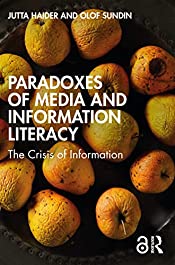
Questions for a Crisis (Book Review)

Paradoxes of Media and Information Literacy: The Crisis of Information
By Jutta Haider and Olof Sundin (Routledge, 2022)
Reviewed by Barbara Fister

In a new book, two Swedish LIS researchers lay out a series of “paradoxes” that face librarians and others who struggle to align their media and information literacy programs with the needs of the present moment, drilling deeply into issues that practitioners will find familiar – and enormously challenging.

Continue reading Questions for a Crisis (Book Review) →

Semantics as Praxis: The Challenge of Naming the People Who Use Academic Libraries

By Meggan Press
Undergraduate Education Librarian
Indiana University Bloomington

Introduction

Libraries are not neutral; they never have been. The history of libraries reflects capitalism, racism, and misogyny. The legacy of our racist, biased, and exclusionary practices is built into the fabric of our work. The implications of history continue to play out in our daily practices, often so rote as to remain unnoticed, unexamined, and unquestioned. Consider as an example the words librarians use to refer to the people who use libraries—patron, customer, user, student, and member, among others. The act of choosing which word is used creates systems and behaviors that prioritize some people over others and reveals alignment with ideologies that may have felt progressive at one time but no longer serve us.
Continue reading Semantics as Praxis: The Challenge of Naming the People Who Use Academic Libraries →

Job Stories: A Creative Tool for Library Service Design and Assessment

By Taylor Moorman,
Research & Instruction Librarian, Montana State University Library
and
Scott W.H. Young,
User Experience & Assessment Librarian, Montana State University Library

Abstract

A job story tells the tale of a user, a task to be completed, and the service used to accomplish that task. The job story can be a helpful design tool for understanding users and improving a service. This method draws from the traditions of agile design, user experience, and service design, and it is now beginning to enter the practice of library and information science. In this article, we introduce the job story for library practitioners. We begin by locating the job story within its wider context of service design tools. We then describe our own experience in creating a job story about a service in our library, including our motivations, process, and results. We conclude with steps for creating your own job story.

Continue reading Job Stories: A Creative Tool for Library Service Design and Assessment →

Poetry, Pizza, and Pandemics: How an Academic Library Successfully Moved a Popular In-Person Student Engagement Program Online

Stephanie Evers Ard
Social Sciences Librarian
Marx Library
University of South Alabama

Abstract

When the COVID-19 pandemic forced most libraries to move their services online, the University of South Alabama’s Marx Library was quick to respond. The library already provided robust online services, and library workers understood their crucial role in providing remote academic support to faculty and students. However, the Marx Library also recognized that providing social support was just as essential. This article describes how the Marx Library Student Engagement Committee rallied to provide students with a much-needed sense of community by developing online programming–specifically, by moving the library’s very popular semesterly “Poetry & Pizza” open mic events online. The author details how the library successfully planned two fully virtual poetry events by identifying and collaborating with relevant campus departments and community organizations, adapting available technology to create a safe and comfortable place for student expression, and drawing upon a strong social media presence. The author also evaluates the Student Engagement Committee’s successes, reflects on the problems they encountered, and offers suggestions for other libraries hoping to plan similar online events.

Continue reading Poetry, Pizza, and Pandemics: How an Academic Library Successfully Moved a Popular In-Person Student Engagement Program Online →