Sabino Fernandez, Coordinator of Music Acquisitions & Processing, the University of North Texas
Steven S. Sellers, Music Metadata and Digitization Librarian, the University of North Texas
Kristin Wolski, Music Information Literacy and Outreach Librarian, the University of North Texas
Abstract
Research about video game music and sound design, often referred to as ludomusicology, is an emerging field of academic study that has experienced a surge of activity in the last two decades which correlates to the popularity of video games as a form of media. Despite this growing interest, there is a gap in library resources related to the field including scores, soundtracks, literature, and other materials. To meet the demand of this relatively new field of scholarship, the authors of this article build on the work of researchers like Karen Collins and Tim Summers and share their strategies for promoting and supporting video game music resources in the library of a large R1 research institute. Video game music is an important part of culture and has a worthy place in academic libraries to be researched and enjoyed, and the methods in this case study discussed are based on real world problems, solutions, and examples that the authors and their collaborators encountered when embarking on this project. The following strategies describe the practical steps taken by the University of North Texas Music Library to address resource gaps and promote the collection, serving as a template for other types of libraries and learning environments.
Introduction
As central hubs for collaborating and sharing knowledge, academic libraries are in a unique position to collect and preserve video game resources and host video game programming. In “Checked out? Videogame Programming in U.S. Libraries and Implications for Videogame Literacies,” Sandra Schamroth Abrams and Richard N. Van Eck surveyed 1,016 professionals from all types of libraries about the existence of video game programming in libraries. The results showed that approximately 48% of libraries have some type of video game programming in 2021.[1] Even though some libraries are including video games in collections and library professionals have been writing about video games in libraries for nearly twenty years, little has been reported about video game music materials—such as scores, soundtracks, and research books—in academic libraries. Due to the relative newness of this field of research, library professionals may not be prioritizing video game music and sound design materials in their collection development selection or creating programming for promoting these materials. Video game music and sound design are an important part of culture and have a worthy place in academic libraries to be researched and enjoyed.
To fill this gap, this article aims to share strategies for promoting, supporting, and increasing access to video game music resources for research based on a large-scale case study at the University of North Texas (UNT), a large R1 research institute. First, the authors contextualize their project within a literature review before presenting the project efforts undertaken. Following an overview of their methods, the authors discuss their successes and challenges before providing their recommendations and opportunities for future directions. For the sake of brevity, the authors have chosen to abbreviate “video game music and sound design” to “VGM” for this article.
Defining Video Game Music and Ludomusicology
Research about video game music and sound is now referred to by music scholars as “ludomusicology” with a particular focus on video games and interactive media.[2] Ludomusicology surfaced as a potential area of research in the late nineties and has since grown into a fully-fledged, internationally recognized academic field. In his article on ludomusicology, Juan Pablo Fernández-Cortés names two seminal works that laid the groundwork for the field’s recognition: Matthew Belinkie’s “Video Game Music: It’s Not Just Kid Sounds” published in 1999, and Karen Collins’s Game Sound, published in 2008.[3] Since the publication of these initial works, ludomusicology has seen increased engagement in the area of academic scholarship, most notably in publishing, periodicals, and academic presentations. Leaders of this space are Tim Summers, Michiel Kamp, and Mark Sweeney, who founded the Journal of Sound in Music and Games (JSMG), as well as the Ludomusicology Research Group (LRG) at the University of Oxford in 2012.[4] These two resources alone have become an authoritative voice in the field of ludomusicology due to their numerous contributions to the field. The efforts of researchers like Summers, Kamp, Sweeney, and many more, has impacted the development of ludomusicology research substantially over the past decade and continues to show promise as more people participate in the exciting scholarship that is happening all over the world.
Literature Review
Video Game Music in Culture and Higher Education
In recent years, video game music has grown from humble beginnings into a well-respected and nationally recognized form of media in popular culture. Karen Collins acknowledges this evolution when recalling a nascent era in a recent article, comparing her early research in video game music to “planting a seed a field of mud,” only to return years later find it had grown into a “strong forest.”[5] In 2023, the National Recording Preservation Board announced the addition of Koji Kondo’s “Super Mario Bros. Theme” to the registry, the first ever inclusion of a VGM soundtrack.[6] When asked how the music of Super Mario Bros. enhances the experience of playing the game, Kondo emphasizes how integral music is to gameplay explaining how he included jingles and fanfares for accomplishments and player failures “with the aim of making the games more fun to play.”[7] Two years later, the National Recording Preservation Board added “Minecraft: Volume Alpha,” referencing Minecraft as a “cultural phenomenon.”[8] These entries to the Library of Congress’s registry further cement VGM’s cultural significance. Underscoring these developments is a new awards category at the GRAMMY Awards for “Best Score Soundtrack for Video Games” in 2023.[9] Moreover, “The Game Awards”—hosted annually— includes a live orchestra performing important themes from the “Game of the Year,” which shows video game music’s presence in concert performances.[10]
Not only are cultural institutions acknowledging the importance of VGM, but higher education institutions are recognizing VGM as a cultural phenomenon, too. Recently, ludomusicology has reached new heights in academia, as it has been officially included in the curriculum of several higher education institutions. For example, the University of Hartford’s Introduction to Video Game Music course covers the history of video games and explores the “relationships between music and technological constraints & capabilities to the multiple roles that sound can play in different kinds of game genres.”[11] Similarly, UNT’s course Video Games: Behind the Screens allows students an opportunity to play and study several games, with a particular emphasis on game audio analysis.[12] The Rose-Hulman Institute of Technology’s Associate Professor of Music, David Chapman, also added a ludomusicology course to his institution’s catalog, where he paired course materials with performances of the curriculum’s repertoire by an artist in residence, pianist Clare Longendyke.[13] Chapman’s innovative approach of adding a performance component to his course stands out because it strengthens the connection between an in-game audio recording and a live musical event. This course creates an opportunity for students to observe the differences and necessary changes between two very different listening environments where video game music is presented, while simultaneously creating an access point to classical music and orchestras. This creative approach to instruction will hopefully set a precedent for ludomusicology courses in the future as academic interest continues to grow.
Video Game Music in Academic Libraries
There is limited research on developing VGM collections in libraries, but a few articles have been published by the authors and individuals associated with UNT. These articles shed light on the current state of video game music in libraries. For example, music cataloger and musician Joshua Dieringer recognizes opportunities for libraries to support VGM composers, researchers, and enthusiasts by collecting video game music resources.[14] Dieringer states that the presence of VGM in libraries “promotes awareness of the field and occupations related to game music,” recommending adding materials such as books, audio recordings, scores, and journals to music collections.[15] Furthermore, Dieringer explains that “score acquisition and distribution of video game music continues to grow and develop.”[16] To continue conversations about video game music in libraries, Dieringer established the Video Game Music Interest Group, a community of library professionals sharing interest in VGM licensing, lending, and resource acquisitions.[17] Importantly, this group is building a VGM score collection development guide and is collaborating on cataloging and metadata issues related to video game music.[18]
Concerning collecting video game music in an academic music library, Sabino Fernandez describes a step by-step strategy for starting a VGM collection enhancement project and searches for historically significant books, scores, and audio recordings from recommendations by bloggers, discussion forums, and professional organizations.[19] Both Dieringer and Fernandez recognize the limitations surrounding the availability and acquisition of print music scores.[20],[21] Additionally, Fernandez discusses the challenges that the UNT Music Library faced with purchasing digital scores, since they are outside of the scope of the libraries’ collection acquisitions policies.[22] In contrast to video game music scores, it is less difficult to purchase books about video game music and audio recordings. Fernandez shares that libraries wishing to purchase books will find them through book vendors, like GOBI Library Solutions, and video game music recordings are often available through online retailers, like Iam8bit, Mondoshop, Fangamer, PopMarket, and Amazon.[23]
As it pertains to programming and events, the literature is limited to efforts of the UNT Music Library and their staff, of which the authors of this paper represent. In their retrospective of “Press Start!”: A Video Game Music Symposium, Blaine Brubaker, Sabino Fernandez, and Kristin Wolski summarize their experiences of hosting a large-scale event in support of VGM.[24] While that article presents the practicalities of the event and references the programing that is this paper’s topic, this paper expands on that foundation by offering previously unexplored findings, reflections, challenges, and insights about programming VGM initiatives.
Project Origins and Development
University Setting
The project occurred at the University of North Texas (UNT), a large public university located within the fourth-largest metropolitan region in the United States.[25] UNT offers undergraduate, master’s, and doctoral degrees with over 46,000 students attending either at the residential campuses in Denton and Frisco or online. UNT is part of the UNT System, which comprises three distinct institutions throughout the Dallas Fort-Worth metroplex. UNT achieved Carnegie Classification Research 1 (R1) status in 2015,[26] and the UNT libraries joined the Association of Research Libraries in 2023.[27] The UNT libraries follow two guiding concepts that underscore their Strategic Directions: 1) “having a welcoming and affirming culture” and 2) “radical collaboration.”[28] The libraries define radical collaboration as “reaching out across the library, across the campus, and across our community to find new and innovative ways to work together and create new things.”[29]
The University of North Texas is home to the College of Music, one of the largest public university music programs, offering degrees in composition, conducting, jazz studies, music history, music theory, ethnomusicology, music education, commercial music, music business and entrepreneurship, and performance.[30] The project authors work at the UNT Music Library, which supports the research and performance goals of the students, faculty, and staff of the College of Music as well as the UNT and local Denton communities. The UNT Music Library, founded in 1941, is one of the largest academic music libraries in the country. The collection contains research resources in art music, jazz, popular music, and world music found in music scores, books, journals, recordings in a variety of formats, and streaming resources.[31] The Music Library is particularly known for its jazz special collections, first editions of early French opera, research into music accessibility, and The Soundbox music makerspace. The UNT Music Library offers spaces for solo and group study, including access to electronic synthesizers, digital audio workstations, and adaptive technology for people with visual disabilities.
UNT has a growing curriculum in the Game Design and Studies program, an undergraduate Bachelor of Science degree designed to prepare students for the video game industry. Coursework for this degree is supported by the UNT Media Library, which holds a sizeable gaming collection for research, instruction, and enjoyment. The Media Library hosts The Nest, a space for designing and researching video games as well as for playing them. This space is also utilized by the UNT eSports team, providing a practice space for competitive gaming with high-tech PCs. The strengths within the courses and libraries at UNT have combined to create a fertile environment for VGM on UNT’s campus. This presents an opportunity for the UNT Music Library to participate by promoting VGM studies.
Recognizing Community Needs
In 2018, a UNT Music Library staff member started a VGM collection development project, which resulted in the initial purchases of print resources and a selection of audio recordings for the collection. Efforts toward VGM collection development accelerated in 2019 and 2020, picking up from where the initial work started. Throughout the course of developing the video game music collection, with contributions from staff within the UNT Music Library and other library departments such as the Media Library and Collection Development, the number of available resources added to the collection grew exponentially.
Given that this area of study is beginning to grow, there were many ideas on how the UNT Music Library can contribute to discourse while sharing and promoting resources. It was discussed that an event to bring in experts in the field was a way to start. In the area of ludomusicology scholarship, the Ludomusicology Videogame Music Research Group coordinates Ludo, an international conference on video game music. Domestically, the North American Conference on Video Game Music provides a platform for presentations and discussion on VGM. For those working in the industry, such as composers and sound designers, the notable conference is GameSoundCon. What is noticeably underrepresented in VGM discourse is the role of libraires. The UNT Music Library identified an opportunity to bridge together researchers and VGM industry professionals to share their knowledge and experience on many VGM topics, culminating in library programming for UNT and the greater community.
Methods
Music Librarian Matthew Vest discusses how hosting events can be a nexus for uniting people on campus with similar interests, especially for featuring projects that are “invisible.”[32] Libraries have the opportunity to host events that bring to light emerging fields of study such as ludomusicogy. To celebrate ludomusicology and the new VGM collection at the UNT Music Library, the project team brought together music researchers, library staff involved with gaming, composers, sound designers, and fans for discussions about video game music in society and culture through multiple events, starting in 2021.
First Chair Chat: Video Game Music and You
Drawing from established outreach programming at the UNT Music Library, the project team organized “Video Game Music and You,” an episode of First Chair Chats. Established during the COVID-19 pandemic to stay connected with colleagues and patrons, First Chair Chats is a music discussion series hosted by the UNT Music Library staff using the Zoom video conferencing platform. The purpose of the series is to unite people with shared interests and offer opportunities for the audience to interact with experts by asking questions live “on air” or through Zoom’s question and answer (Q&A) feature. Past episodes have featured students, staff, faculty, and librarians from around the world, including community members from the Dallas-Fort Worth metroplex. Like previous episodes, “Video Game Music and You” brought together people from across the globe.
As the project team prepared logistics for the event, they quickly realized that the scope of what could be discussed would not fit within the normal timeframe of an episode in the series. It was proposed at one time that a larger event could be an option, but due to the uncertainty of COVID-19 and the need for funding that was unavailable, the project team decided to do an expanded episode of the First Chair Chats and split “Video Game Music and You” into two parts, hosted in back-to-back sessions on the same day with each part approximately one hour and thirty minutes. Panelists were invited based on their expertise within their specialization, with the aim of selecting panelists from a broad range of backgrounds, including students.
In the first part, ludomusicologists, music librarians, media librarians, and composers focused on exploring ludomusicology, the challenges of collecting video game music in libraries, and perspectives about music in games from players. Throughout the discussion, audience members submitted many questions that demonstrated the breadth of interest in VGM from people participating in various roles at educational institutions.[33] In Part 2, moderator Blaine Brubaker led a discussion focused on video game music and sound design, featuring composers and sound designers Bruce Broughton, Richard Vreeland (Disasterpeace), Eli Rainsberry, and Matthew Hopkins (2 Mello). The group explained how video game composers and sound designers are oftentimes in separate roles guided by a creative director.[34] Throughout the discussion, panelists expressed reverence for Broughton, a significant film composer in the industry. Broughton, who composed Heart of Darkness—one of the first orchestrated video game scores—was asked how he came to write the soundtrack for it.[35] This discussion gave the audience a glimpse of the intricacies of the video game industry from accomplished composers and sound designers at various career stages, offering hope on “making it” in the thriving but competitive field of VGM.
Leveling up: The “Press Start!” Symposium
The retrospective article on “Press Start!”: A Video Game Music Symposium outlines the logistical and practical aspects of hosting the event, including its hybrid format, institutional grants and local sponsorships, and innovative branding and promotion.[36] Hosted by the UNT Music Library in March 2022, the symposium brought together scholars, composers, and industry professionals for a day of panels, posters, and presentations. To punctuate the day of the event, Steven Sellers and Dave Huff from the event team organized the “Press Start Jam,” an open VGM jam encouraging musicians to bring instruments and call their favorite video game tunes for live performance and improvisation (see fig. 1).
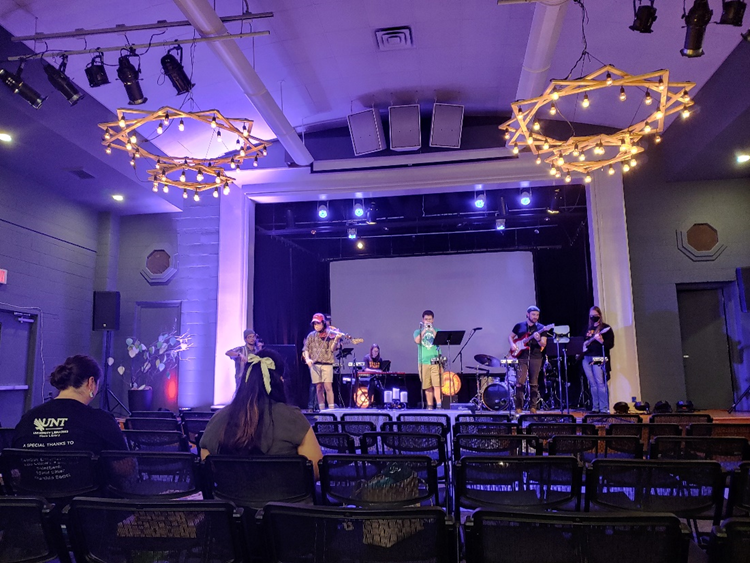
Figure 1. The “Press Start!” symposium’s “Press Start Jam” event.
This event distinguished itself from other conferences through its dynamic and visually engaging atmosphere, designed to mirror the energy of video game experiences. It fostered an inclusive and interactive environment by welcoming emerging scholars, facilitating real-time audience engagement, integrating hybrid participation during poster sessions, and incorporating Media Library tabling to enhance scholarly exchange through hands-on opportunities. Additionally, this event was free and open to both students and the public while also providing a breakfast spread, catered lunch, and snacks throughout the day at no additional cost to attendees. Doing this alleviates financial barriers that would typically defer one from attending professional or industry events and conferences. To commemorate the day, participants and attendees were offered branded swag featuring the “Press Start!” logo designed by the UNT Libraries’ Marketing and Communications team (see fig. 2).
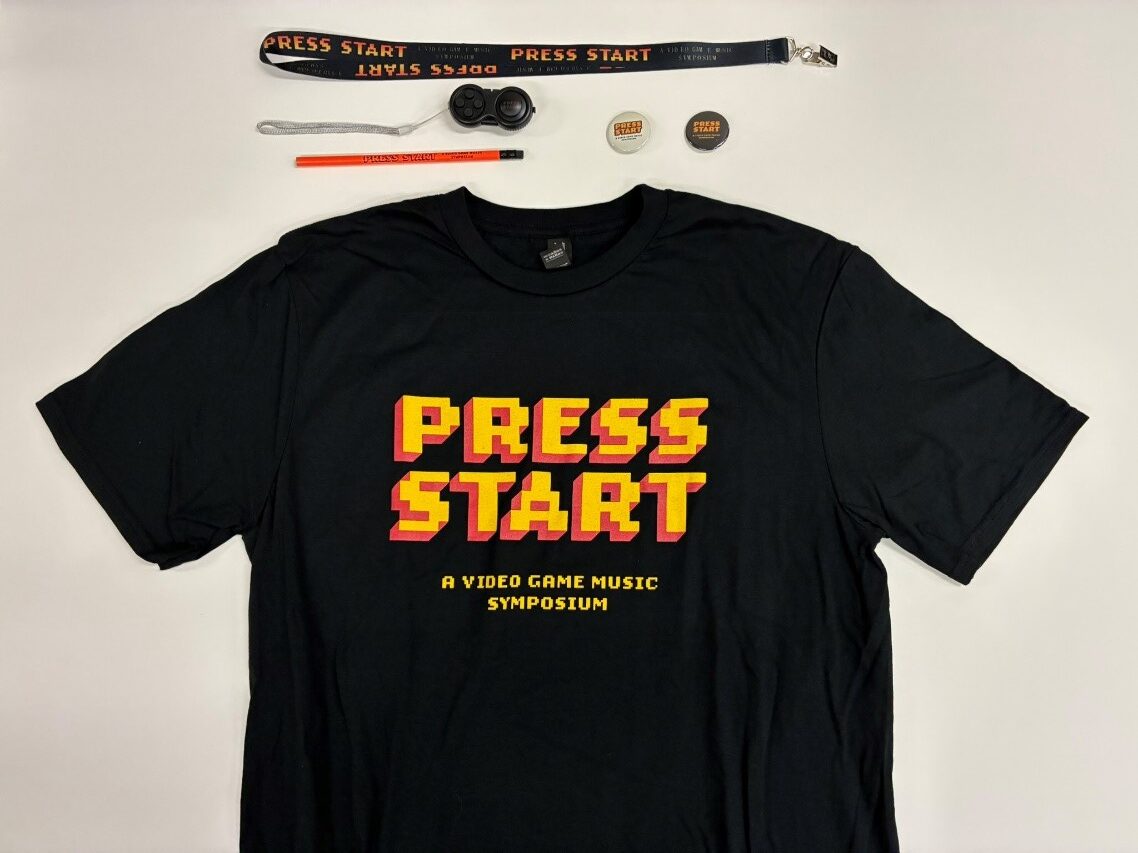
Figure 2. “Press Start!” swag with logo, including: a lanyard, a game control fidget toy, a pencil, black and white buttons, and a t-shirt.
Volunteers, library administrators, university staff members, national and international researchers, composers, and sound designers united to support the “Press Start!” symposium. Moreover, the project team could not have done the event without campus departments, community businesses, and community organizations that provided sponsored spaces and funding. This large group assisted in celebrating VGM through discussions and presentations that furthered ludomusicology research.
“Play Again?”: An Online Mini-Symposium
To continue supporting emerging researchers in ludomusicology, the team created a scaled-down online event, “Play Again?”: An Online Mini-Symposium, to happen between larger in-person conferences. The project team hosted “Play Again?” in 2023, with a theme on Massively Multiplayer Online Role-Playing Games (MMORPGs), and for the 2024 mini-symposium, the event team offered a colleague at the University of Minnesota an opportunity to host the event, organized around a theme of horror in VGM. To make the process smooth, the UNT project team provided project management support. The objective of offering a “roaming” model of “Play Again?” is to give other VGM advocates an opportunity to introduce VGM research at their home institution, supported by the UNT Music Library staff, who have hosted multiple symposia-style events. Adding VGM to academic library collections is still met with skepticism at some institutions; hosting an online symposium helps to legitimize VGM resources for ludomusicology, performers, composers, and fans.
At the end of the 2024 online mini-symposium, the core video game music project team invited attendees to consider hosting the 2025 mini-symposium at their institution. The team quickly heard from an external partner wishing to host during Fall 2025, continuing the effort to promote VGM with a new partner. Each mini-symposium event had approximately 50 attendees and over 70 registrations, which in the experience of the UNT Music Library staff, is a strong turnout. In assessing whether to continue “Play Again?”, the UNT Music Library staff concurred that the symposia series offers a friendly space for emerging researchers and librarians, a needed space as venues for sharing video game music research become increasingly competitive.
Promoting Events
The project team promoted the events through a variety of methods, including emails to professional organizations and in newsletters as well as with physical and digital flyers. Additionally, the project team used social media to promote the event and document the projects. The UNT Music Library has long supported social media, so it was a natural extension to promote the VGM events on UNT Music Library’s Facebook and Instagram channels (@untmusiclibrary). Before the events, the social media team posted calls for papers, registration information, and plugged presenters, incorporating hashtags such as #VGM, #sounddesign, and #ludomusicology to reach a wide audience. The social media team made certain to tag the Videogame Music Research Team. In reciprocity, the organization reposted and promoted the symposium through their social media, which expanded the promotional reach. During “Press Start!”, members of the social media team “live-tweeted” to update followers on discussion highlights during the panels, which resonated with followers through their engagement with liking and reposting.
Discussion
Successes and Outcomes
The efforts of the UNT Music Library in developing a collection of VGM and its preservation, along with outreach and promotional efforts to support patron needs and researchers in the field, have not gone unnoticed. These activities have presented various opportunities for collaboration both within UNT and with external colleagues in the field.
Partnerships with the UNT Media Library have led to additional outreach collaborations and acquisition opportunities. For example, the UNT Music Library was invited to participate in a presentation for students interested in eSports—this connection was facilitated by Diane Robson of the UNT Media Library. Establishing regular communications between library departments and degree programs within the College of Music will inform future purchases for supporting coursework and students. This approach ensures the collection remains relevant to curricular needs and responsive to the evolving research interests of the academic community.
Over the past several years, the project team has experienced several opportunities to share information about their efforts. At the 2024 Annual Meeting of the Music Library Association in Cincinnati, the Video Game Music Interest Group sponsored the presentation “Video Game Music in Academic Libraries: The Library Life Cycle” where invited specialists shared their experiences working with VGM materials. Topics included acquisitions, cataloging and metadata, preservation, and outreach. The presentation was moderated by Joshua Dieringer and speakers included Blaine Brubaker, Sabino Fernandez, Elizabeth Hambleton, Myrna Layton, Steven Sellers, and Kristin Wolski. Active academic discussions on these topics are still in the infancy stage, so it is necessary to continue knowledge sharing activities.
A significant outcome was in response to the UNT Music Library’s extensive event programming. As a result of “Press Start!”: A Video Game Music Symposium, the event coordinators were invited to collaborate with the JSMG as co-editors for a special series in the journal surrounding the event. The special series included contributions from the project team, peer-reviewed articles published on the presentations during the symposium, digital publications of poster presentations exhibited at the symposium, and a set of special series essays on topics about video game music in libraries. Moreover, the establishment of “Play Again?” as a roaming series encourages further collaborations with universities interested in supporting ludomusicology.
To continue sharing information about VGM with the UNT community and beyond, the project team turned to a traditional, but effective, method of promotion by creating a subject guide. Subject guides feature research resources like books, journals, sound recordings, databases, and organizations on specific subjects, topics, or courses. The events hosted by the UNT Music Library informed the inception of their subject guide “Video Game Music and Sound Design,” providing an overview of available resources, applicable methods of research on the topic, and much more.[37] The guide includes a “Scholarly Texts” page featuring notable research in the field, “Video Game Music Soundtracks” page with a gallery of sound recordings, a “Research” page that provides a brief outline on how to get started with video game music research, an “Acquisitions” page offering tips on sourcing ideas for new purchases, an “Outreach” page presents ideas for promoting ludomusicology and VGM, and a “Preservation” page covering maintenance tips for gaming consoles and media to strive for longevity. The guide lays a foundation for furthering library skills instruction customized to VGM.
As a growing unit of the UNT Music Library, the project team envisions The Soundbox Music Makerspace as a resource with endless potential to support students wishing to create VGM. The Soundbox is a place to experiment and play with synthesizers and to create music utilizing digital audio workstations (DAWs). As part of this makerspace, the staff hosts instruction and wishes to host workshops in the future. Workshops have the potential to address issues related to sound design and composition for video games. The Soundbox staff could draw on their recent collaboration with the UNT Media Library, in which The Soundbox team provided live music for a live production of a Dungeons & Dragons (D&D) one-shot. At this event, The Soundbox staff contributed live music, sound effects, and ambiance.[38] The Soundbox is continuing their collaboration with the UNT Media Library by creating a soundtrack for a pre-recorded D&D campaign.
Building on the success of the event, the UNT Music Library staff continued to promote VGM by highlighting soundtracks and scores in the collection. Furthering discourse around VGM, a UNT Music Library student assistant developed a series of cross promotional campaigns between the UNT Music and Media Libraries. These featured resources such as VGM research books, scores, recordings, and games as well as the physical spaces in the two libraries for listening to music and playing video games. The student created the video in a way that reflects the creative values of UNT’s campus by using a plushie of the campus’s mascot, Scrappy, to tour the spaces. Furthermore, in the spirit of First Chair Chats, a Music Library student assistant conducted a brief interview with Media Library student assistants to learn about their favorite VGM soundtracks and to gauge their awareness of VGM in the Music Library. The two students who were interviewed either recently learned about the VGM collection or were unaware, thinking the Music Library had “regular music”—which to them meant “only music for music students.”[39] Their helpful responses reveal that further promotions are needed about ludomusicology as a discipline and the additions of the VGM items to the collection.
Challenges and Limitations
Reflecting on the substantive conversation between panelists and the enthusiastic participation from the audience during the First Chair Chat, the project team considers “Video Game Music and You” a success. Although the UNT Music Library staff regarded the event largely as successful, it was not met without criticism regarding comments made during the discussion as well as opinions that the discussion would have benefited from a more diverse panel. These concerns were taken seriously, discussed with a supervisor, and led the team toward further introspection about the purpose of First Chair Chats and strategic goals of the UNT Libraries. In the end, the event organizers acknowledged the participants’ concerns and responded, assuring them that the issues would be considered when developing future programs. In an internal follow-up conversation, the event organizers recognized that the time allotted was not enough to cover what was pitched to the panelists—essentially, the project team overpromised what could be done. Knowing more time would be needed to address the broad scope of research on VGM, the project team continued onward to develop a scaled-up event with “Press Start!”, which featured panels on dedicated topics, including one on diversity, equity, and inclusion.
Although the initial funding for “Press Start!” was secured through an internal library Dean’s Innovation Grant (DIG), budgetary constraints quickly became apparent as the planning process progressed. As the practicalities of the event expanded, it became clear that the original budget would not sufficiently cover all the anticipated expenses. Recognizing this gap early in planning, the project team sought additional financial support through UNT’s Global Venture Fund and external sponsorships from local businesses. This experience highlights the importance of flexible and scalable budgeting when planning large-scale events. While the initial grant funding created a strong starting point, additional resources are often needed as the event takes shape. By identifying potential funding gaps early on, planning for scalability can help ensure the event’s success without compromising its goals.
Coordinating technology for hybrid events can be challenging, especially in large spaces with configurations for hosting panel discussions. “Press Start!” was hosted in a recital hall with a large stage, as well as online. During dress rehearsals, the project team initially encountered challenges with creating high-quality audio experience. Additionally, the space was not equipped with the technology needed to run the presentation slides, Zoom webhosting platform, and audio. Thanks to the expertise and equipment provided by the team, the technology ran smoothly. It was only after that there were issues with the recording of the event. It was not in the minds of anyone that there could be issues with how the event was recorded since things were functioning as planned due to how technology was positioned at the time. The main tech support station was set on the side of the stage to troubleshoot issues with online participants, record the panels and keynote speaker, display slideshow presentations, and coordinate audio for the room. An additional station was set up in front of the audience with a camera to capture the events on the stage. This was done unknowing that the station that was recording on Zoom would only be capturing the audio and not the video. Although the loss of video footage of the event was regrettable, the team was able to compile enough photographs to pair with the audio and present it as a complete recording.
The aforementioned “Press Start Jam” was a post-conference musical event that also experienced some challenges and limitations that future iterations could improve upon. While there were many successful elements to the jam, it would have been better attended had the event had remained on campus, rather than being moved to a venue off campus. As a result, many attendees who had participated in the conferences opted to retire for the day rather than moving to a second location off campus. Additionally, while the venue was a conducive performance environment, the layout of the stage plot and the use of in-ear monitors (IEM’s) inhibited communication between the performers. Because of this, the musicians struggled to communicate about the details of the arrangements, which were mostly being sight-read. This led to the event being perceived as a performance rather than an open rehearsal. Finally, this event took place later in the evening, and would likely be more successful if it had occurred earlier, in between sessions, or multiple times during the event to promote ore interaction between panelists, presenters, and audience members.
The project team has internally reflected on the successes and challenges of the initiatives, but moving forward, an opportunity exists to develop an assessment tool to gather feedback about the events from event participants. The project team is currently witnessing survey fatigue across campus and has observed that assessment participation is best achieved when incorporating it into the live event. In-application polling tools might be a streamlined option for moving forward.
Recommendations
Institutions can scale events to a size that works within their goals and budgets. Based on their experiences, these are the project team’s recommendations:
- Use what is available. Most libraries have access to tools like subject guides, social media, and blogs. Even if an institution does not have VGM materials, staff can share information about career paths in VGM or open access resources.
- Connect with library and campus partners. In-person events require adequate space, staffing, and technology. Plan early to make accommodations and strengthen partnerships through collaboration.
- Host online events to limit barriers. Generally, online events require less funding and are ideal for highlighting specialists within a local institution and the surrounding community. They are also ideal for connecting people and limiting the need to travel.
- Principally, showing appreciation is an appropriate and important step when hosting events. When possible, offer an honorarium, thank you note, or higher-quality campus swag. For campus participants, delivering thank-you notes and swag in-person goes far when expressing appreciation; mail notes and swag to external partners.
- Stay organized by using project management tools. Agree on using a tool that resonates with the whole team, so that team members are more likely to engage in planning.
- Identify stakeholders to create a marketing strategy. Start with your target audience and expand by advertising locally and through academic organizations with physical and digital materials. Keep contact lists to use for a future project.
- Develop a brand that unifies and captures the spirit of the initiative by creating a logo. When applicable, check with the institution’s marketing team for policies.
- Involve students and people who are passionate about the initiative. Students bring valuable insights into projects and the event planning offers edifying, real-life experience. This also helps connect students with academic and industry leaders.
It is important to remember that the aim in promotions is not about perfection but about sharing knowledge of VGM with the community. Initiatives will grow over time, offering opportunities to refine processes or to move in new directions.
Future Directions
Events
The UNT Music Library will continue to collaborate on “Play Again?” An Online Music Symposium, offering external institutions the opportunity to host. This symposium has been an affordable way to introduce audiences and students to ludomusicology scholarship. With project management systems in place, this academic event requires a relatively low time commitment, which allows the team to continue pursuing this project. The national and international conferences on VGM have grown into large events, where it is highly competitive to get an abstract accepted. “Play Again?” will continue to be an additional option for library professionals and emerging scholars to share their voice on their latest projects and research. Given the amount of time and funding it took to host “Press Start!”, the event team aims to host a hybrid event once every five years. Learning from past planning, the project team will scale the event more appropriately according to the budget allotted. Just as the project and event teams organized panel discussions for “Press Start!” and “Play Again?” around themes, they will continue to organize future events around relevant topics that are important to libraries and VGM scholars and industry professionals.
Like the “Play Again?” series, there is an incentive to continue to explore how live music performances fit into the scope of ludomusicology. As discussed in the literature review, the success of Dr. Chapman’s ludomusicology course demonstrates that there is user interest in connecting VGM research to live performances, which is further supported by the success of groups like The 8-Bit Big Band, Video Games Live, and the numerous programs of video game music performed by orchestras all over the world. Since the Press Start Jam, the project group has identified several ways to strengthen this connection. Future iterations of a live performance featuring video game music could embrace the structure of a more traditional music event to gather musicians into chamber group or orchestra and feature a performance of both popular and student arrangements. Alternatively, the D.I.Y. approach of the Press Start Jam could be further iterated on as a way to foster collaboration between presenters and attendees who are also musicians. During the planning phase of the “Press Start” conference, other ideas for musical formats were presented, like an open mic or a small combo that adds live music to users playing a video game in real time. While these examples were ultimately not chosen, their consideration proves that there are a variety of exciting ways that live performances could be developed and implemented by the libraires to create a more immersive environment.
Information Literacy
Music students at UNT’s College of Music have shown an interest in VGM through their studies in commercial music, performance, musicology, and music theory. The UNT Music Library staff is preparing to support students and faculty researching video game music through sharing the VGM subject guide and reaching out to faculty. With plans to design information literacy instruction, the UNT Music Library staff wish to guide students in developing ludoliteracy (gaming literacy) and ludomusical literacy (musical literacy about games).[40] To achieve this, instruction librarians at UNT Music Library have opportunities to host workshops exploring the Association of College and Research Libraries (ACRL) Framework for Information Literacy Frameworks for Higher Education, particularly the frames for Scholarship as Conversation and Authority Is Constructed and Contextual.[41] In the rapidly evolving field of ludomusicology, these frames present opportunities for holding rich discussions on using unconventional resources in VGM research and to shine light on emerging scholars and fans as participants in ludomusicology discourse.
Conclusion: Reflecting on the Role of Libraries
It is not unusual to hear academics describe the campus library as “the heart” of a university. Likewise, Eric Klinenberg describes public libraries as the “social infrastructure” of the city as a place for people to interact.[42] These sentiments describe libraries as a nexus for disparate departments on campus or organizations within cities to unite based on a common goal. Regarding their experiences of starting a video game collection, in 2009, Mary Laskowski and David Ward reflected:
Academic libraries have a key role to develop as a hub to coordinate and raise the visibility of academic gaming teaching, research, and best practices. This work begins by embracing video games as a medium that not only is receiving scholarly interest, but also being investigated as a next generation educational platform that will both deliver academic content, and become a major medium for instructional interactions.[43]
Laskowski and Ward continue by urging institutions to develop standards, best practices, and relationships in the gaming industry, as well as developing processes for licensing and purchasing in support of gaming research and education.[44] Adding VGM collections to libraries is the next step in the course of supporting gaming initiatives. Above, Laskowski and Ward encourage libraries to embrace video games for their educational potential. Now is the opportunity for Music libraries, performance arts divisions within libraries, and public libraries to embrace the role of adding VGM as ludomusicology flourishes as a discipline. VGM research spans beyond ludomusicology, as these resources can also be used in interdisciplinary fields. Perhaps even more, VGM resources can be used for recreation, spreading joy and reminding people what it is like to have fun playing games.
Developing and supporting new collections is no easy task, especially when the medium tends to be costly, in the case of video games. Despite that fact, there are scalable, practical methods that intuitions can implement to spread awareness of ludomusicology and VGM resources. Some methods discussed in this article included planning events, creating subject guides, and using social media to promote VGM. These efforts are ongoing and in various stages of development. As panelists Diane Robson and Richard Vreeland expressed during the First Chair Chat “Video Game Music and You,” they initially became involved with video games in small ways.[45],[46] Through iteration, Vreeland became a successful composer and Diane Robson helped to usher in a dynamic gaming center at the UNT Media Library.
As collectors, instructors, catalogers, and preservationists, library professionals are positioned well to facilitate partnerships between departments in institutions and community organizations. While different disciplines within game-related disciplines will inevitably have unique resource needs, academic departments have an opportunity to work synergistically to develop holistic programming for ludic disciplines. This is an opportunity for libraries to lead in facilitating connections between scholars, industry professionals, and independent composers. Furthermore, libraries can foster community building by acknowledging the expertise fans contribute to VGM preservation. Recalling Karen Collins’s tree metaphor about her work in the early 2000s, she comments that not only did the tree grow strong, but it bore fruit standing amongst a forest.[47] Even such, Collins says there are “still seeds to be planted.”[48] Now is the time for libraries to cultivate the work that others have started by adding VGM to collections.
Bibliography
Brubaker, Blaine, Sabino Fernandez, and Kristin Wolski. “‘Press Replay’: A Retrospective on ‘Press Start!’: A Video Game Music Symposium.” Journal of Sound and Music in Games. 5, no. 1 (2024): 57–61. https://doi.org/10.1525/jsmg.2024.5.1.57.
Collins, Karen. “Game Sound: Reverberations.” Journal of Sound and Music in Games 1, no. 1 (2020): 100–102. https://doi.org/10.1525/jsmg.2020.1.1.100.
Dieringer, Joshua. “Video Game Music in Libraries.” The Journal of Sound and Music in Games 5, no. 1 (2024): 83–86, https://doi-org.libproxy.library.unt.edu/10.1525/jsmg.2024.5.1.83.
Fernandez, Sabino. “Collection Development and Acquisitions of Video Game Music at the University of North Texas.” Journal of Sound and Music in Games 5, no. 2 (2024): 112–115. https://doi.org/10.1525/jsmg.2024.5.2.112.
Fernandez, Sabino, host. Adam La Spata and Joshua Dieringer, moderators. First Chair Chats. “FCC: Video Game Music and You, An Exploration of Ludomusicology and Sound Design.” The University of North Texas Libraries. YouTube (video). February 11, 2021. 1 hr., 20 min., 56 sec. https://youtu.be/poYOsOp6ixA?si=68A9pKOmfkXngD4K&t=2.
Fernandez, Sabino host. Blaine Brubaker, moderator. First Chair Chats. “Video Game Music and You, Part 2.” The University of North Texas Libraries, YouTube (video). February 11, 2021. 1 hr., 34 min., 43 sec. https://www.youtube.com/watch?v=s8ORxyplSnA&list=PLjdZcAp5Ay1ukmDptJplmR0ZPsdSfcZT5&index=6.
Fernández-Cortés, Juan Pablo. “Ludomusicology: Normalizing the Study of Video Game Music.” Translated by Karen M. Cook. Journal of Sound and Music in Games 2, no. 4 (2021): 13–35. https://doi.org/10.1525/jsmg.2021.2.4.13.
Gibbons, William. “Ludomusicology.” In Grove Music Online. May 29, 2020. https://doi.org/10.1093/omo/9781561592630.013.90000369370.
GRAMMY Awards. “New Categories For the 2023 GRAMMYs Announced: Songwriter of the Year, Best Video Game Soundtrack, Best Song For Social Change & More Changes.” News. June 9, 2022. Accessed May 23, 2025. https://www.grammy.com/news/2023-grammys-new-categories-songwriter-year-best-video-game-soundtrack-social-impact-special-merit-award-65th-grammy-awards.
Groves, Kaylyn. “University of North Texas to Become 128th Member of ARL.” Association of Research Libraries. November 9, 2022. Accessed June 22, 2025. https://www.arl.org/news/university-of-north-texas-to-become-128th-member-of-arl/?_ppp=1925f03a91.
Kamp, Michiel, Tim Summers, and Mark Sweeny. “About.” Ludomusicology Video Game Music Research Group. Accessed June 7, 2025. https://www.ludomusicology.org/about/.
Klinenberg, Eric. “To Restore Civil Society, Start With the Library.” New York Times. September 8, 2018. https://www.nytimes.com/2018/09/08/opinion/sunday/civil-society-library.html.
Kondo, Koji. “Interview with Koji Kondo.” April 13, 2023. Interview by the Library of Congress. Written interview, p.3. https://www.loc.gov/static/programs/national-recording-preservation-board/documents/koji-kondo-interview.pdf.
Laskowski, Mary and David Ward. “Building Next Generation Video Game Collections in Academic Libraries.” The Journal of American Librarianship35, no. 3 (2009): 267–273. https://doi.org/10.1016/j.acalib.2009.03.005.
National Recording Preservation Board, Library of Congress. “Recording Registry.” April 9, 2025. https://www.loc.gov/programs/national-recording-preservation-board/recording-registry/registry-by-induction-years/2025/.
National Recording Preservation Board, Library of Congress. “Recording Registry.” April 12, 2023. https://www.loc.gov/programs/national-recording-preservation-board/recording-registry/registry-by-induction-years/2023/.
Rose-Hulman Institute of Technology. “Rose-Hulman’s Ludomusicology Class Brings Video Game Music to Life.” Rose-Hulman Institute of Technology. Accessed June 2, 2025. https://www.rose-hulman.edu/news/2024/rose-hulman-ludomusicology-class-brings-video-game-music-to-life.html.
Schamroth Abrams, Sandra and Richard N. Van Eck. “Checked out? Videogame Programming in U.S. Libraries and Implications for Videogame Literacies.” Journal of Adolescent & Adult Literacy 65, no. 3 (2021): 227-236, https://doi.org/10.1002/jaal.1197.
The University of Hartford. “HLM 218 – Introduction to Video Game Music.” Accessed June 2, 2025. https://catalog.hartford.edu/preview_course_nopop.php?catoid=26&coid=92156.
The University of North Texas. “History of UNT.” Accessed June 22, 2025. https://www.unt.edu/legacy/history/our-story.html.
The University of North Texas. “MUAG 4200 – Video Games: Behind the Screens.” Accessed June 2, 2025. https://catalog.unt.edu/preview_course_nopop.php?catoid=35&coid=152881.
The University of North Texas. “R1 Our Way Taskforce.” Accessed June 22, 2025. https://vpaa.unt.edu/initiatives/r1.html.
The University of North Texas College of Music. “Homepage.” Accessed June 22, 2025. https://music.unt.edu/.
The University of North Texas College of Music. “Music Library.” https://music.unt.edu/facilities/music-library.
The University of North Texas Music Library. “Home.” Subject & Course Guides: Video Games Music and Sound Design. Last modified February 11, 2025. https://guides.library.unt.edu/VGM.
The University of North Texas Libraries. “Strategic Directions.” Accessed June 22, 2025. https://library.unt.edu/administrative-office/strategic-directions/.
Vest, Matthew. “Events in an Academic (Music) Library.” In Outreach for Music Librarians, edited by Scott Stone, 85–91. A-R Editions, 2019.
Notes
[1] Sandra Schamroth Abrams and Richard N. Van Eck, “Checked out? Videogame Programming in U.S. Libraries and Implications for Videogame Literacies,” Journal of Adolescent & Adult Literacy 65, no. 3 (2021): 230, https://doi.org/10.1002/jaal.1197.
[2] William Gibbons, “Ludomusicology,” in Grove Music Online, May 29, 2020, https://doi.org/10.1093/omo/9781561592630.013.90000369370.
[3] Juan Pablo Fernández-Cortés, “Ludomusicology: Normalizing the Study of Video Game Music,” trans. Karen M. Cook., Journal of Sound and Music in Games 2, no. 4 (2021): 13–35. https://doi.org/10.1525/jsmg.2021.2.4.13.
[4] Michiel Kamp, Tim Summers, and Mark Sweeny, “About,” Ludomusicology Video Game Music Research Group, accessed June 7, 2025, https://www.ludomusicology.org/about/.
[5] Karen Collins, “Game Sound: Reverberations,” Journal of Sound and Music in Games 1, no. 1 (2020): 100–101, https://doi.org/10.1525/jsmg.2020.1.1.100.
[6] “Recording Registry,” National Recording Preservation Board, Library of Congress, April 12, 2023, https://www.loc.gov/programs/national-recording-preservation-board/recording-registry/registry-by-induction-years/2023/.
[7] Kondo, Koji, “Interview with Koji Kondo,” April 13, 2023, interview by the Library of Congress, written interview, p.3, https://www.loc.gov/static/programs/national-recording-preservation-board/documents/koji-kondo-interview.pdf.
[8] “Recording Registry,” National Recording Preservation Board, Library of Congress, April 9, 2025, https://www.loc.gov/programs/national-recording-preservation-board/recording-registry/registry-by-induction-years/2025/.
[9] “New Categories For the 2023 GRAMMYs Announced: Songwriter Of The Year, Best Video Game Soundtrack, Best Song For Social Change & More Changes,” News, GRAMMY Awards, June 9, 2022, accessed May 23, 2025, https://www.grammy.com/news/2023-grammys-new-categories-songwriter-year-best-video-game-soundtrack-social-impact-special-merit-award-65th-grammy-awards.
[10] See the YouTube channel @thegameawards, https://www.youtube.com/thegameawards.
[11] “HLM 218 – Introduction to Video Game Music,” the University of Hartford, accessed June 2, 2025, https://catalog.hartford.edu/preview_course_nopop.php?catoid=26&coid=92156.
[12] “MUAG 4200 – Video Games: Behind the Screens,” The University of North Texas, accessed June 2, 2025, https://catalog.unt.edu/preview_course_nopop.php?catoid=35&coid=152881.
[13] “Rose-Hulman’s Ludomusicology Class Brings Video Game Music to Life,” Rose-Hulman Institute of Technology, accessed June 2, 2025, https://www.rose-hulman.edu/news/2024/rose-hulman-ludomusicology-class-brings-video-game-music-to-life.html.
[14] Joshua Dieringer, “Video Game Music in Libraries,” The Journal of Sound and Music in Games 5, no. 1 (2024): 83, https://doi-org.libproxy.library.unt.edu/10.1525/jsmg.2024.5.1.83.
[15] Dieringer, “Video Game Music in Libraries,” 83.
[16] Dieringer, “Video Game Music in Libraries,” 84.
[17] The Music Library Association’s (MLA) Video Game Music Interest Group is open to all MLA members. Find more about joining at https://www.musiclibraryassoc.org/members/group.aspx?id=219134.
[18] Dieringer, “Video Game Music in Libraries,” 85.
[19] Sabino Fernandez, “Collection Development and Acquisitions of Video Game Music at the University of North Texas,” Journal of Sound and Music in Games, 5, no. 2 (2024): 113, https://doi.org/10.1525/jsmg.2024.5.2.112.
[20] Dieringer, “Video Game Music in Libraries,” 84.
[21] Fernandez, “Collection Development and Acquisitions of Video Game Music,” 113.
[22] Fernandez, “Collection Development and Acquisitions of Video Game Music,” 113
[23] Fernandez, “Collection Development and Acquisitions of Video Game Music,” 113.
[24] Blaine Brubaker, Sabino Fernandez, and Kristin Wolski, “‘Press Replay’: A Retrospective on ‘Press Start!’: A Video Game Music Symposium,” Journal of Sound and Music in Games, 5, no. 1 (2024): 57–61, https://doi.org/10.1525/jsmg.2024.5.1.57.
[25] “History of UNT,” the University of North Texas, accessed June 22, 2025, https://www.unt.edu/legacy/history/our-story.html.
[26] “R1 Our Way Taskforce” the University of North Texas, accessed June 22, 2025, https://vpaa.unt.edu/initiatives/r1.html.
[27] Kaylyn Groves, “University of North Texas to Become 128th Member of ARL,” Association of Research Libraries, November 9, 2022, accessed June 22, 2025, https://www.arl.org/news/university-of-north-texas-to-become-128th-member-of-arl/?_ppp=1925f03a91.
[28] “Strategic Directions,” the University of North Texas University Libraries, accessed June 22, 2025, https://library.unt.edu/administrative-office/strategic-directions/.
[29] “Strategic Directions,” the University of North Texas University Libraries.
[30] “Homepage,” the University of North Texas College of Music, accessed June 22, 2025, https://music.unt.edu/.
[31] “Music Library,” the University of North Texas College of Music, https://music.unt.edu/facilities/music-library.
[32] Matthew Vest, “Events in an Academic (Music) Library,” in Outreach for Music Librarians, ed. Scott Stone (A-R Editions, 2019), 85.
[33] Sabino Fernandez, host, Adam La Spata and Joshua Dieringer, moderators, First Chair Chats, “FCC: Video Game Music and You, An Exploration of Ludomusicology and Sound Design,” University of North Texas Libraries, YouTube (video), 1 hr., 20 min., 56 sec., https://youtu.be/poYOsOp6ixA?si=68A9pKOmfkXngD4K&t=2.
[34] Sabino Fernandez, host, Blaine Brubaker, moderator, First Chair Chats, “Video Game Music and You, Part 2,” University of North Texas Libraries, YouTube (video), February 11, 2021, 23 min., 39 sec., https://www.youtube.com/watch?v=s8ORxyplSnA&list=PLjdZcAp5Ay1ukmDptJplmR0ZPsdSfcZT5&index=6.
[35] Fernandez, “Video Game Music and You, Part 2,” 1 hr., 20 min., 17 sec.
[36] See Blaine Brubaker, Sabino Fernandez, and Kristin Wolski, “‘Press Replay’: A Retrospective on ‘Press Start!’: A Video Game Music Symposium,” Journal of Sound and Music in Games, 5, no. 1 (2024): 57–61, https://doi.org/10.1525/jsmg.2024.5.1.57.
[37] The University of North Texas Music Library, “Home.” Subject & Course Guides: Video Games Music and Sound Design, last modified February 11, 2025, https://guides.library.unt.edu/VGM.
[38] See the UNT Media Library, “Live D&D at UNT – Brought to you by the UNT Media Library,” YouTube Video, recorded on October 30, 2024, posted on April 3, 2025. 2 hrs., 37 mins., 42 secs., https://www.youtube.com/watch?v=tyyWdQtnlKA.
[39] UNT Music Library (@untmusiclibrary), “Did you know we have video game soundtracks? We asked some student assistants from the Media Library what their favorite video game original soundtracks are… #untlibraries #untmusiclibrary #untmedialibrary #videogamemusic #vgost,” Instagram, January 23, 2024, https://www.instagram.com/p/C2c0zXus3Zv/.
[40] See Juan Pablo Fernández-Cortés, “Ludomusicology: Normalizing the Study of Video Game Music,” trans. Karen M. Cook., Journal of Sound and Music in Games 2, no. 4 (2021): 13–35.
[41] See Association of College & Research Libraries, “Frameworks for Information Literacy for Higher Education,” Guidelines, Standards, and Frameworks, https://www.ala.org/acrl/standards/ilframework.
[42] Eric Klinenberg, “To Restore Civil Society, Start With the Library,” New York Times, September 8, 2018, https://www.nytimes.com/2018/09/08/opinion/sunday/civil-society-library.html?searchResultPosition=50.
[43] Laskowski and Ward, “Building Next Generation Video Game Collections in Academic Libraries,” 272.
[44] Laskowski and Ward, “Building Next Generation Video Game Collections in Academic Libraries,” 272–273.
[45] Fernandez, “Video Game Music and You: Part 2,” 1:34:43.
[46] Fernandez, “Video Game Music and You: Part 1,” 1:08:55.
[47] Collins, “Game Sound: Reverberations,” 101.
[48] Collins, “Game Sound: Reverberations,” 102.