By Sarah Moukhliss, Ed.D., MLS
STEM Online Learning Librarian & CIRT/OER Liaison
Thomas G. Carpenter Library
University of North Florida
Abstract
This article outlines the initial development and iterative changes made by Online Learning Librarian Moukhliss during the course refresh of a one-credit-hour online undergraduate library research course. Specifically, it focuses on the Evaluate phase of the ADDIE instructional design process (Analyze, Design, Develop, Implement, Evaluate). Based on student feedback, Moukhliss incorporated greater voice and choice into the final research assignment.
Introduction
Instructional design is an iterative process, meaning a course may never be truly finished. Each iteration may be deemed complete for a semester or two but remains subject to ongoing observation and adjustments based on student feedback and teacher observation. In this paper, I will discuss how I designed a credit-bearing, one-credit-hour online undergraduate research course (LIS 1001) to align with student-centered pedagogy principles, aiming to enhance student engagement and self-efficacy. I will also cover the changes made during the second iteration’s course refresh.
Student-centered pedagogy focuses on giving students voice and choice in their learning (Collins & O’Brien, 2003). Self-efficacy, part of Albert Bandura’s social learning theory, refers to self-confidence levels. Students with high self-efficacy believe they can achieve their goals, even when learning becomes difficult, while those with low self-efficacy are more likely to struggle (Bandura, 1977). I am interested in how confidence intersects with academic choice within a course. Assessing whether the new iteration improves interest, engagement, and confidence will take time. This paper will focus on the design process for the course and the course refresh with these goals in mind. I will outline the development of the first iteration in 2022 and my strategies for the 2024 course refresh based on student feedback and my observations. I used the ADDIE framework, which stands for Analyze, Design, Develop, Implement, and Evaluate (Reinbold, 2013). Data collected during the Evaluate phase prompted changes in the 2024 refresh.
The first and second iterations of this course are available for download in Canvas Commons. I invite you to access them as you read this article. Those who don’t have access to Canvas may download with a click both the original course and the refreshed version as ePub documents; these contain most of the course content though they don’t provide a perfect viewing experience. For information about importing the courses into another course management system, please contact the author.
Situational Context
I am a STEM Online Learning Librarian at the University of North Florida (UNF). In this role, I curate Open Education Resources (OER) for faculty, create library tutorials, guides, learning objects, a badging course, and course modules to develop the library research skills of UNF students and faculty. My responsibilities include teaching an introductory LIS 1001 course on library research skills.
During my second year, I shadowed instruction librarians teaching LIS 1001. After completing my observations, I was granted permission to teach an LIS 1001 online course. With encouragement from an instructional design colleague and permission from my supervisor, I decided to design my own course using my institution’s vetted learning objectives and my vision for a successful online course. I hold a Doctorate in Curriculum and Instruction with a minor in instructional design and technology from the University of West Florida. During my dissertation I researched self-efficacy and struggled with low self-efficacy throughout the process. I am interested in how instructors can help students grow their self-efficacy and engagement through student-centered pedagogy.
Before academia, I worked in a K-12 school library, serving both mainstream students and those needing exceptional services. My experiences inspired me to differentiate learning so all students could engage and thrive. I am particularly interested in how self-efficacy impacts students’ learning of library technologies and research skills. These philosophies and interests have followed me to academic libraries. As an academic librarian, I recognize the importance of students understanding advanced research skills, library services, and tools for success and retention, acknowledging that many students enter academia underprepared for academic research.
Self-Efficacy
Self-efficacy is a construct of Albert Bandura’s (1977) social learning theory. This theory reinforces that students can learn in various ways, including face-to-face interactions, observing more capable students or their instructor, and through documentaries or films. Self-efficacy refers to:
one’s beliefs concerning what one is capable of doing, and it arises from a variety of sources, including personal accomplishments and failures, seeing others who are seen as similar to oneself succeed or fail at various tasks, and verbal persuasion. (Hergenhann & Olson, 2005, p. 350.)
Research indicates that students with high self-efficacy are more likely to succeed at challenging learning tasks than those with low self-efficacy (Bandura, 1977). During the early course design phase, I wondered if student self-efficacy could increase by incorporating student-centered pedagogy into a library research course. More recently, I contemplated whether additional structured choices during a course refresh could further enhance the self-efficacy levels of LIS students.
Student-Centered Pedagogy
Student-centered pedagogy is an “instructional approach in which students influence the content, activities, materials, and the pace of learning” (Collins & O’Brien, 2003, pp. 338-339). It incorporates four constructs: voice, choice, competency-based progression, and continuous teacher check-ins to understand students’ educational needs.
- Voice: Enables students to have agency in what and how they learn.
- Choice: Allows students to select parts of the learning opportunities that align with their interests and learning styles.
- Competency-based progression: Recognizes that students enter the course with different experiences and progress at different paces, honoring flexibility in the learning process.
- Continuous monitoring: Involves regular check-ins by the instructor to address students’ work-life balance struggles and needs for differentiation (Green & Harrington, 2020).
I followed the ADDIE model to design the first iteration of my LIS 1001 course and revisited it during the course refresh in Winter 2024. Here are the definitions of the ADDIE stages:
- Analyze: Considers what the learner needs to effectively learn the content, including technology, content, and structuring (Durak & Ataizi, 2016).
- Design: Involves developing course objectives and planning the layout, content, and activities to best serve the learner and meet the course’s objectives (Durak & Ataizi, 2016). For the first iteration, I combined vetted objectives used by my colleagues and added a seventh objective to align with student-centered pedagogy:
- Describe the organization of a university library and the tools available at UNF.
- Identify and describe types of resources (book, journal, etc.) and the elements of a citation.
- Use major research tools with accuracy and confidence.
- Locate resources in a university library.
- Identify appropriate research materials for a given topic.
- Evaluate and analyze sources, including websites.
- Assess your growth and ask questions about the UNF library, resources, and services.
During the initial Design phase, I reviewed my notes from observing other LIS 1001 courses and drew on my personal learning style, interest in student-centered pedagogy, and background in instructional design. I aimed to develop content and activities that centered around student agency, taking these steps:
- Development: Combines the Analyze and Design phases to create the course content in the LMS system (Durak & Ataizi, 2016). I decided to create modules and content by weeks rather than topic areas, with each week building towards the final assignment of an annotated bibliography.
- Implement: The Implement phase refers to the student actively engaged with the course (Durak & Ataizi, 2016).
- Evaluate: The Evaluate phase encourages one to determine the effectiveness of the course (Durak & Ataizi, 2016).
I applied the constructs of student-centered pedagogy as follows:
- Voice: To promote active learning, I created an Online Dictionary of Terms in Padlet as an assignment. Students define six library or research-related terms throughout the semester, with the option to add terms they discover. In Week 1, students choose their own topics to work with throughout the course, becoming subject matter experts and engaging with classmates on discussion boards. Student suggestions also help drive the curriculum.
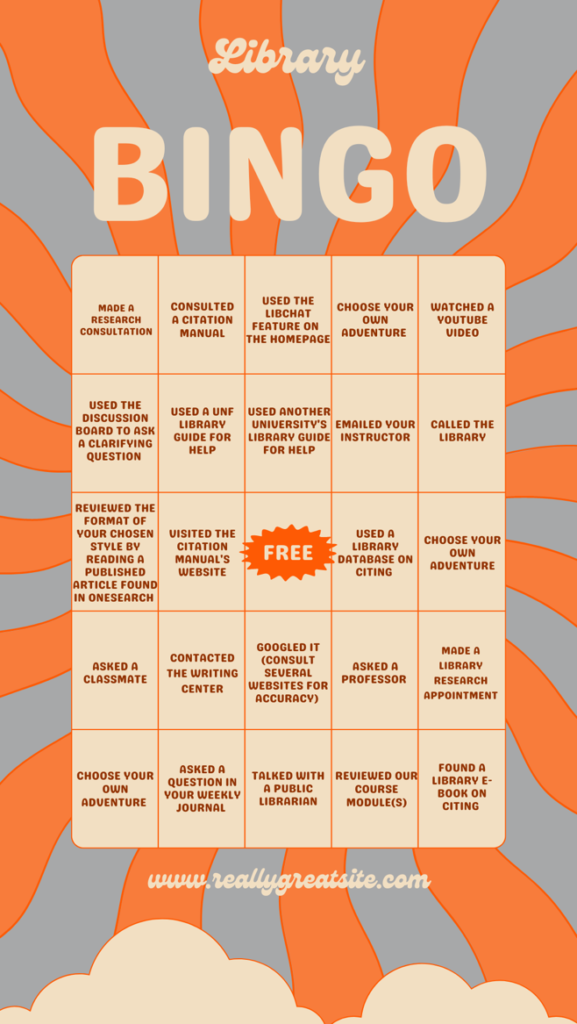
- Choice: Students choose their own topic, an assessment tool for evaluating articles, a subject-specific database for searching, and a citation style for the annotated bibliography. During the OER advocacy module, they choose between creating a social media post or writing a theoretical letter to a professor. To prepare for the final submission, they play Library Bingo, selecting resources, tools, and services that interest them.
- Competency-Based Progression: This construct focuses on mastering a learning goal before moving on to the next step. Assessments are included in all modules, and students are encouraged to book research consultations or office hours if they feel stuck. Although every module is open from the first day of class, some students may need more time to master a concept. Students who need less time are not penalized, nor are those who need extra time. Because the course is competency-based, students must master Module 1 and complete its assignments before starting Module 2. The course is sequenced and chunked to align with competency-based progression: students must pick a topic before learning search strategies, understand basic search strategies before tackling advanced ones, and so on. I regularly check in with students through online journaling activities. If a student struggles with a lesson, I offer office hours and research consultations. Additionally, I send weekly emails notifying the class of extra resources, worksheets, and videos based on students’ needs from reflection journals.
- Continuous Check-Ins: Continuous check-ins are promoted through weekly and later bi-weekly journal entries and research consultations. Students reflect on questions, barriers, and celebrations they encounter during the course. I read and reply to every journal entry, whether students share extensively or state “No concerns.” Through these check-ins and frequent grading and monitoring of discussion boards, I personalize the curriculum based on the class’s needs from reflection journals, discussion boards, and direct emails. Although students drive the conversations in discussion board activities, I comment on each post within the gradebook.
This table outlines the weekly activities and their alignment with the module’s objectives and assessments:
| Week | Module Objectives | Assessments |
|---|---|---|
| 1 Introduction to the UNF Library | (1) Define key library terms (2) Discuss UNF library resources (3) Identify a topic of interest (4) Assess your growth and ask questions about library resources | (1) Student Dictionary Assignment (2) Discussion board post (3) Topic Submission Assignment (4) Student Reflection Journal |
| 2 Evaluating Library Resources | (1) Identify and choose an appropriate assessment framework (2) Assess a scholarly article with your chosen assessment framework (3) Describe strengths and weaknesses based on your chosen assessment framework (4) Assess your growth and ask questions about evaluating library resources | (1) Assess an academic article (2) Discussion Board (3) Student Reflection Journal |
| 3 UNF Library OneSearch | (1) Conduct a search and describe basic search strategies for your topic using OneSearch. (2) Discuss the pros and cons for searching your topic using OneSearch | (1) Basic Search Assignment (2) Discussion Board |
| 4 Advanced Searching in OneSearch | (1) Describe advanced search strategies for OneSearch based on your topic (2) Define library vocabulary centered around research and search strategies | (1) Reflective Essay (2) Student Dictionary of Terms Assignment |
| 5 Topic Refinement | (1) Propose a refined topic so you can explore library resources more effectively (2) Discuss your refinement strategies based on your topic with intent to use library resources more effectively | (1) Topic Refinement Assignment (2) Discussion Board Activity |
| 6 Ethical Use of Information and Citing | (1) Assess a variety of citation manuals and choose one for your topic (2) Discuss strategies to avoid plagiarizing (3) Assess your growth and ask questions about plagiarism. | (1) Citation Style Assignment (2) Discussion Board Activity (3) Student Reflection Journal |
| 7 Practice for Reading, Writing, Analyzing, & Citing Scholarly Articles and Websites | (1) Appraise a Website Using SPAT (2) Discuss the process of evaluating an article using your chosen framework (3) Build a rough draft citation using the OneSearch QuickCite feature | (1) SPAT Website Assignment (2) Discussion Board |
| 8 Tools for Citing | (1) Create a RefWorks account (2) Select an article found in OneSearch based on your topic and export it into RefWorks (3) Discuss the pros and cons for using RefWorks (4) Assess your growth and ask questions about RefWorks | (1) RefWorks Assignment (2) Discussion Board (3) Student Reflection Journal |
| 9 Exploring Your Citation Style | (1) Discuss rules from your citation manual (2) Define library terms related to citations, citing, plagiarism, or this course | (1) Discussion board (2) Student Dictionary of Terms |
| 10 Subject-Specific Databases | (1) Discuss your experience exploring a subject-specific database (2) Assess your growth and ask questions about subject-specific databases | (1) Discussion Board (2) Student Reflection Journal |
| 11 Introduction to Annotated Bibliography | (1) Build an annotated bibliography (with scholarly materials) based on your topic (2) Discuss one annotation using proper formatting from your citation manual | (1) Annotated Bibliography Assignment Rough Draft (2) Discussion Board |
| 12 The Iterative Process | (1) Build an annotated bibliography (with scholarly materials) based on your topic (2) Discuss one annotation using proper formatting from your citation manual (3) Discuss one service, resource, or source that you consulted to improve your annotated bibliography draft | (1) Annotated Bibliography Assignment (2) Getting Help Reflection Assignment (3) Discussion Board |
| 13 Introduction to OER and OA Materials | (1) Discuss your experience(s) with OER and OA materials (2) Define library terms related to OER, OA, or some other element of this course | (1) Discussion Board (2) Student Dictionary of UNF Library Terms |
| 14 Searching for Open Access Materials Using OneSearch and Online Repositories | (1) Discuss your process for searching for OA materials using OneSearch (2) Explain what OA materials you discovered based on your topic (3) Discuss your process for exploring online OER repositories based on your topic (4) Summarize what types of OER materials you discovered in the repositories based on your topic | (1) Discussion Board |
| 15 OER Advocacy | (1) Discuss OER advocacy actions you may consider engaging in (2) Create an OER advocacy piece | (1) Discussion Board (2) OER Advocacy Assignment |
| 16 Finals Week | (1) Assess and reflect on the takeaways from this course | (1) Reflection (2) OER survey |
You can review a synopsis of positive student feedback from my poster presentation, ‘Takeaways in Creating an Online Introductory Research Course Using Student-Centered Pedagogy,’ presented at the ACRL Conference in Pittsburgh (Moukhliss, 2023). A summary of observations and constructive criticism that informed my course refresh is provided following a discussion of relevant research.
Literature Review
Little is written about library instruction and student-centered pedagogy, especially regarding library skills, online learning, and course development. However, literature on library instruction, online course development, and ADDIE yield more results. This review will first address student-centered pedagogy, followed by ADDIE.
Student-Centered Pedagogy
Maddison et al. (2017) conducted a systematic search on library instruction in online environments, covering databases such as LISA, LISTA, ERIC, OVID, and CINAHL, with publications from 2010-2015. After reviewing 89 articles, they found that librarians struggle to keep students engaged during online information literacy instruction. Additionally, librarians faced challenges in learning new technologies, adhering to logical design and format, meeting ADA compliance, and maintaining and refreshing courses. They also desired better assessment components to measure the impact, successes, and failures of the courses.
Blau & Shamir-Inbal (2018) discussed student voice in online courses and the technologies used, while Sarvary et al. (2022) focused on enhancing biology labs by making them student-centered. Baker et al. (2021) explored a student-centered pedagogy centered around questioning.
Not much is written about student-centered pedagogy and library instruction. However, Dearborn & Flierl (2023) wrote a conceptual paper on diplomatic-informed archival pedagogy, a theoretical approach to teaching archival students in higher education about research and library archives based on diplomatics and self-determination theory. Their guidelines promote less “sage on the stage” and increased student agency, voice, and choice during archival instruction—all facets of student-centered pedagogy. One example the authors offer to get students more involved in the learning process is for the archivist to share an artifact and have the students help drive the narrative by finding the item’s finding aid and research materials where the item has been referenced. Another option is to have students begin the session with what they know about the artifact and use their knowledge to drive the narrative, allowing the instructor to fill in learning gaps. However, the article focused on in-person instruction and is currently a theoretical model for future course delivery.
Willey (2013) discusses making the library instruction component of the Introduction to Music Industry Studies at Loyola University New Orleans more student-centered. This was achieved by shifting from “sage on the stage” style presentations by librarians to student-involved research workshops and group learning activities. These activities emphasized hands-on practice with searching in catalogs and databases, as well as group activities focused on source evaluation.
Smith-Cruz & Bakaitis (2022) wrote a chapter about the development of an Open Pedagogy Symposium at the City University of New York (CUNY). The symposium includes Open Educational Resources and presentations on critical pedagogy with a student-centered approach. While Smith-Cruz & Bakaitis (2022) focus on educating about pedagogies, Vine (2021) discusses making the library workforce and the employment of student workers more student-centric. Scholars are interested in student-centered approaches in libraries, with both theoretical and in-person examples. However, the landscape for student-centered pedagogy in online learning and library instruction is still in its infancy.
ADDIE in the Library Literature
Reinbold (2013) discussed restructuring the library instruction component in a face-to-face Evidence-Based Medicine (EBM) course that her team teaches with Public Health faculty, based on student feedback from prior instruction. She maximized lecture time while also allocating more time for students to work together through the critical appraisal process. Allen (2017) described the process of selecting an instructional design model for creating asynchronous modules to replace face-to-face one-shot library instruction sessions. After selecting the ADDIE model, the library team developed a series of first-year information literacy asynchronous course modules.
ADDIE as a Theoretical Framework and a Methodology
I used the ADDIE process for designing and redesigning my course. Additionally, it serves as the instructional design methodology and theoretical framework for this reflection paper. The changes I made to the course are based on the data I assessed during the Evaluate phase of ADDIE.
Integrating AI Between Initial Implementation and Course Refresh: AI Tech Tips for Research
Between the original course design and the 2024 course refresh, I decided to incorporate Artificial Intelligence (AI) topics into my course. I was not ready to create a new module or change the course significantly. Therefore, I added a subsection to certain module landing pages called “AI Tech Tips for Research.” Here, I provide brief tips centered around library research and an Artificial Intelligence (AI) tool.
Here is Module 1:
AI Tech Tips for Research
Have you heard the buzz? Artificial intelligence or AI is here and accessible. We are living in an era where we will need to learn to navigate and use AI ethically and responsibly. AI should not write your college paper, but AI can be a helpful tool to use throughout your research process. Some AI tools you may have already used without recognizing the AI integrations and other tools are new. Let’s explore and learn to use AI for research responsively throughout this course! Keep an eye out for the AI Tech Tips for Research icons and educational tips that I will sprinkle throughout the course.
The Tech Tips for Research Icon looks like this:
 And Guess what? The Tech Tips for Research image was generated using Canva.com’s “Bring learning to life: Use 5+ Words to Describe Your Design,” an artificial intelligence tool for image creation. The 5+ Words I used to design this icon are: “Design a social media post to promote artificial intelligence technology tips for research.” (Moukhliss, 2023).
The initial Tech Tips integrated throughout the course provided students with education on the following topics:
- Generating keywords for searching using ChatGPT (Week 4)
- An AI Tech Tools for Library Research library guide (Week 5)
- EbscoHost databases use generative AI for predictive keyword searching (Week 10)
- Generative AI and OER textbook publishing (Week 14)
- Generative AI and Social Media posts (Week 15)
Course Refresh
After teaching the LIS 1001 course three times, I returned to ADDIE’s Evaluate stage and I observed that a variety of students enroll in this course, ranging from first-year students to those nearing graduation. The first iteration of the course was designed to prepare students for a final project—the annotated bibliography. I assumed that most students were new to UNF and that the annotated bibliography would best serve them for research and future writing assignments. I did not anticipate that many of my students would be in their last semester, making the annotated bibliography less relevant as a cumulative assignment.
I noted that the annotated bibliography assignment did not seem meaningful for students in less research-intensive majors or for those preparing to graduate and enter the workforce. After reflecting on the course structure, where students find their own articles and practice annotating and providing references through discussion board posts throughout the semester, I realized that the practice period was sufficient for many students. Consequently, I scheduled an appointment with a university instructional designer to discuss my desire to diversify the final assignment.
An instructional designer and I brainstormed variations for the final assignment that would still require students to conduct intensive research but not necessarily create a final annotated bibliography. From this brainstorming session, I decided to offer three options for the final project: (1) an annotated bibliography, (2) an infographic on their research with an attached reference list, or (3) a podcast on their research with an attached reference list. I will use a single rubric for the final assignment, with the same points, but will differentiate the performance criteria and indicators for each option.
I used a (currently free as of 2025) Ed-Tech tool called MagicSchool AI to generate a choice board of activities. I utilized this tool for brainstorming and provided significant editing to finalize the choice board. I present the choice board to the students several times throughout the course and introduce it early in the new iteration. Here is the choice board:
| Assignment Title | Assignment Description | Research Requirements |
|---|---|---|
| Annotated Bibliography | Write an annotated bibliography using five sources. | You will include the following resource types: --A scholarly book title related to your topic --A scholarly book chapter related to your topic --A website related to your topic --A Peer-reviewed article related to your topic --A resource type of your choice At least one resource should have been found in a subject-specific database of your choice. Also, please include screenshots of your five sources after your annotated bibliography. After the screenshots, include your Getting Help Bingo Activity. Write 2-3 sentences for each square. |
| Infographic | Design an infographic to educate scholars about your topic. Include a reference list indicating the five sources used. Use a free educational tool such as Canva to build the infographic. | You will include the following resource types: --A scholarly book title related to your topic --A scholarly book chapter related to your topic --A website related to your topic --A Peer-reviewed article related to your topic --A resource type of your choice At least one resource should have been found in a subject-specific database of your choice. Also, please include screenshots of your five sources after your annotated bibliography. After the screenshots, include your Getting Help Bingo Activity. Write 2-3 sentences for each square. |
| Podcast | Record a Podcast to educate scholars about your topic. Include a reference list indicating the five sources used. You can use a tool such as VoiceMemos Links to an external site. or Canva Links to an external site. or book an appointment with the recording studio at the library. | You will include the following resource types: --A scholarly book title related to your topic --A scholarly book chapter related to your topic --A website related to your topic --A Peer-reviewed article related to your topic --A resource type of your choice At least one resource should have been found in a subject-specific database of your choice. Also, please include screenshots of your five sources after your annotated bibliography. After the screenshots, include your Getting Help Bingo Activity. Write 2-3 sentences for each square. |
Additionally, for the course refresh, I decided to reduce the number of assignments for Week 1 based on student feedback. Students consistently shared through end-of-semester evaluations and journaling assignments that the workload was too much. Therefore, I eliminated one discussion board post and one reflection journal.
From student feedback, I also noted that some students found the activities redundant after multiple weeks of similar tasks. This feedback reinforced my decision to create a choice board. Regardless of whether students choose the annotated bibliography, infographic, or podcast for their final project, they will practice reflecting on source information throughout the course.
I also made universal changes to all assignments where students use a source to annotate via discussion boards and final submissions. For the course refresh, students must submit a screenshot of the record or site of the source. I had experienced several occasions where I suspected students used an AI tool to find sources, as I could not replicate their searches. I believe these were hallucinations. Rather than avoid this issue, I now require screenshots as part of the submission. Additionally, I added an AI Tech Tip to Module 5 to educate students about hallucinations.
Check out the library guide AI at New Albany: What Librarians Need to Know on AI tools for research. Awareness of these tools may help you as you navigate your research and explore the literature of your refined topic.
Did you know? Using ChatGpt for finding library research articles is NOT reliable? Try it out. Enter: Provide me 10 peer review articles about X topic. Review the list of results. Try finding these articles in OneSearch and Google Scholar. How successful were you in finding them? I bet it’s not too successful! ChatGPT invents article titles. They look real! But they are NOT. Fake articles from ChatGPT are referred to as hallucinations. (Moukhliss, 2024).
Conclusion
I implemented these changes for a course to be taught in Spring 2025. My goal is to collect data on students’ perceptions of the course enhancements. I will track this data through surveys, students’ journaling assignments, emails, and research consultations to understand their responses to this iteration. The data I collect will prepare me for a future course refresh, as ADDIE is cyclical and should be revisited often.
References
Allen, M. (2017). Chapter 4 – Designing online asynchronous information literacy instruction using the ADDIE model. In Distributed learning (pp. 69–91). Elsevier Ltd. https://doi.org/10.1016/B978-0-08-100598-9.00004-0
Baker, S., Formo, D. M., Headley, C., & Springer, L. M. M. (2021). Transforming the feedback paradigm: A qualitative study examining a student-centered, question-based pedagogy in college composition and literature courses. Teaching English in the Two-Year College, 48(4), 387–412.
Bandura, A. (1977). Self-efficacy: Toward a unifying theory of behavioral change. Psychological Review, 84(2), 191-215. https://doi.org/10.1037/0033-295X.84.2.191
Blau, I., & Shamir-Inbal, T. (2018). Digital technologies for promoting “student voice” and co-creating learning experience in an academic course. Instructional Science, 46(2), 315–336. https://doi.org/10.1007/s11251-017-9436-y
Collins, J. W. & O’Brien, N. P. (2003). The Greenwood dictionary of education. Greenwood.
Dearborn, C., & Flierl, M. (2023). A diplomatic-informed archival pedagogy: fostering student-centered learning environments for novice archival researchers. Journal of Documentation, 79(3), 743–756. https://doi.org/10.1108/JD-06-2022-0128
Durak, G., & Ataizi, M. (2016). The ABC’s of online course design according to Addie Model. Universal Journal of Educational Research, 4(9), 2084–2091. https://doi.org/10.13189/ujer.2016.040920
Green, C. & Harrington, C. (2020). Student-centered learning: In principle and in practice. Lansing, MI: Michigan Virtual University. Available from https://michiganvirtual.org/research/publications/student-centered-learning-in-principle-and-in-practice/
Harrington, C. & DeBruler, K. (2019, October 22). What exactly is student-centered learning? [Blog post]. https://michiganvirtual.org/blog/wha
Hergenhann, B. R., & Olson, M. H. (2005). An introduction to theories of learning (7th ed.). Pearson Education
Maddison, T., Doi, C., Lucky, S., & Kumaran, M. (2017). Chapter 2 – Literature review of online learning in academic libraries. In Distributed Learning (pp. 13–46). Elsevier Ltd. https://doi.org/10.1016/B978-0-08-100598-9.00002-7
Moukhliss, S. H. (2023). LIS 1001: Beginning library and information systems strategies. University of North Florida. Canvas.
Moukhliss, S. H. (2024). LIS 1001: Beginning library and information systems strategies. University of North Florida. Canvas.
Moukhliss, S. H. (2023). Takeaways in creating an online introductory research course using student-centered pedagogy. Library Faculty Presentations & Publications. 125. https://digitalcommons.unf.edu/library_facpub/125
Reinbold, S. (2013). Using the ADDIE model in designing library instruction. Medical Reference Services Quarterly, 32(3), 244–256. https://doi.org/10.1080/02763869.2013.806859
Sarvary, M. A., Castelli, F. R., & Asgari, M. (2022). Undergraduates’ experiences with online and in-person courses provide opportunities for improving student-centered biology laboratory instruction. Journal of Microbiology & Biology Education, 23(1). https://doi.org/10.1128/jmbe.00289-21
Smith-Cruz, S., & Bakaitis, E. (2022). Breaking open: Defining a student-centered pedagogy. In M. A. Cullen & E. Dill (Eds.), Intersections of open educational resources and information literacy (pp. 321–342). Association of College & Research Libraries.
Vine, L. (2021). HIP check: Equity, learner-centered pedagogies, and student employment. Ascending into an Open Future: The Proceedings of the ACRL 2021 Virtual Conference, April 13-16 2021 (Chicago: ACRL, 2021): 321-29.
Willey, M. (2013). Amplify the active learning: Revamping course-integrated library instruction to be student centered. (2013). LOEX Conference Proceedings 2011. 22. https://commons.emich.edu/loexconf2011/22