By Jonathan Cornforth, Reference and Instruction Librarian
and
Sarah Parramore, Reference and Instruction Librarian
Pollak Library
California State University, Fullerton
Peer-to-peer support has become a cornerstone of learning across various levels and areas of education. Its impact can be felt in many settings; not least of which is an academic library. There has been no lack of experimentation and successful implementation of peer education and related learning models within such spaces. Over time, libraries have helped innovate such forms of learning as they target specific courses and students.
In this vein, library instruction practices are amenable to adaptation. Instructors and various other stakeholders continue to seek out and implement new ways of delivering content which incorporates authentic approaches and pedagogies suited to today’s learner. This includes such innovations as High Impact Practices and other experiential approaches designed to engage students within the context of peer education. Library instruction has been and will continue to advance peer-to-peer engagement practices within various classroom settings.
Along these lines, this study was undertaken to better understand peer-facilitated library instruction geared toward supporting a first-year student’s understanding of essential functions, services, and resources provided by their library. It describes and assesses a peer-assisted learning (PALs) method of delivering instruction to first-year students enrolled in courses which require the completion of research assignments. This often under-used approach to introductory library instruction was also taken into consideration and implemented in order to support librarians’ various commitments to their subject areas and liaison duties. In this vein, PALs can help augment instruction provided by librarians as they respond to the needs of faculty and students in other areas.
Peer-Assisted Learning
An abundance of resources and related research has been devoted to first-year students across libraries as well as universities and their divisions. To be sure, an increase in support for first-year students has risen to reach new programs devoted to student success in a variety of forms. Research shows that support for first-year students improves retention rates (McKenna-Buchanan et al., 2020; Woolfork-Barnes, 2017). In concert with the development of first-year student support in higher education, peer-led guidance and support has proven to be invaluable across disciplines and aforementioned academic divisions (Luciano-Wong & Crowe, 2019; Rawlinson & Willimot, 2016; Yomtov et al., 2017).
The efficacy of training and promoting student employees as educators is a critical development in this efficacious mode of cross-divisional learning and guidance. High Impact Practices (HIPs) lie at the center of our study and many others. A HIP is defined as “learning to work and solve problems in the company of others and sharpening one’s own understanding by listening seriously to the insights of others, especially those with different backgrounds and life experiences” (Association of American Colleges and Universities, 2018). They are known to provide opportunities for students to engage with advanced, practical, and discipline-specific, learning. These learners can apply recently gained knowledge in practical settings (Kuh, 2008). Specific HIPs have evolved in unique ways to engage the peer dynamic even further (Keup, 2016).
Building on this confluence of HIPs and peer education, practitioners within academic libraries have determined that this dynamic is beneficial and sustainable across service points which support information literacy and general library literacy. Academic libraries often intervene in a student’s education at the point-of-need, when varying levels of research support are required for specific assignments tied to the curriculum. Moreover, library anxiety can problematize the research process (Mellon, 2015). In order to inform librarians who help reduce general unease with use of the library (and campus resources in general), unfamiliarity with resources, and barriers to access, numerous studies demonstrate and contribute to a greater understanding of the impact of library resources and support on first-year student success. Student-led activities not only orient first-year students to library resources and services, but also help facilitate awareness of services and improve access to the library as a supportive space for both individual and social/group experiences and exchanges (Crisp & Cruz, 2009; Jacobi, 1991; Kuh & Gonyea, 2003; Smith, 2017). As noted, peer education provides critical support; in particular, it facilitates social integration and fosters a sense of belonging in the library (Kuh, 1991; Terenzini et al., 1996).
Invaluable recent research has been performed on peer education within the context of libraries, including areas of instruction. Several studies indicate the positive impact peer engagement in the form of mentoring and tutoring has had on student use and understanding of library research and information literacy skills (Henrich, 2013; O’Kelly et al., 2015). Importantly, though the literature is limited, peer-led library instruction has played a role in library instruction at several institutions (MacAdam & Nichols, 1988; Holliday & Nordgren, 2005; Rinto et al., 2009). To push the idea further, a program was put into practice at one institution which led to a highly successful program centering upon peer-to-peer learning (Bodemer, 2014). Overall, this indicates the efficacy and value of peer learning within the context of lower-division, course-level information literacy skill development and library awareness.
Building on these approaches, this case study is primarily focused on a specific subset of courses and therefore learners as well, namely, individuals enrolled in First Year Experience (FYE) programs. In support of this group, the Peer-Assisted Learning (PALs) program integrates several elements of peer-led learning, including tutoring, one-on-one reference help, and general peer leadership and support. Ultimately, the program combines HIPs and peer education targeting first-year students to increase their awareness of library resources.
Background
These two ideas lie at the heart of First Year Experience course programs available to a large range of students, from first-time freshmen to transfers enrolled at California State University, Fullerton.
CSU Fullerton is a public university with an enrollment of nearly 40,000 students, with over 100 degree programs in eight colleges. The Pollak Library’s information literacy instruction program provides resources, support and other offerings for students across the spectrum, from first-time freshmen to those earning a doctorate degree.
The quantity of library sessions which support First Year Experience courses has varied, based in large part on FTE and interest in these programs. During the 2018-19 academic year, 34 sections received in-person library instruction sessions. The campus provides a variety of FYE seminars, from one set available to undeclared students to several available to students who declare majors in a variety of disciplines. The library partners with many of these programs. The PALs program provided instruction to the undeclared sections, as well as those that fall under the Colleges of Health & Human Development, Communications, Arts, and Humanities & Social Sciences. With a few exceptions noted below, the lesson plan and instructional materials remained consistent across the sessions, which also helped with the process of hiring and training peer mentors.
Recruitment and Training
Rather than start from scratch with recruiting new students to the PALs program, the selection process of viable candidates began by examining the pool of student workers already employed at the library’s frontline Information Desk. These individuals had a strong base of knowledge about the library as the first point of contact with visitors. Several majored in areas of study which are popular with first-year students, including Communications, Business, and various disciplines within the College of Humanities & Social Sciences. Moreover, two students desired to obtain teaching credentials or advanced degrees in order to become educators. Importantly, all of these students were reflective of the campus demographics in terms of ethnicity and range of year/age, from freshmen to graduate students. This helped provide varying backgrounds and perspectives that would ultimately contribute to meaningful conversations before, during, and after the sessions. Ultimately, this enabled PALs to better speak to campus life and, at the same time, their experiences with their respective majors as they answered questions and engaged with students. In all, nine students participated as PAL instructors/facilitators.
To prepare them for instruction, librarians created all of the content and training materials. Ultimately, one lesson and set of activities served as a framework for all sessions, with minor variations depending on the discipline or focus within which the PALs taught. Activities centered upon group work and active learning strategies, and were created to give students basic guidance on searching and accessing resources, services, and means of asking for help. In order to accommodate the demands of specific disciplines, examples of materials, such as books and articles, reflected the needs of particular assignments.
To begin the training process, librarians first demonstrated the lesson for the PALs and provided an overview of classroom management techniques. They were then paired up and practiced facilitating instruction as a team. To provide additional experience, mock lessons were held in which the PALs facilitated lessons for library employees and fellow student assistants. These sessions proved to be the most critical part of training, as it is difficult to know what to expect without a live audience. Repeated sessions of mock lessons ensured the PALs were confident enough to facilitate instruction in front of live classes. It was also very helpful to provide these students the chance to teach in a real-world setting in the form of a summer bridge program that met prior to the semester. This afforded them the opportunity to build confidence while working with actual learners.
Combining the PALs in pairs originally functioned as a training mechanism and as a means of building confidence as their toolkit of skills expanded. Because this idea was extremely helpful during the training stage, it was in turn added as an essential element of instruction throughout the program. Partnering students as co-facilitators increased collaboration, reliability, and trustworthiness amongst these individuals.
Challenges
Despite these efforts to improve upon the program as it developed, issues arose that were not anticipated at the outset. The idea of partnering PALs as mentioned did indeed prove helpful. On a few occasions, however, a PAL did not show up to their scheduled instruction session due to traffic/parking issues or an error in time management. The team-based model therefore played a critical role in sustaining the program since at least one individual PAL was present to facilitate the session. While this rarely happened, librarians were also on-call to fill in as needed. This additional safety net was ultimately not necessary due to the generally high level of commitment and punctuality consistently displayed by the PALs.
Scheduling sessions also proved challenging. Many student employees rely on campus employment to work around their class schedules and so prefer a set schedule. The nature of “one-shot” library instruction means these sessions can often be scheduled at varying times and therefore might be out-of-sync with the schedules or availability of student employees. In this regard, finding PALs who had complementary schedules to accommodate instruction requests was, upon occasion, a challenge.
The pairing method described above also had to be addressed and ultimately reconfigured due to scheduling conflicts. This did not ultimately impact how we were able to provide help to students enrolled in these courses. Availability proved to be the biggest factor in helping find the right combination of PALs who could work together. Since the lesson plan and content did not vary, librarians ultimately were able to find matching schedules and then subsequently pair up PALs in a consistent manner..
Another challenge involved the solicitation and procurement of reflective responses from the PALs themselves in order to gauge the impact of the program. Ultimately, librarians did receive responses through emails, as noted below under Assessment.
Lastly, finding receptive partners on campus to gather accessible data did prove challenging. Some FYE program directors felt that students would become overwhelmed or burdened by additional assessment tests, such as the library’s questionnaire. They therefore opted out of participating in the project. Ultimately, one FYE program director enthusiastically embraced the idea of testing the effectiveness of the program.
Assessment
Despite these challenges, data collection and analysis was conducted in order to assess the effectiveness of a peer-led model of library instruction. An IRB proposal was submitted and approved prior to the start of the collection process. The authors assessed both the impact of HIPs on the PALs themselves and on students who attended sessions taught by these individuals.
Indicators thus include the following: survey results from PAL facilitators, perspectives of faculty instructors, and data collected from a pre- and post-test assessment tool of student learning within a cohort of first-time freshmen.
Impact on Peer-Assisted-Learning (PAL) facilitators:
To determine the impact on the peer-assisted learners of the program on their academic and career success, PALs were asked to respond to a survey. These questions were adopted from the Iowa GROW student assistant questionnaire (University of Iowa, n.d.). The question bank was composed of the following questions:
- How is this job fitting in with your academics?
- What are you learning here that’s helping you in school?
- What are you learning in class that you can apply here at work?
- Can you give me a couple of examples of things you’ve learned here that you think you’ll use in your chosen profession?
Investigators received the following sample responses:
How is this job fitting in with your academics?
“This job fits in well with presentations. As a Human Services major, my job/career goals has me talking to clients and building rapport with them. When I give tours, orientations it’s important to build rapport with students so that they feel comfortable engaging with us. This can include asking questions and participation.”
What are you learning here that’s helping you in school?
“I learned about a lot of resources we have here within the library. In my classes, I tend to know more information about resources and support than my fellow peers who do not visit the library often or engage in any workshops hosted within the library. I am also becoming more and more comfortable with presentations. Basically, learning how to present information is critical. As I am now in my major classes, many of them require presentations, so having the ability to practice and become comfortable talking to and in front of people is great.”
What are you learning in class that you can apply here at work?
“The qualities that I am learning in class that I apply at work is working diligently, organization, going over details, and doing my best day to day.”
“I am able to gage [sic] what students need to learn more about, most students are not currently aware of the resources on the library website so I am able to point out which would help the most students.”
Can you give me a couple of examples of things you’ve learned here that you think you’ll use in your chosen profession?
“As someone who wants to be a professor, this job is perfect for me because it gives me firsthand experience with teaching a class. It gives me the opportunity to connect with students and understand their needs of the library and their campus.”
Perspectives from Faculty Instructors:
In turn, faculty instructors who requested peer-led instruction provided feedback in the form of a survey. They were asked if they could provide “Any comments or suggestions for improvement”. This is a sample of their comments:
“Assistants were amazing!!”
“Fantastic PALs, and I’m so glad xxx recommended them to my freshman class. I’m glad to see more peer to peer learning and sharing.”
Pre- and Post-test Survey of FYE Cohort:
Data was also collected on the impact peer-assisted learning had on the students enrolled in courses who attended one-shot instruction instructed by peers. A specific population of First Year Experience students were selected. After gaining support from the faculty coordinator of the College of the Arts First Year Experience program, a set of questions were delivered to these students via their LMS. For the pre-test, their responses helped determine how well they were able to navigate the library’s website and use the discovery system prior to the one-shot session. A number of these students also participated in a post-test.
The questions, numbers of participants, and charts detailing percentage changes are provided in the Appendix.
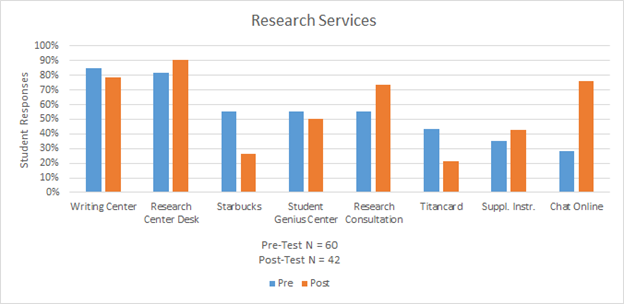
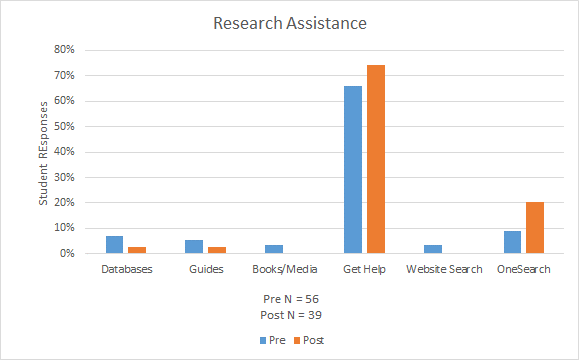
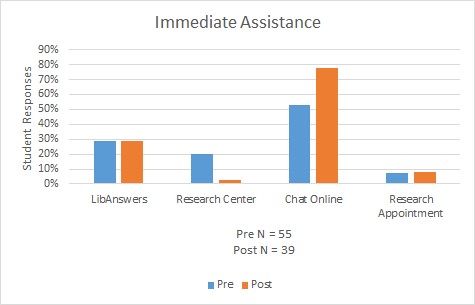
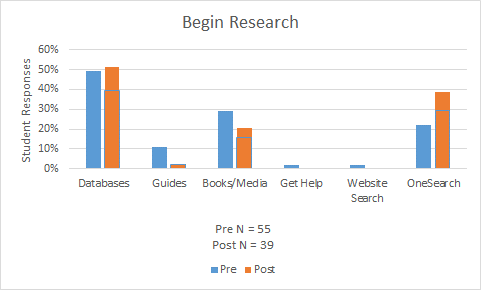
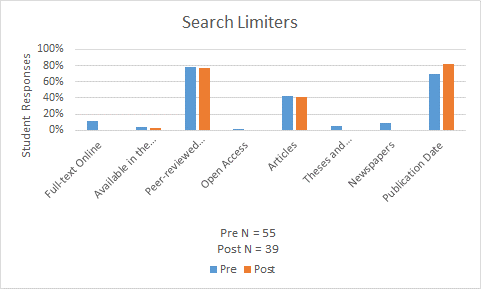
The cohort’s understanding of library services and resources increased across several indicators. They gained knowledge about research services. Knowledge of the Research Center increases by 8.8%, Research Consultations by 18.8%, and Chat Online by 48.9%. Overall, their understanding of where to get help on the library’s homepage after regular hours increased by 8.3%. The group’s understanding of the use of 24/7 support increased by 24.2%. In addition, they gained an understanding of how to use facets available in the discovery interface. For instance, use of the date filter to locate more recently published peer-reviewed articles increased by 13%. Finally, students were also able to better locate links to databases and other resources that provided access to articles as opposed to books and other media. 2.1% more students chose databases after the session and 16.7% more chose the discovery tool OneSearch which provides access to articles.
Discussion
Based upon these results, peer-led instruction appears to have positively impacted learners enrolled in Fullerton’s FYE programs, as well as student workers employed as PALs. It provided students the opportunity to develop pertinent skills related to scholarly research, engage with one another in a positive learning environment, and develop general library awareness.
In terms of PALs facilitators themselves, they benefited from participating in this program by gaining academic and career-related skills, and feeling they contributed to their peers’ success.
In addition, responses from instructors indicate a positive response to peer-driven instruction. Enthusiasm for peer-driven instruction appears to have a place within the ranks for instructors, who reportedly see clear benefits.
Finally, as indicated in the survey test, a specific cohort of students showed an improvement in several areas of information literacy skill development while also gaining awareness of essential library services. There was an increase in knowledge of library support among this cohort of first-year students. They developed a greater understanding of search processes and research tools as well.
We acknowledge the fact that the data reflects only the impact peer instruction had on improvement of information literacy and library literacy skill acquisition. Moving forward, the researchers would like to compare results with similar instruction by librarians. A study of this nature could reveal more definitively the value of peer-facilitated instruction as opposed to librarian-led instruction. There is, nevertheless, an indication that students gain an understanding of library services upon attending library instruction led by their peers; that faculty instructors value this form of instruction; and that PALs themselves gain meaningful, educational benefits which are transferable to the classroom and workplace.
Conclusion
The positive feedback received from students, faculty and PALs has provided sufficient motivation to continue the program into the next academic year. To sustain the program, the plan was for current PALs to train new incoming cohorts. The strength of peer-to-peer learning is a model to replicate for future learning. It is clear as well that HIPs have a place in academic libraries.
The program has, however, taken a detour due to the COVID-19 pandemic; the nature of virtual learning is not conducive to the model of instruction originally designed. Some concerns have also grown due to financial instability of a program which funds student employment. Ideally, PALs will continue their work when it is safe and feasible to return to either virtual or in-person instruction. Stakeholders, such as instructors, have expressed disappointment that peers are not at the moment leading instruction for FTF and transfer students.
Therefore, alternative methods of empowering learners and improving upon how libraries help build information literacy skills for new students has become necessary. In order to create the same level of active engagement in a virtual environment, the authors plan to replicate and deliver much of the same content of the PALs-led sessions using an asynchronous, self-paced virtual escape room format. A variety of hosting platforms and examples from public libraries indicate the rich possibility of this type of instruction that is both engaging and informative.
Acknowledgement
The authors would like to acknowledge the ongoing support provided by assessment officer and fellow librarian at Pollak Library, Eric Karkhoff. He was instrumental in analyzing and presenting the data behind this project.
References
Association of American Colleges and Universities (2018). Chart of high-impact educational practices, available at: https://www.aacu.org/leap/hips
Bodemer, B. B. (2014). They CAN and they SHOULD: Undergraduates providing peer reference and instruction. College & Research Libraries, 75(2), 162–178. https://doi.org/10.5860/crl12-411
Crisp, G., & Cruz, I. (2009). Mentoring college students: A critical review of the literature between 1990 and 2007. Research in Higher Education, 50(6), 525-545. doi: 10.1007/s11162-009-9130-2
Henrich, K. J. (2013). Leveraging strategic institutional partnerships: Creating a phased learning commons at the University of Idaho Library. Collaborative Librarianship, 5(4), 228. https://digitalcommons.du.edu/cgi/viewcontent.cgi?article=1119&context=collaborativelibrarianship
Holliday, W., & Nordgren, C. (2005). Extending the reach of librarians: Library peer mentor program at Utah State University. College & Research Libraries News, 66(4), 282-284. doi: 10.5860/crln.66.4.7422
Jacobi, M. (1991). Mentoring and undergraduate academic success: A literature review. Review of Educational Research, 61(4), 505-532. doi: 10.3102/00346543061004505
Keup, J. R. (2016). Peer leadership as an emerging High-Impact Practice: An exploratory study of the American experience. Journal of Student Affairs in Africa, 4(1), 31–50. doi: 10.14426/jsaa.v4i1.143
Kuh, G. (1991). Involving Colleges: Successful Approaches to Fostering Student Learning and Development Outside the Classroom. San Francisco, CA: Jossey-Bass.
Kuh, G., & Gonyea, R. (2003). The role of the academic library in promoting student engagement in learning. College & Research Libraries, 64(4), 256-282. doi:https://doi.org/10.5860/crl.64.4.256
Kuh, G.D. (2008). High-impact Educational Practices: What They Are, Who Has Access to Them, and Why They Matter. Washington, DC: Association of American Colleges and Universities
Luciano-Wong, S., & Crowe, D. (2019). Persistence and engagement among first-year Hispanic students. Journal for Multicultural Education, 13(2), 169–183. doi: 10.1108/jme-12-2017-0072
MacAdam, B., & Nichols, D. P. (1988). Peer information counseling at the University of Michigan Undergraduate Library. Journal of Academic Librarianship, 14(2), 80. https://deepblue.lib.umich.edu/bitstream/handle/2027.42/93796/DB511013.pdf;jsessionid=401F1C93B76F5F9881F5B631B916A593?sequence=1
McKenna-Buchanan, T., Munz, S., Wright, A., & Williams, J. (2020). The importance of the basic communication course in the first-year experience: Implications for retention. Basic Communication Course Annual, 32, 148–169. https://ecommons.udayton.edu/cgi/viewcontent.cgi?article=1598&context=bcca
Mellon, C. (2015). Library anxiety: A grounded theory and its development. College & Research Libraries, 76(3), 276-282. doi: 10.5860/crl.76.3.276
O’Kelly, M., Garrison, J., Merry, B., & Torreano, J. (2015). Building a peer-learning service for students in an academic library. Portal: Libraries & the Academy, 15(1), 163–182. https://doi.org/10.1353/pla.2015.0000
Rawlinson, C., & Willimot, M. (2016). Social justice, learning centredness and a first year experience peer mentoring program: How might they connect? Journal of Peer Learning, 9, 41–48. https://files.eric.ed.gov/fulltext/EJ1115047.pdf
Rinto, E., Watts, J., Mitola, R. (Eds.). (2009). Peer Assisted Learning in Academic Libraries. Santa Barbara, CA: Libraries Limited.
Smith, J. (2017). Innovating for student success: The University Leadership Network (ULN) and tiered undergraduate peer mentor model. Metropolitan Universities, 28(3), 80-101. doi: 10.18060/21543
Terenzini, P., Springer, T., Yaeger, L., Pascarella, P., & Nora, M. (1996). First-generation college students: Characteristics, experiences, and cognitive development. Research in Higher Education, 37(1), 1-22. doi: 10.1007/bf01680039
University of Iowa. (n.d.). Iowa GROW. https://vp.studentlife.uiowa.edu/initiatives/grow/
Woolfork-Barnes, T. (2017). Seven-year (2007-2013) retention study on students enrolled in thematic and nonthematic First-Year Experience seminar courses. Strategic Enrollment Management Quarterly, 5(3), 118–127. https://doi.org/10.1002/sem3.20110
Yomtov, D., Plunkett, S. W., Efrat, R., & Marin, A. G. (2017). Can peer mentors improve first-year experiences of university students? Journal of College Student Retention: Research, Theory & Practice, 19(1), 25–44. doi: 10.1177/1521025115611398
Appendix: Pre- and Post-test Survey of FYE Cohort
Q1 – What services are offered in the library to help support you with your research assignments? Select all that apply.
Q2 – You are struggling with your research after regular library hours. From the library homepage, where would you go for immediate assistance? Please select the appropriate box below.
Q3 – Which specific service listed below would you use to get immediate research assistance after regular library hours? Please select the appropriate box.
Q4 – Your professor has asked you to locate scholarly articles. Where on the library’s homepage would you begin your search? Please select the appropriate box below.
Q5 – You need to find sources on the history of science. Which options on the left side would you select to narrow your search to peer-reviewed articles published within the last ten years?
One thought on “Student Educators as Facilitators of Learning: A Model for Peer Education in Academic Library Instruction”
Comments are closed.