By Beth Carpenter, User Services & Instruction Librarian
Transylvania University
and
Bria Sinnott, Arts & Communication Librarian
Towson University
Abstract
Memes are powerful social media tools, but also powerful information literacy artifacts. Through theory and practice, memes have an important place in how we understand the way our students are thinking, how we can envision the future of information literacy, and how we can have some fun in the process.
Introduction
There is an inherent danger in explaining memes. Either you come across as an out-of-touch adult trying to stay hip and cool, or you ruin the humor and experience of the meme. Sometimes you can do both simultaneously! Despite this minefield, there is a lot that can be learned from memes about information literacy, our patrons, and information dissemination. Alongside the intellectual benefits of discussion memes, they’re just plain fun.
Memes began as a term from everyone’s favorite evolutionary biologist, Richard Dawkins, in 1976. Instead of a gene, which “spreads through sexual selection and physical fitness, a meme…spreads through social selection and ideological fitness” (McCulloch 2020, 239). While memes started in the early days of Usenet, with Mike Godwin using the word “meme” to describe his own experience as an internet phenomenon when he coined Godwin’s Law[1], in the nineties, what memes have become since then is something that couldn’t have been imagined by Dawkins or Godwin. As Bradley Wiggins puts it, “Fundamentally, it is problematic to assume an analogous relationship between the Dawkinsian and the digital term because this ignores the discursive aspect of internet memes” (Wiggins 2019). As memes have gone from macros, or text emblazoned across images of cats wanting cheeseburgers to a multimodal form of humor and idea-spreading, their definition has changed.
Memes offer a case study for how information is now transmitted, how information can grow and change, and how we can contribute to it. To put ourselves in the ACRL framework we all know and love, this new information-sharing world makes us all experts, makes us all potential contributors. Authority is constructed and contextual. Scholarship is a conversation. Searching is strategic exploration.
The creation and understanding of memes demands proficiency in visual literacy skills as well. In her seminal whitepaper, Bramford recognizes that we now live in an increasingly visual culture and that “visual images are becoming the predominant form of communication across a range of teaching and learning resources, delivered across a range of media and formats” (Bramford 2003, 2). The meme is an organic evolution of our affinity for communicating through images, akin to ancient frescoes and street art (Woodworth 2018). What other mode of modern communication can so succinctly express emotional extremes? Unbridled joy, physically painful laughter, all the hard feelings? There is a meme for that.

Is This Information Literacy?
There’s a joy to creating a welcoming atmosphere for students, being able to see the barriers breaking down, and making friends out of the people who walk into the library, or into your classroom. Memes are funny, plain and simple, and can do a lot of legwork for us in this respect. Often in library instruction, we use pop culture references and memes inserted into our presentations as a way to keep the interest of our students.
As an ice breaker, memes can work wonderfully well, setting a more relaxed tone, and helping to break down the library intimidation factor that some students come to college with. There’s a chance you’ve seen these memes before; The Credible Hulk, Batman returns his Library Books, Buzz & Woody reminding us that information is, indeed, everywhere. This passive use of memes is employed for comic relief. Beyond a quick laugh, this connects to the overall themes discussed in this paper. If memes are truly a changing and evolving organism of information, using them as visual punctuation is a means of tapping into their staying power. Their relatability and familiarity can be used to communicate an idea or feeling in a way that even the best of bullet points could fail to do. When expertly deployed, students can get the sense that you’re not a regular librarian, you’re a cool librarian, and can develop a connection to you from a shared understanding of a joke.
Creating connection and community with users is at the heart of many outreach activities, and academic libraries are already adding memes to their marketing toolbox in a variety of ways. University of Florida librarian Sam Putnam is using in-house student generated memes as an advertising tool on Instagram. Posts from the library account that included original memes showed an increase in both engagement and reach (Putnam 2020). A team of UNC Greensboro librarians has taken this a step further and created a year-long program themed around “uplifting memes.” Along with meme-making contests and a student art show, they planned nearly a dozen events including “What’s the memeing in the Message?: Memes as Political Discourse, Activist Art and Propaganda” and a workshop on graphic design and digital communication (Murphy, Dale & Biggers 2019).
It can be used, as Megan Hodge describes, as an “anticipatory set,” creating a tone for the class itself (Hodge 2014, 161). She adds that,
how students feel in class makes a surprisingly large difference on how receptive, consciously or unconsciously, they are to learning. The importance of affective learning is one of the reasons that the anticipatory set is so important: it can help the students relax and make a connection with you. Developing a rapport with students can begin even before class has started, however, by greeting students as they come in or making conversation after they’ve settled in. (Hodge 2014, 164)
One way to encourage buy-in at the start of a session is to ask students to summarize their feelings and experiences surrounding research via meme-making. Memes are a direct way to scaffold learning and activate deep knowledge creation. A potential library session could begin with asking students to find public domain images from Google or a specific database, and to re-envision the artwork as a modern meme. When this session was applied to a class with interdisciplinary fine arts students, they were set loose on the task cold with no instruction on search keywords or boolean operators. They approached the assignment with enthusiasm, using creative search terms and discovery methods to navigate and find images that reflected feelings or personal situations. This created the opportunity for a low-stakes interaction with a database and set the stage for the discussion about free-use images that followed.

Beyond that, memes and internet pop culture are something most students interact with every day, actively or passively. Hodge urges teachers to move away from covering traditional material in the classroom and “reflect our students’ realities, rather than our own” (Hodge 2015, 9). The reality is that creating, enjoying and disseminating memes is an act of serious leisure for many students.
In their 2016 article, Hartel, Cox and Griffin introduce this serious leisure perspective in a research context for information science. Serious leisure activities include serious pursuits (you don’t become a master meme-maker overnight); casual leisure (meme-browsing); and project-based leisure (creating a custom inside joke meme). They used Anders Hektor’s model to interpret information behaviors of hobbyists like runners and musicians. Four general modes of information lay at the center of the model: seeking, gathering, communicating and giving. These behaviors influence information activities: search & retrieve, browse, monitor, unfold, exchange, dress, instruct and publish (Hartel, Cox & Griffin 2016, 3). We are able to apply these same strategies to interaction with internet memes:
- Search & Retrieve: Demonstrated skill in finding images, sound bites and text/image pairings that have meme-potential.
- Browse: Users can locate images and pre-existing memes using keyword searches and serendipitous browsing online social media sites.
- Monitor: Some actively seek to stay current by monitoring websites like Reddit, GIPHY, TikTok or Twitter.
- Unfold: Here users actively take part in discussions surrounding memes and meme creation, developing shared-interest groups both online and face to face.
- Exchange: Expanded communication with the meme internet community and a sharing of ideas and feedback on created memes.
- Dress: Users interject thoughts and emotions into visual form with images and text.
- Instruct: Expressing knowledge of meme construction and application by remixing images or text captured by others.
- Publish: Posting and sharing of memes virtually. Fun for all!

If we consider interaction with memes a frequent leisure activity for many students, there may be opportunities to expand on these existing behaviors. By bringing memes into the classroom, we are able to connect concepts with their lives outside of the classroom, giving more immediacy and importance to whatever library concept is currently being discussed. This can go beyond memes. When we teach higher-level searching concepts, like wildcards and truncation, through Google searches, or meme and infographic evaluation when we ask students to look at the images that they come across on social media in a critical way, we can ground this in the things they come across in their daily lives. Any number of memes can be examined through an academic discipline. Media and communication studies students can examine visual messaging and dissemination, political science classes can investigate the Pepe the Frog meme used during the 2016 election cycle. Linguists like McCulloch are already enchanted by internet language. Those interested in social justice and equity can debate the digital blackface phenomena associated with memes and animated gifs.
As mentioned previously, Art & Design students can have a field day manipulating images and discussing the constructs of open access and public domain. In one general information literacy session, students were working on ways to generate thesis topics that were not only researchable but interesting. They were asked to start with the Kardashians, a family entwined with pop culture on the internet, at the center of a concept map. From here students brainstormed in small groups what academic topics could be connected to the family’s many personas and public actions. Ideas were vast and included topics like blended families, mental health of trans men and women, plastic surgery as non-verbal communication and women-owned businesses. The Kardashian family is not likely to become the next hot thesis topic, but the exercise reminded students that ideas are everywhere, even in the supposed mundane or unscholarly.
Memes can also be used to show the way information travels through the internet. A non-joyful example that appeared as recently as late in July 2020 is that a black and white photo challenge began in Turkey as a means of raising awareness about the murders of women. This was taken by influencers and people on social media as simply a challenge to post a flattering black and white photo of themselves as a means of empowerment with no further context. Context for memes is important, but also once created, memes take on a life of their own, and it’s up to the consumer to follow the meme-trails to understand the full impact and implications of the memes they share and create. This is an opportunity for students to practice critical thinking before they share or participate in seemingly benign internet activity.
Meme propagation mimics the way scholarly conversations occur. An activity with students where they are given a meme, as well as the various ways in which it has grown and spread, shows the way that ideas are taken, built upon, and have impact in the world. Students then try to find the path the meme has taken, from its origin to its end, to see the impact individual Twitter users can have on the spread, and to see how something that starts so small and innocuously can become something that touches millions of people’s lives.
The same is true of scholarly conversation: an idea is posited, researchers and scholars build upon that idea, more analysis is completed, other papers are written. The difference between memes and scholarly conversation is that one moves much faster than other; in some cases, memes have a lifespan of a day or less, whereas scholarly conversations can span years. Scholarly discourse may be catching up, as academic communities begin to use open peer review mechanisms. Authority takes on deeper meaning when examining the varied scope of meme creators. When the author can be completely anonymous, how does that impact the information artifact itself? It’s time we honor students as active content creators and acknowledge that they have erudite authority over topics of personal interest.

30-50 Feral Memes and Why It Matters
When we step outside of the framework of lesson plans, teaching, and the classroom, memes do more than illustrate information literacy concepts and make learning an enjoyable and memorable (meme-orable) experience.
As Peter Brown says, “First, to be useful, learning requires memory, so what we’ve learned is still there later when we need it. Second, we need to keep learning and remembering all our lives…Third, learning is an acquired skill, and the most effective strategies are often counterintuitive…The more you can explain about the way your new learning relates to your prior knowledge, the stronger your grasp of the new learning will be, and the more connections you create that will help you remember it later.” (Brown 2014, 2-5).
Memes support all three aspects of the learning experience: to participate and understand memes, they are built on memory, and how concepts relate to each other. Using memes means you are constantly building your meme knowledge base – the more you meme, the better you are at meme-ing.
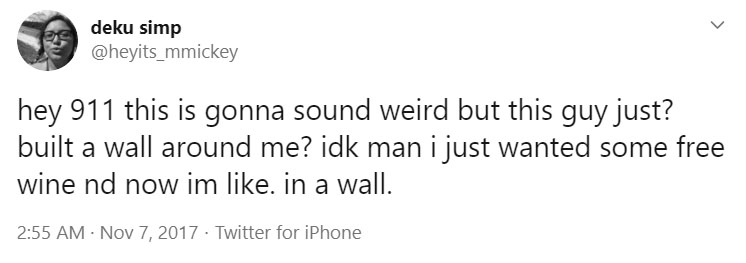
Alongside the illustration of these learning concepts, there is a larger lesson to be taken from memes, from the way information is disseminated and consumed, and one that may seem obvious: it’s all changing. When our structures to relay information were created, things looked very different from how information travels now. Long before the internet, people created images on public walls in the form of frescoes and street art to convey a universal emotion. What a lovely and strange evolution to go from Edgar Allen Poe’s “The Cask of Amontillado” to the 911 caller meme.
Looking at the Dewey Decimal System or Library of Congress Headings, they are akin to a foreign language. Students that come to the reference or circulation desks aren’t sure what letters mean, or how the numbers function. It’s a postal code directing them to an address they don’t know how to find. Librarians become the translators of this code, one which only librarians have the key to understanding. It’s our job to then instruct our student workers or our patrons how to locate the items they’re looking for.
Beyond translating call numbers, “libraries have taken on a range of functions to manage those collections, and the services and tools that libraries have built to provide access to content have evolved to the point that they may become just as important to the institutional mission as the collection itself” (Levine-Clark 2014, 1). As we, librarians, work towards assisting patrons with access and research, the skills we bring to the table in this work become almost as valuable as the materials we are guiding patrons towards (Levine-Clark 2014). Now is the time to extend our investment in the tools and resources that enhance the use of information in libraries to work alongside the way our patrons are already thinking.
When looking at memes, it’s clear that the way things are traveling is not linear. A moment may go viral, and the way people interact with it cannot fully be predicted. Information from prior memes comes to bear on current responses, sometimes a moment is funny only because of how it relates to earlier moments. The connections can be innate and hard to explain, but they demonstrate the nonlinear nature of our brains. If the response to a meme cannot be predicted, why, then, are we attempting to predict the way the human brain thinks and interacts with research topics and events? Yes, we need a system in place to help patrons find the location of items they need, but it should be a system that coincides with the way our patrons think, rather than forcing our patrons to think the way an outdated system does.
Already there are libraries thinking about new ways of presenting their resources, ways that are more in line with how our users are thinking. Memes show that our userbase is already forming connections and creating new content when they consume pop culture and scroll through social media – how can we harness this automatic and intrinsic skill in the way that we present and teach information? The Sitterwerk Library in Switzerland is a library with a dynamic organizational system, without call numbers. In the words of Marina Schütz,
The subjective knowledge of both the collector and the art library’s users would be taken into consideration, and the thematic compilations created as researchers consulted the holdings would be recorded both digitally and physically…The dynamic approach allows for serendipitous discoveries, so researchers can find relevant material even in places where they didn’t know to look for it. This lets readers gain knowledge for their own research, and also opens up new and surprising perspectives” (Roth 2015, 7).
Perhaps an RFID-based system of scanning and presenting information is not a viable solution for most libraries, this brings up the importance of serendipity in research, as well as the idea that sometimes we don’t know how to find information, or we don’t yet have the words for what it is we’re looking for.
Using the internet means building a knowledge base. Students are engaging in the same sort of scholarly conversation that exists in journals and at conferences, but it’s happening online, it’s happening on social media. Inspiration comes from any point – it can be an innocuous tweet response to a blue checkmark (meaning a verified account, usually with lots of followers) on Twitter. It can be a banal game meant just to pass a half hour of time (see: The Untitled Goose Game). It can be two random screenshots clipped together (see: the woman pointing at a cat meme). Isn’t this the same as the research process? Bringing together old ideas to create something new, spawning a conversation.
The internet, and the way information transfers through it, has created a “multimodal” way of thinking, or a form of communication that may include textual, linguistic, spatial and visual sources to create a message. We can see from the meme examples in front of you how these different sources work together to create one message – a tweet can use a linguistic in-joke to make commentary on a new viral sensation. There are layers to every message that must be parsed – and our students are fluent in this new vernacular, moving from a more linear, traditional style of thinking to a more modular way of thinking.
The ability to have conversations and trade ideas by building on what people have already created is the way memes and moments go viral. Creator and consumer become one and the same, and it’s exciting to participate, to get validation, to be funny! It’s also the momentum in these moments that gets journalists, reporters, and avid fans, to dig deeper, to do more research.
As Ken Bain says, “We use our existing mental models to shape the sensory inputs we receive. That means that when we talk to students…Even if they know nothing about our subjects, they still use an existing mental model of something to build their knowledge of what we tell them” (Bain 2004, 26-7). By using memes as a foundation to express concepts, we are taking advantage of the pathways that already exist in their minds as a way to scaffold and build upon their already existing information literacy.
The point of this all, really, is to understand that information means something different now than it did even five or ten years ago. In our own information literacy sessions, students are wary of any news source, no matter how big a name, or how credible a source we might think it. The playing field for participating in conversation is flat, and it’s always changing. We see that students know this instinctively. What they don’t necessarily know is what to do next – and that’s where we come in.
In his book on multimodality, Gunther Kress lays out a framework for this new kind of information and media literacy (Kress 2009). Perhaps the idea that is most related to librarianship, in regards to being information stewards, is that we should encourage our users to focus on building and creating, rather than on navigating and selecting. Users who are born-digital have over a decade of practice in searching and evaluating information online before they meet us in a classroom and are often frustrated that library databases lack the intuitiveness and ease of search engines. Many librarians, including the authors, have to agree: What do scholarly information seeking mechanisms have to lose by modeling themselves on reddit or Google?

Conclusion
In very simplistic terms, memes bring joy. They bring laughter to the classroom, to our daily lives, to others. Memes survive because they create community around relatable human emotion. They offer the same opportunity for communication between students and librarians along a two-way street. Students understand things intrinsically that we, more removed from the undergrad and graduate experience, may miss, or may have to put more effort into learning. Acknowledging this different way of thinking and processing and disseminating gives us a chance to be better librarians, and better at understanding our students, and the information world in which they exist.
Beyond improved connection, there is a purely selfish reason to incorporate memes into the information literacy classroom: They. Are. Fun. They are more fun than researching “body image in mass media” for the umpteenth time. Librarians become so familiar with the over-used queries that the fun is removed from the activity and all that remains is work. Motivational posters and calligraphed tote bags advise to do what you love and love what you do, this means removing the barriers between the personal and professional. If you love pop culture, finding a way to integrate it into your work life can be invigorating. We want students to view themselves as scholars but rarely show them the ways that frivolity can be scholarly if you dig deep enough and ask the right questions.
Sometimes it can feel difficult to stay on top of meme culture. If you take a nap at the wrong time, you may miss the whole life cycle of a particular meme. But there’s a great deal of enjoyment to be gained from exposing yourself to the world of memes. Don’t make it a requirement to know every meme, just fully understand the few memes you really respond to, and you’ll be a success! Look to student workers for inspiration and use memes as a way to initiate conversation apart from library procedures. You are guaranteed to spark curiosity if you say you are researching memes to incorporate into your next lecture. Step back from your regular Instagram feed and enter discovery mode. Fall down hysterically delightful rabbit holes in the name of information science. To adapt the immortal words of John Lennon, let it meme.
Beth Carpenter is the User Services & Instruction Librarian at Transylvania University in Lexington, KY. Combining high and low culture is one of her passions, and bridging pop culture literacy and information literacy is a way to bring those interests together in a professional setting. Her favorite meme of 2020 is “I’m a geese goose.”
Bria Sinnott is the Arts & Communication Librarian at Towson University in Maryland. She’s interested in bringing surprise and creativity into the library classroom and living vicariously through student researchers. Her favorite meme of 2020 is the Dolly Parton Challenge.
[1] Godwin’s Law states that as an online discussion grows longer, the probability of a comparison involving Nazis or Hitler becomes more likely. (Godwin 1994)
Bibliography
Bain, Ken. 2004. What the Best College Teachers Do. Professional Development Collection. Cambridge, Mass.: Harvard University Press. http://www.worldcat.org/oclc/832319118
Brown, Peter C., Henry L. Roediger, and Mark A. McDaniel. 2014. Make It Stick : The Science of Successful Learning. Cambridge, Massachusetts: Belknap Press of Harvard University Press. http://www.worldcat.org/oclc/1028627250
Godwin, Mike. 1994. “Meme, Counter-meme”. Wired 210. https://www.wired.com/1994/10/godwin-if-2/
Hartel, Jenna, Andrew M. Cox, and Brian L. Griffin. 2016. “Information Activity in Serious Leisure.” Information Research: An International Electronic Journal 21 (4). http://informationr.net/ir/21-4/paper728.html.
Kress, Gunther R. 2009. Multimodality: Exploring Contemporary Methods of Communication. Abingdon: Routledge. http://www.worldcat.org/oclc/496997229
Levine-Clark, Michael. 2014. “Access to Everything: Building the Future Academic Library Collection.” Portal: Libraries and the Academy 14 (3): 425–37. doi:10.1353/pla.2014.0015.
McCulloch, Gretchen. 2019. Because Internet : Understanding the New Rules of Language. Riverhead Books. http://www.worldcat.org/oclc/1159881273
Murphy, Maggie, Jenny Dale, and Brown Biggers. 2019. What Does it Meme? Visual Literacy Programming in the Library through the Language of Memes. Conference Poster. North Carolina Library Association Conference. http://libres.uncg.edu/ir/uncg/f/M_Murphy_What_2019.pdf
Putnam, Samuel P. 2020. Memes of Engagement: Using Memes on Social Media to Engage Students. Conference Poster. American Library Association Conference.
Roth, Ariane, and Schütz Marina, eds. 2015. The Dynamic Library : Organizing Knowledge at the Sitterwerk–Precedents and Possibilities. Translated by Alta L Price. Chicago: Soberscove Press. http://www.worldcat.org/oclc/1131497029
Lowe-Wincentsen, Dawn, ed. 2014. Skills to Make a Librarian: Transferable Skills Inside and Outside the Library. Chandos Information Professional Series. Amsterdam: Elsevier. http://www.worldcat.org/oclc/891121649
Wiggins, Bradley E. 2019. The Discursive Power of Memes in Digital Culture : Ideology, Semiotics, and Intertextuality. Routledge Studies in New Media and Cyberculture, 45. New York, NY: Routledge. http://www.worldcat.org/oclc/1178638456
Woodworth, Andy. 2018. “My Body Is Ready: Best Practices for Using Memes on Library Social Media.” Reference & User Services Quarterly 58 (2): 87–90. https://journals.ala.org/index.php/rusq/article/view/6928/9355
Amazing article! Very helpful and informative. I’d love to read more by these authors!