By Tina Chan
Reference Services Program Manager and Humanities Librarian
MIT Libraries
It can be challenging for information and reference staff to learn and remember the resources and services available in their library to assist patrons. Information and reference staff receive training when they are new employees, but they need to update their skills as new resources and services become available. This article explores an information services training program that MIT Libraries implemented to support all library staff who provide any information and reference service. It examines the goals for a library-wide information services training program, the steps taken to complete the project, future work for the training program, and concludes with recommendations for creating a staff training program framework.
Training Program Goals
To serve MIT’s 11,500 students and over 2,000 professors and teaching staff, MIT Libraries consists of five separate libraries (architecture and planning, engineering, humanities and science, music, and social sciences and management), as well as archives and special collections and a library storage annex. With fourteen departments and about 170 library staff, research support services include subject librarians, citation management and writing tools, scholarly publishing (open access and copyright), and data services (geographic information systems, data management services, and statistical services).
Staff training at MIT Libraries reference services originally was structured such that each service had its own training program. For example, chat service and email service had separate trainings with some staff working with both services. The new training program was designed to bring multiple training opportunities into one coherent training framework.
To begin the process, a project plan was written to identify the description, timeline, relevant people involved, purpose and expected outcomes, deliverables, and success criteria for the project. The project description was to develop a framework for systematic, comprehensive, and ongoing training to support all MIT Libraries staff who offer any information and reference service.
The goal of the information services training program is to provide staff with the knowledge, skills, and tools to support users better in order to:
- Understand deeply the services and resources staff provide
- Be confident in responding to and referring users
- Recognize our colleagues’ work
The project team consisted of five members of the public services staff. The author was the project manager, one team member was a liaison librarian, and three team members were access services support staff, with the author’s manager as the project sponsor. The stakeholders were the department heads and staff in the department — a total of eight stakeholder groups.
The purpose and expected outcomes were to:
- Pull together all information services training under a single umbrella to prevent duplication
- Ensure that all public staff are trained to the appropriate levels for the services they provide
- Eliminate conflicts when training opportunities overlap
- Ensure that systematic and ongoing training will be available both for new staff and to refresh the skills of all staff
The deliverables were the following:
- Visual representation of the information services portfolio
- Training framework
- Recommendations regarding implementation and assessment of the framework
The success criteria were:
- The training framework achieves the expected outcomes
- The training framework can be implemented
- All library staff support the plan and are willing to attend sessions
- The training framework is flexible enough to allow other units to add training sessions within the framework
Project Plan
The training program aligned with one of the library’s strategic priorities: “to advance scholarship, research, and knowledge creation, we will equip, empower, and inspire staff to leverage their unique skills and interests, and to pursue new knowledge – individually and collectively – so all can effectively and meaningfully contribute.” This alignment assisted with getting administration approval for the project, as well benefit library staff and patrons. The project team met every two weeks to complete an activity with a deliverable. As shown in Figure 1, the project team reviewed the project plan with the deliverable as a list of suggestions for possible information services training framework. The project team then developed the framework structure, brainstormed a list of training needs, and matched training sessions/modules to an appropriate spot in the structure. The project manager then met with the stakeholder groups to review the training framework, which she revised until a finalized training framework was approved. This process took about nine months to complete.
Figure One: The Project’s Activities and Deliverables
| Activity | Deliverable |
|---|---|
| Review project plan | List of suggestions for possible information services training framework |
| Developed framework structure, brainstorm list of training that needs to fill the structure, and match training sessions/modules to a spot in the structure | Draft Information services training framework |
| Meet stakeholders to review training framework, revise until approved | Finalized training framework |
The training framework originally had three categories for the training levels since staff are at different levels of experience and knowledge. The categories were:
- Service basics: For any staff who interacts with users
- Library/service based: What staff in a specific library/service need to know to serve users
- Specialized/disciplinary: What certain staff need to understand in a field to do their work
Most of the sessions in the specialized/disciplinary category were for liaisons as the intended audience. These training levels were renamed to better reflect subject knowledge. They are now called basic subject knowledge, intermediate subject knowledge, and advanced subject knowledge.
Broad Subject Categories
The project team developed the following broad subject categories to include in the training framework: content delivery, discovery systems, library collections, library spaces, research services, services for visitors, technical support, and wellness. Team members then worked on these broad subject categories to add potential training sessions. The following examples are the project team’s initial brainstorming, later revised based on the stakeholders’ feedback.
For example, in the discovery systems category in Figure 2, not every training level was needed. The project team had potential training sessions for service basics and specialized/disciplinary. The library/service based category was left blank.
Figure 2: Discovery Systems Category In the content delivery category in Figure 3, the project team separated what MIT owns and what it can get from other institutions. They did not list potential training sessions for specialized/disciplinary topics.
Figure 3: Content Delivery Category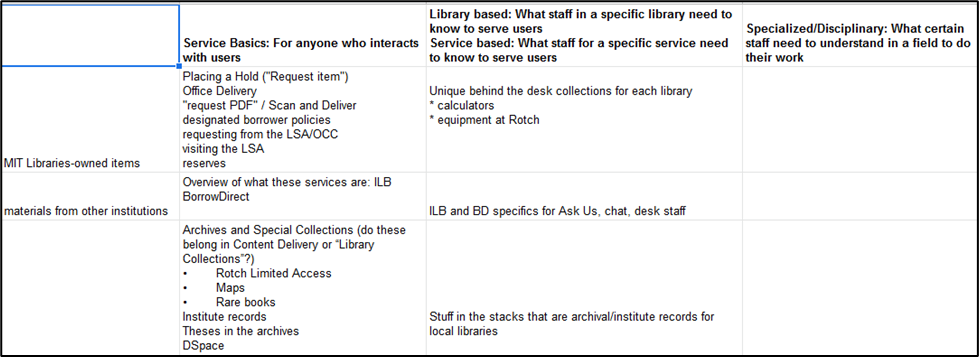 The project team added a wellness category (see Figure 4) as the library hosts weekly meditation sessions at the engineering library. The library also has a wellness guide that highlights the library’s wellness resources.
Figure 4: Wellness Category
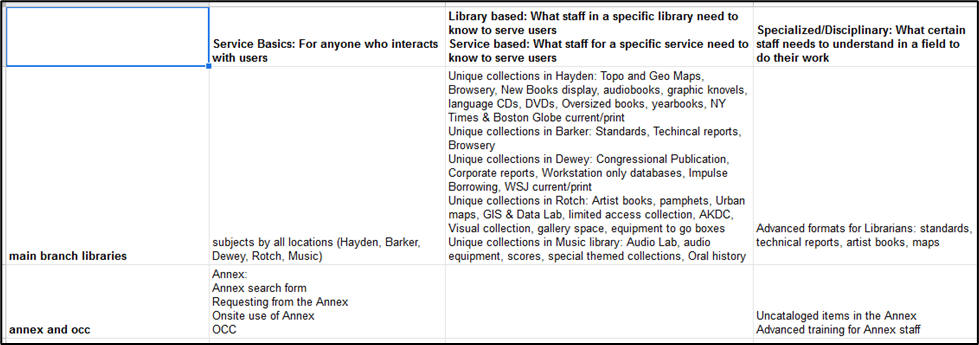
 The library collections category (see Figure 5) was separated into “main branch libraries” and “annex and OCC” (the library storage annex and off campus collections). Further down the spreadsheet (not shown) continues to be broken down by format and location. The library based category lists unique collections in the libraries.
Figure 5: Library Collections Category
When the project team revised the broad subject categories, the project manager met the eight stakeholder groups to review them, along with another team member as the note taker. Meeting with stakeholders informed the project team about recommended session topics that were added based on their suggestions.
Once the project team had identified the training sessions, they devised a schedule. With large sticky notes that had the 12 months written on them and with training session titles written on pieces of paper, they matched sessions to months, taking into account particularly busy times of the academic year and avoiding filling months with too many sessions. Each month had no more than five sessions, although the scheduling was flexible based on the trainer’s schedule. While some sessions named an intended audience, sessions would be open for all staff to attend.
Figure 6 shows the training schedule for the year organized by category and by month. Each training level does not have a session every month, but each month has a session in one of the training levels. The training calendar is flexible so that if a trainer is not available in a certain month, the session can be rescheduled to another month depending on the number of sessions offered that month.
Figure 6: Annual Training Schedule

Incentives
Staff are encouraged to attend as many sessions as they can, conferring with their manager to determine which sessions would be most useful. To try to have more staff attend, the project team developed a passport booklet given to participants. Attendees got a “due date” stamp in their passport booklet after they attended or viewed an online training session. (After the library closed due to the COVID-19 pandemic, the honor system was used for asynchronous sessions.) Once a year, every staff member who attended two sessions in a fiscal year would get a $5 MIT gift card that can be used on campus and in area businesses. Some staff were motivated to attend as many sessions as they could regardless of incentives; others liked to get the stamps as a souvenir. Since pandemic-related budgetary limitations eliminated monetary incentive, a certification program is being developed for participants who complete a set of sessions which might be included in annual performance reviews.
Training Session Logistics
When the training program was announced to library staff in October 2019, the first two months of the training sessions were scheduled. The training sessions continue to be scheduled one to two months in advance, which allows enough time for trainers and attendees to plan ahead. Pre-COVID-19, the training sessions were held in person. They were live-streamed and recorded on request. After closing due to COVID-19, the training sessions moved to Zoom. The handouts, slides, recordings, and training schedule are available on an internal webpage. Reminders are sent when a training session is coming up so staff can register. Statistics on how many staff attend a training session are kept in order to evaluate the program.
Implementation and Self-assessment Plans
The training program includes an implementation plan and a self-assessment plan. The implementation plan spells out roles and responsibilities of relevant people, such as managers handling session logistics and trainers developing content and handouts aligned with the stated learning outcomes. Trainers are sent the implementation plan before scheduling a session so they understand their responsibilities.
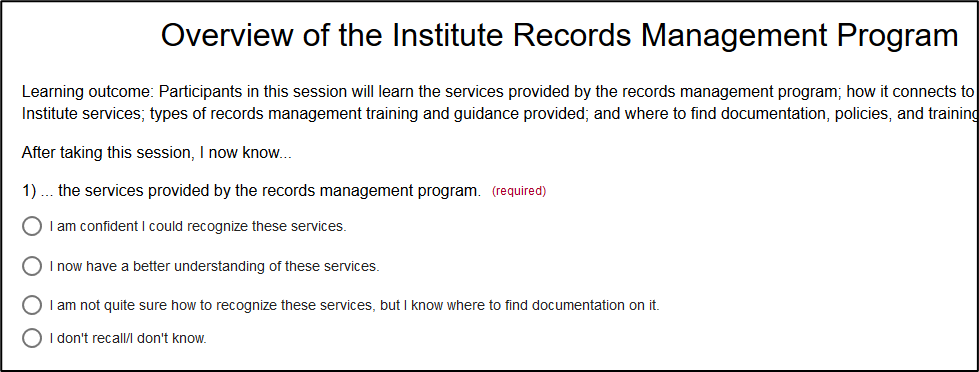
A brief and anonymous self-assessment template was created for staff who attended a session so they can reflect on their learning, and so that trainers can consider improvements for the future. The self-assessment has seven questions (five required multiple choice, two optional for comments). Questions include how much they know now versus before they attended the session, what they liked about the session, and what could have been done to improve their learning. Questions are based on learning outcomes and are adaptable to the content of the training sessions. Figure 7 shows an example of a self-assessment of a training session called Overview of the Institute Records Management Program.
Figure 7: Example of a Self-assessment
Future Work
The training program continues to evolve as more information is gathered from the self-assessments and feedback. The following are features to be worked on:
- Certification program: The training program included a monetary incentive for staff to attend the training sessions, but it is on hold due to budgetary limitations and COVID-19. Instead, a certification program will be developed for participants who complete a set of sessions to increase their knowledge.
- Include active learning: If appropriate for the topic, the author works with the trainers to develop a hands-on activity, such as a question to work on in a small group, to increase participants’ engagement. The small groups then return to the session to discuss each group’s strategies for determining the answer to the question.
- Continue gathering self-assessments: Self-assessments were sent starting in June 2020. As more results are received, they will be assessed to determine the success of participants’ learning.
- Identify new training needed: As new projects and workflows are identified, new training opportunities may arise. For example, MIT Libraries has a new patron data privacy policy. A training session about the new policy will be added so staff are aware of what it includes and how it affects their interactions with patrons.
Best Practices and Strategies
Best practices and strategies emerged from creating an information services training program framework. They include:
- Obtain support: If you have your manager’s support, they can advocate on your behalf. The project sponsor talked to administration about having a training program. She was able to convince them that a training program would benefit staff and our service to patrons. The more support you can obtain, the better. Be prepared with answers to potential questions. You might also gain more support if the training program is aligned to your library’s mission, vision, or strategic priorities.
- Identify key people involved: Who should be involved with creating a training program framework? Would it be your manager, public service staff, your department head, administration, or someone else? Whoever it may be, let them know your idea for a staff training program, and how it will benefit staff and patrons. You may have to write a proposal to get the process started.
- Have a project sponsor: Similar to identifying the key people involved, have a project sponsor for your project. In project management hierarchy, a project sponsor is above a project manager. The project sponsor is not involved with the day to day operations of a project, but they provide resources and support for the project. Project sponsors are usually the people who conceived the project and advocated for it.
As the author was the project manager and her manager the project sponsor, the project sponsor talked to administration about the project and sought approval. She did not attend team meetings, except for the first one when the project was introduced. After that, the project manager updated the project sponsor after each team meeting, whether it was by email, at one on one meetings, or when copied on emails to the project team
- Have a regular team meeting schedule: When you can move forward with the training program framework and you have a project team, have a regular meeting schedule to keep the project moving forward. The project team met every two weeks and notified members when meeting notes were posted.
- Name different training levels: You may have someone who has worked in your library for ten years, and someone else who has worked in your library for only one year. Depending on the session topic, an introductory session may be appropriate for the one-year staff member. Likewise, an advanced session may be appropriate for the 10-year staff member. Offering different training levels meets staff’s experience and knowledge.
- Start general, then be specific: Categorizing the services broadly helped the project team when they were determining what sessions to have. For example, for the research services category, the project team thought about introductory research services such as data management help and GIS help. Something more specialized would be search tips and adding items to the DSpace@MIT repository. Also in the research services category are research services by subject discipline. For example, for business resources in the library/service based training level has a collection overview (print and electronic) in the business library, including unique formats, such case studies from Harvard Business School. In the specialized/disciplinary level are patent resources for science and engineering librarians and business librarians. Thinking broadly will help you be specific.
- Write an implementation plan: List the roles and responsibilities of relevant people. How do you ensure the people involved know what they need to do? By putting the implementation plan in writing, the project manager was able to articulate responsibilities for the reference services program manager, the trainers, the managers, and stakeholders.
- Include self-assessments: Create a self-assessment template to determine what you want to know from participants after attending a session. Giving a self-assessment to participants after they attended a session informs the organizers and trainers what participants learned and what can be improved in future sessions. It can be brief and anonymous so participants can be comfortable completing it. Examples of survey forms include Springshare’s LibWizard, Google Forms, LibQual, and Survey Monkey. These companies may have a free version or your library may have an institutional subscription.
- You don’t know what you don’t know: When thinking about possible training sessions, it is okay if you don’t know what every department in your library does. That is why you meet with the department stakeholders so they can fill in the gaps. For example, the project team did not know what sessions the archives and special collections wanted, but they did the best they could with the suggestions they came up with. Meeting with the archives and special collections stakeholders provided they wanted staff to learn.
Conclusion
Learning and remembering the resources and services available in your library does not have to be challenging if you have a training program that is systematic, comprehensive, and ongoing. A training program should provide staff with the knowledge, skills, and tools to support patrons so they can understand services and resources, and to be confident when responding to patrons.
This project was a collaborative effort among the project team, project sponsor, and stakeholders. Although the project is complete and a training program is underway, it continues to evolve. The work involved was worth the effort to support all staff with the knowledge, skills, and tools to serve patrons in-person and remotely.
Acknowledgements
The author thanks the project sponsor, project team, stakeholders, and administration for their support with this project.
References
MIT Libraries. (n.d.). Strategic priorities. https://libraries.mit.edu/about/vision/strategic-priorities/
MIT Libraries (2020, November 30). The MIT Libraries has a new Patron Data Privacy Policy. https://libraries.mit.edu/news/libraries-patron-privacy/31491/