Janice Grover
Carol J. McMurry Distinguished Librarian for Academic Excellence
University of Wyoming Libraries
At the University of Wyoming, the Zine Collective meets in the basement of the Honors College, a large old house on the edge of campus. Over time, the basement has become our space. Three round tables are pushed together and covered with glue sticks, scissors, old magazines, scraps of paper, and half-finished zines. The Honors Library interns usually get there first to spread everything out while people wander in carrying backpacks, water bottles, and random ephemera they found somewhere and wanted to share. I usually walk in carrying dinner, either local takeout, or the cheapest pizza we can afford depending on how many people are expected to show.
Conversation is a cacophony of folks discussing their classes and exams, relationships, creative projects, and everything in between. Everyone is there because they’re into zines, and that shared interest gives our relationships a starting place that doesn’t feel forced or performative. Students aren’t waiting for an instructor to begin, and I am not waiting for everyone to find a spot and settle in so I can get through my lesson plan. In fact, there’s very little structure at all. We are just letting the night unfold based on what we’re thinking and feeling at any given meeting. At most Zine Collective meetings, nothing has to be finished. We are making things together, chowing down, talking, laughing, and everyone in the room, myself included, feels a little more comfortable showing up as whole(r) versions of ourselves. Learning objectives never enter conversation, even though learning is happening constantly.
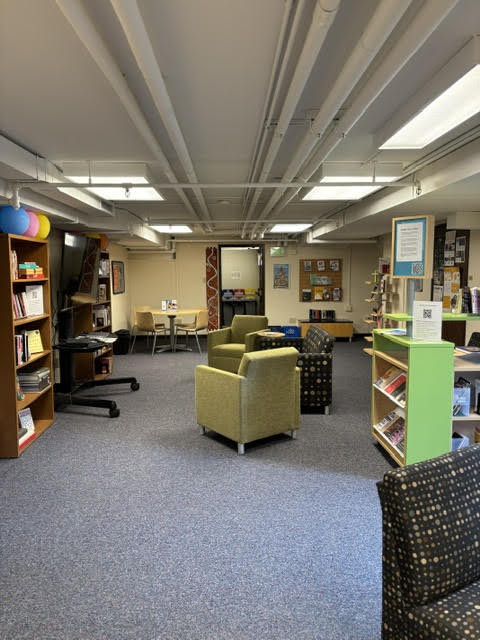
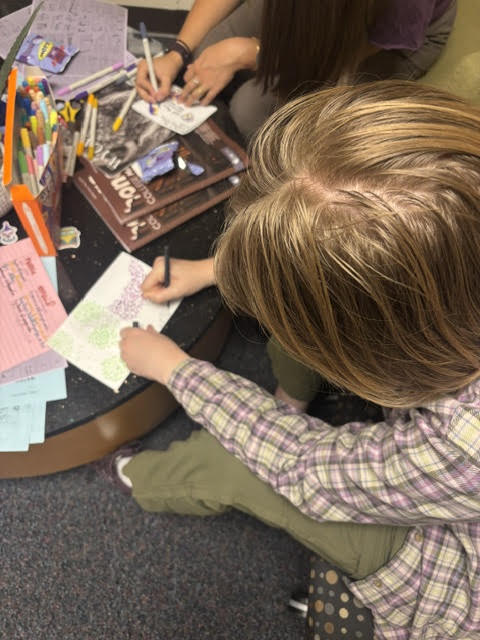 Building this kind of community took a lot of planning, and I approached it in stages. In the first year, the Honors Library internship was created, and together with the first intern, we transformed the main room of the Honors College basement into what we started calling the “Hidden Library.” We stocked it with zines and supplies, and we arranged furniture to encourage zine making and camaraderie. Rather than announce the Hidden Library with a formal opening, we wanted it to feel like a hideaway, something folks could discover, and a place to create information with their hands. The following year, the internship grew to two students, and together we planned house parties at the Honors College, nights with karaoke, tabletop games, and food, where a zine-making workshop was just one of the scheduled activities. We wanted the house parties to give students a chance to discover the Hidden Library and zines without any pressure. By the third year, with a new pair of interns, one returning and one new, we used the same house parties to formally launch the Zine Collective. Along with a scheduled zine workshop hosted by existing Collective members, we also put up posters and left information in the Hidden Library so students who were interested could find out when and where the Collective would meet for the semester.
 I didn’t initially think of this work as instruction. Much of library instruction happens through one-shot sessions, research consultations, tutorials, and course-integrated content, all designed with specific student learning needs in mind. Librarians collaborate with faculty and build sessions around learning outcomes. These are the staples of instruction librarianship, the tools most written about, taught, and relied on. They also come with real structural constraints. Librarians are tasked with doing several things at once in a short time period. We’re likely supporting an assignment or other important academic work, introducing unfamiliar tools and concepts, and we’re also trying to leave the door open for a student to reach out again. A single instructional exercise, even one designed to help students interact with each other, can create a moment of connection, but that isn’t the same as building a community. Community requires trust, familiarity, and shared ownership and purpose, and those rarely have time to truly develop in a single session or consultation.
The Collective offers something different from the standard instructional lineup, not a replacement, but another place where meaningful learning happens. People have to choose to show up, and then choose to come back, which means the food has to be there, the supplies have to be ready, and members have to be willing to stay on campus after the school day or the workday has already ended and hope the room fills up. Creating consistency without a lot of structure allows deeper relationships to form. Members bring their friends, introduce newcomers to zines and to one another, and there’s always someone willing to stay even later to help to clean up at the end of the night. The space feels like ours because it is.
All of that, the slow process of discovery, the space we settled into, the patience it took to gain momentum, wasn’t just about creating a place people wanted to be. It was also about creating the conditions for community-centered learning. Once those conditions existed, I started noticing the kinds of learning taking place. The more time I spent in that basement, the more I began to recognize elements of the ACRL Framework for Information Literacy for Higher Education in what we were doing together. None of this was designed around the Framework, and I would not claim a perfect fit, but I kept seeing pieces of it in the ways we made and shared zines and how we decided what went on the page. There was no lesson plan, but the learning was happening anyway.
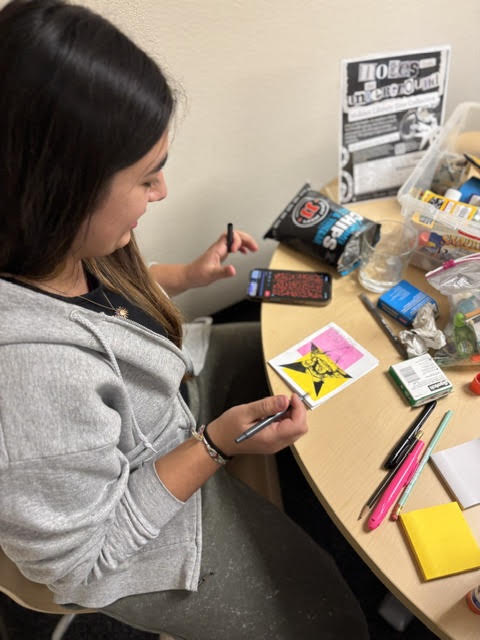
Here’s one example of how this played out. A student was putting together the title for the cover of our spring issue, the Collective’s own zine, and he was about to shorten the word “Hyperlocal” to “Hyperloca” to make it fit when another student, an art education major, leaned over and started talking with him about the design issue. They tried several solutions and finally, they adjusted the spacing until the full word fit. No one had assigned her that authority. She just had it, and everyone else in the room saw it too. This was Authority Is Constructed and Contextual playing out at the table. Her authority came from what she knew and could contribute in that moment, not from any formal role she had been given.
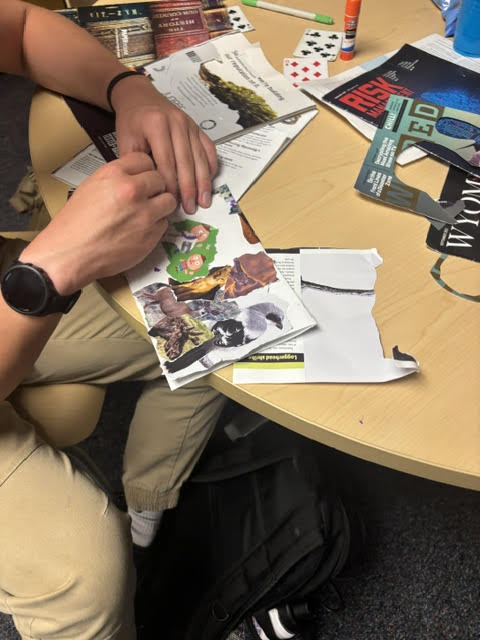
Authority wasn’t the only Frame our work aligned with. When we work on collaborative zines, we start with a shared prompt, but the process of responding to it requires a little trial and error. We arrange and rearrange images and words on our pages before committing ourselves to anything, often talking through our choices with whoever is sitting nearby. The reluctance to glue is real. One page of our zine took shape when a line about overconsumption was paired with images promoting homemade gifts. We moved that specific line, “It’s not too late to change the ways we all consume” from spot to spot as we considered where it would have the most impact. Sitting with an unfinished zine, repositioning text, and reconsidering it in conversation with others is part of Information Creation as a Process, and it’s happening right next to our egg rolls and combination lo mein.
So far, most of our zines have been visual, more collages than text, with a few clipped words or a single line lifted and remixed into something new. In our first issue, organized around the prompt, “call to action”, one page was the exception. A student quoted the ACLU’s “know your rights” language directly and credited the organization on the page. On other pages, we might use only a word or two or pull a phrase from its original context and give it an entirely different meaning. Deciding when something needs to be attributed and when it has been transformed into something new is part of this creative practice we talk about the most as we work. The Frame Information Has Value is partly concerned with the ethics of crediting the work of others. Without ever putting it in those terms, we were already asking those questions and engaging in those discussions.
Usual means of assessing or documenting instruction don’t necessarily capture this kind of learning. A one-shot has attendance counts and maybe a follow-up survey or minute paper, but the learning I’ve described happening at the Zine Collective has been easier for me to see in retrospect. I wasn’t assessing what was happening in each meeting, or looking for evidence of the Framework. It was only after working together over time, as these moments accumulated, that I began to realize what was happening. Collective members were recognizing one another’s expertise, working through decisions together, and taking ownership of the space and the work happening there. This kind of community-centered learning may be harder to document, but it is no less important to recognize as part of our instructional work.
The relationships that make this kind of learning possible don’t stay in the Collective, they enter formal instruction too. For example, Collective members occasionally turn up in my one-shot sessions, and their presence can change the dynamic of that class. When I ask a question and no one answers, a Collective member usually speaks up. They know me, I know them, and we aren’t starting that instructional experience as strangers. My community members don’t want to see me struggle, so they tend to jump in when the rest of the class hesitates to engage, and the other students typically follow suit. In Collective meetings, quick reference questions also get asked across a worktable, and projects get talked through informally before they ever become consultation requests through our ticketing system. The community doesn’t replace any of that formal instructional infrastructure, but it changes the relationships we bring to it, and those relationships have influence beyond what occurs in our meetings.
These relationships have also extended beyond the Collective, UW Libraries, and the Honors College, the entities that technically oversee the Hidden Library and the Zine Collective. Through my involvement with zines on campus, I was invited to join a community organization, the Laramie Zine Fest planning board. Through the relationships I built there, and in conjunction with my role as the Fine and Performing Arts liaison librarian, I was invited to help facilitate a zine-making workshop by a member of the art faculty. When I arrived at the visual arts building, everything was already set up, and other art faculty, students, and community members were there. I brought a large selection of zines from the Hidden Library to share, and I spoke about why zines matter to libraries, how they represent voices and perspectives that don’t always make it into traditional library collections. Then, I stepped back as the faculty member who had invited me to co-host led the workshop. She had made far more zines than I had, and the supplies and techniques she introduced were ones I hadn’t encountered before. I learned more than I contributed, and that experience led back to my work at UW Libraries. Shortly after the workshop, one of the faculty members who had also attended submitted a formal instruction request to have me guest lecture on zines in her class. A different faculty member reached out to ask if I could walk her through the Hidden Library collection so she could host a section of her summer American Studies class there, ultimately bringing an entire class into both the Hidden Library and the Honors College.
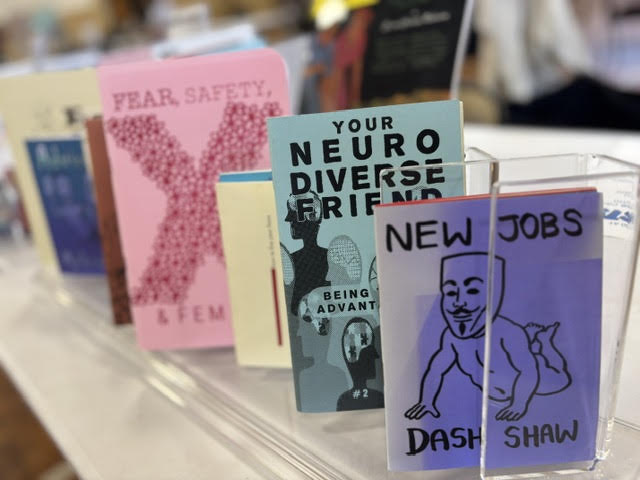 This is not the first time I have watched a library-led group grow into a broader community. Earlier in my career as a youth services librarian, I hosted poetry slams through the public library for several years. Most of the participants were high school students and first-year college students, though people of all ages showed up. They came back, month after month, because they were really into poetry, into performing, into hearing what each other could come up with. As the poetry slam scene grew, a library in the same county library system modeled a similar program after it. Then, in response to the interest the public libraries were experiencing, the community college added a three-credit performance poetry course to their course catalog that semester. Some of the students who had been participating in the library’s poetry slams and similar events enrolled in the college course and eventually competed in the National Collegiate Poetry Slam that year. The public library foundation helped fund travel for the students on the slam team after I submitted a proposal explaining how the team had grown out of the library’s programming. The setting was different, but the patterns feel familiar. People kept showing up because they cared about poetry, and eventually, the relationships and learning happening there spilled into other libraries and the community college. One Zine Collective member, another art education student who is preparing to student teach next year, is already talking about starting a zine collective at the school where she’ll be teaching. I never expected the Collective to expand in that way. But, I’ve seen before what can happen when people care enough about a community to become invested in its persistence.
The Hidden Library looks nothing like a classroom. There is no syllabus, no learning outcomes, and no attendance sheet. Some nights, the conversation never touches research at all, but information literacy gets practiced there anyway, as members recognize one another’s expertise and authority, make choices about how information is created, and work through questions about using and crediting the work of others. The community that forms around creative practice connects people to the library in ways that extend beyond any single session or service. When libraries treat communities like this one as part of our instructional mission, we recognize that relationships themselves create opportunities for learning. Community is the curriculum.
Photos were provided by the author.