Michael Kirby
Julia Furay
Robert J. Kibbee Library
Kingsborough Community College
The City University of New York
Abstract
Given the existing research on reading for pleasure and its benefits, many academic libraries have begun to bolster their offerings by purchasing leisure materials for students. At CUNY Kingsborough Community College Library, we have created five separate browsing collections, each focusing on a particular subcategory: LGBTQ, juvenile, Holocaust, new books, and general leisure. What may sound like overkill is actually a targeted endeavor to make our collection more accessible to our users while minimizing shelving confusion for circulation staff. Equally important is highlighting diverse perspectives in a national environment that is increasingly hostile towards minority groups and intellectual freedom. If students are unable to locate materials that challenge overtly politicized narratives, how can we expect them to be well-informed? This article will include a discussion of browsing behavior in academic libraries and the pitfalls and benefits of creating these leisure collections.
Our Genres
We are in the midst of what many are calling a reading crisis. This holds true even when taking into consideration the social stratum of a given individual; elite college students enrolled in English literature courses are, by and large, no longer able to read what has been assigned by their professors, and they almost never read for pleasure (Horowich, 2024). This has only been exacerbated by the rampant use of AI on college campuses. As an article in New York Magazine puts it, “[m]assive numbers of students are going to emerge from university with degrees, and into the workforce, who are essentially illiterate” (Walsh, 2025, para. 9). And to add further insult to injury, librarians—who find themselves in a hostile political environment—are incentivized to provide reading materials that steer clear of any “controversial” topics (Gold, 2024). The result, if we are to follow these directives, would be a dull reinforcement of the status quo. What is the most boring in terms of subject matter is often the least threatening to the queerphobic, sexist, and ableist discourses that continue to hold an inordinate amount of sway within society.
It remains uncontested, however, that reading for pleasure provides a net positive for students. It improves reading comprehension, vocabulary, and grammar (Clark & Rumbold, 2006; Kashen, 1993). It leads to improvements in mental health and overall well-being (Levine et al., 2020). It even provides an increased sense of belonging within the larger college community, leveraging the already centralized location of the library to bring together students who are increasingly siloed within academic departments (Camargo-Rojas, 2024). Reading for pleasure faces various obstacles, one of the most egregious being the continued use (within academic contexts at least) of LC [Library of Congress] call numbers, which do not lend themselves to browsability (Dalton, 2013; Murphy, Long, & MacDonald, 2013).
With this research in mind, the Kingsborough Community College Library set out to create a browsing collection of leisure books. As time passed, the single browsing collection was joined by four more: LGBTQ, Juvenile, Holocaust, and new books. All five collections are housed on the main floor of the library, ensuring maximum visibility. We chose to implement new classification schemes, ultimately moving towards more user-friendly systems such as BISAC [Book Industry Standards and Communications]. This was mostly informed by BISAC’s successful implementation in various public library systems (Fister, 2010).
As this case study was originally shared at the LACUNY Institute 2025, we have opted to faithfully reproduce the innovative formatting we used during the presentation. And in the spirit of expanding beyond the stale conventions of library science, we have replaced the headings commonly employed within the field (“Literature Review,” “Results,” Conclusion,” etc.) with our own punny inventions: “Popular Science,” “Tell-All Biographies,” “Cozy Mysteries,” “Graphic Novels,” and “The Unfinished Series.” A summarization of the different sections can be found below:
- Popular science: What existing research says about recreational reading in the college community, and BISAC (Book Industry Standards and Communications) organizational scheme in libraries.
- The cozy mystery: The problems we needed to solve in creating the collections
- The tell-all biography: We “tell all” about why we created five separate browsing collections on the main floor of the Kingsborough Library.
- The graphic novel: How we used signage, spacing and stickers to make each collection more visible.
- The unfinished series: Issues we are still tackling.
- Self-help: Our best advice on what to consider in creating a browsing collection.
Popular Science; or Literature Review
This literature review (of sorts) is primarily concerned with outlining the substantial benefits of reading for pleasure that have already been widely documented within the literature—the “popular science” alluded to in the subsection heading. Additionally, we will discuss literature on leisure collection organization and possible alternatives for the academic library. For clarity’s sake, it has been divided into four separate areas of focus: “Academic Benefits,” “Mental Health Benefits,” “College Community Benefits,” and “Organizing Browsing Collections.”
Academic Benefits
The academic benefits of reading for pleasure are not only substantial, but well chronicled. It helps develop the vocabulary of students while increasing their grammar fluency (Clark & Rumbold, 2006; Kashen, 1993). Whitten, Labby, & Sullivan (2016) have observed that it improves reading comprehension across the board. Some studies suggest that it is even more successful than rote learning methods (Krashen, 1985; Seashore & Eckerson). As Krashen (1999) notes, what he calls “free reading” is “far preferable to thirty minutes of drill” (454). Perhaps most significantly reading for pleasure fosters an environment in which students are encouraged to engage with books in a non-confrontational way. Detached from an opaque grading system, reading becomes more approachable for students who may have previously—in the context of a college classroom—lacked the confidence to try something unfamiliar to them (Duncan, 2010; Gilbert & Fister, 2011).
Mental Health Benefits
Both the popular press and academic literature have commented on the increasing prevalence of mental health issues among college and university students (Emmerton, Camilleri, & Sammut, 2024; Kisner, 2024; Zarowski, Giokaris, & Green, 2024). An article in Inside Higher Ed (2024) perhaps puts it most succinctly: “[a] report from the U.S. Government Accountability Office found the number of postsecondary students with depression increased 226 percent from 2004 to 2020 (para. 20)” And while it obviously must be accompanied by several other strategies as part and parcel of a more comprehensive approach, research shows that reading for pleasure does contribute positively to mental health. For example, Levine et al. (2020) maintain that it “was associated with decreased anxiety and depressive symptoms over the school year, when controlling for baseline anxiety and depressive symptoms” (161). Liu (2024) had similar findings.
College Community Benefits
Less substantiated by the literature but nonetheless worthwhile is the positive effect leisure reading can have on fostering a sense of belonging within the greater college community. As asserted by Camargo-Rojas (2024),
academic libraries are generally considered to be an ideal location for bringing the university community together to engage in recreational reading through dialogue and reflection on the emotional connection with the text in activities, moments, and spaces designated for voluntary reading. (5)
As is often noted, students have increasingly been siloed into ever more specialized academic departments (Armstrong & Stahl, 2017; Friedman, 2018). Outside of a few introductory classes they have to take in order to complete their degree, they might have relatively few interactions with other students outside of their disciplines. It is with this in mind that we first proposed the creation of these browsing collections; not only would they help to actualize some of the positive benefits of reading for pleasure within our community, but they might also help foster a greater sense of belonging by acting as a “third space”—one that is neither the home nor the classroom. This is particularly urgent in commuter schools such as Kingsborough, where this lack of a community is felt most severely (Kirk, 2012).
Organizing Browsing Collections
It’s easy to point out the metrics that support the implementation of browsing collections, even in the context of an academic library, but it is much more difficult to create said browsing collections. One of the main obstacles we found in getting this project off the ground was choosing a classification system that would best serve the needs of our diverse community. Although we will go into more depth about this part of the decision-making process in later sections of this article, suffice it to say here, we found ourselves interested in implementing a bookstore-inspired design for these collections, with corresponding signage and displays. Most relevant to this discussion, we also opted to organize the shelves with a system inspired by BISAC (Book Industry Standards and Communications), a commercial system created and maintained by the Book Industry Study Group.
As is familiar to anyone working within an academic library, the LC classification system comes with a whole host of issues in terms of its browsability (Dalton, 2013; Murphy, Long, & MacDonald, 2013). BISAC, on the other hand, is given much more favorable ratings in this regard (Bateman, 2013; Beezley, 2019). Its main features (at least as far as it concerns shelf organization) would be familiar to anyone who frequents bookstores: titles are split into major subject headings (fiction, art, self-help, travel), each with a three-digit code. Books are then subdivided into more specific subdivisions or genres (romance, science fiction, mystery, etc.), with another three-digit code. Further subdivisions are given a third code. For example, according to the BISAC website, Fiction/Mystery & Detective/Collections and Anthologies would be assigned the code FIC022050, then shelved alphabetically by author (BISG, n.d.). BISAC has some limited success in public libraries who have sought to replace the Dewey Decimal System (Fister, 2010). However, some have criticized public library reliance on a commercial standard, given the differing missions of a library and a bookstore (Martínez-Ávila and Kipp, 2014). Salaba and Chan (2023) report that some public libraries who had experimented with BISAC have since abandoned the project. The scholarship on organization of browsing collections in academic libraries (including BISAC) is less fleshed out. This is one of the gaps that this article seeks to fill.
Cozy Mysteries
One of the writers of this article had previously worked at the New York Public Library, where bookstore-inspired call number schemes are somewhat common, especially as it regards fiction. For example, romance novels were shelved in a single location with descriptive signage. They found this not only exceedingly easy to browse (from the perspective of the patron), but also incredibly intuitive from the perspective of circulation staff; shelving books was always easy, and the time it took for newly trained staff to catch on was marginal. With this information in mind, it seemed worthwhile to pursue our own BISAC-inspired call number scheme.
There was also important context to consider with Kingsborough Community College and its library. We have, to put it plainly, a less-than-ideal building structure. Our building, dating from the 1970s, seems stuck in that era. Stacks are spread across four floors, leaky ceilings abound, and students often lose their way. We do have some advantages, however, on the main floor of the library. Positives include attractive ocean views, plenty of natural sunlight, and ample variation in ceiling heights making for lots of pockets in which to put browsing collections. Most importantly, the main floor is enormous. And because this space is the first area of the library that students encounter (it houses the reference desk, the circulation desk, tutoring services, and more), students could easily be pointed in the right direction if they asked for, say, romance books or manga. Finally, we have spent years attempting to “right-size” the print reference collection housed on this level, removing old resources and clearing out many shelves. Deciding where to house these browsing locations, in other words, was an easy decision.
Before beginning the process, we were thus left with three major questions (or mysteries):
- How should we organize the collections?
- How do we avoid reshelving confusion?
- How do we incorporate these processing changes into our book ordering workflow?
We have done our best to solve these mysteries and will describe our approach throughout the following sections.
Tell-All Biographies
Our library, like those at most academic institutions, has had “leisure” material—popular works of fiction and nonfiction—in our stacks since the inception of the college. This holds true for some of the other types of books which might be considered natural fits for browsing collections. We collect a large number of juvenile materials, for example, primarily because of the well-attended education programs on campus. A substantial issue, however, was getting these books into the hands of readers. Anecdotally, many of our students have trouble finding the stacks, subdivided as they are across multiple floors, but they all know the location of the main floor circulation and reference desks. The following section functions as a “tell-all” biography, covering both the good and the bad of how we set up our browsing collections.
LEISURE: Working with (very) limited space
Our leisure collection began inauspiciously: a few dozen books casually collected by librarians in their building laundry rooms or in used bookstores. It was the first of our browsing collections, an unfunded endeavor intended to make our library feel a little more open and friendly. In comparison with leisure offerings at other CUNY community colleges, though, it was something of an embarrassment. We did make an effort to purchase bestselling genre fiction (such as Stephen King or Tana French), but these purchased titles were located up in the stacks.
In 2021, under new library leadership, we started a subscription to a rotating leisure collection and moved the books to a showcase location in the library. Suddenly we had many more books, and a wonderful place to highlight them. Given the physical realities of the space we selected, there was (and is) no current possibility for expansion in the immediate vicinity. (On the other hand, there is certainly space elsewhere on the main floor, as we will discuss in the context of later collections.) We knew that we would be confronted with the space issue nearly immediately after building the collection. Therefore, we elected to use the following approach to organizing and maintaining the leisure collection.
- Little separation by genre. As discussed in the literature review, we were very interested in incorporating elements of BISAC organization, but you need space to do that (i.e., a separate shelf or area for mysteries, romances, self-help, and so on). Given our constraints, it made the most sense to shelve these leisure books alphabetically by the author.
- Very robust turnover. If we fail to weed the collection every month or two, the circulation staff informs us that they can’t shelve returns until we remove books. We have set up a report that provides circulation staff with a list of titles that are over two years old with no loans. This keeps the collection very dynamic and responsive to user preferences.
- Endeavoring into subcollections. At the reference desk, we are most frequently asked about graphic novels and manga. Eventually we made the decision to give these books their own special (albeit less prominent) area, allowing these genres room to grow. They are now located 20 yards from the rest of the leisure collection, and the subcollections are indicated by GRAPHIC and MANGA both in the catalog and on their spine labels. This gives us a specific direction to point to when students are looking for these works. As a note, the term “sublocation” refers informally to the area printed on the book’s spine label, and not a specific subcollection in our LMS [Library Management System] Alma.
- What goes in the stacks stays in the stacks. For the most part, books originally allocated to the stacks (those mystery and thriller books we had been buying for many years) were not shifted to the leisure collection location. There were two main reasons for that: first, we didn’t have enough space, and second, we wanted to keep the collection fresh with recent titles. Additionally, on some occasions (if a book proved to be a literary award winner, for example) we might move a book from the leisure collection to the stacks for posterity.
The upshot: The rotating leisure collection has been extremely successful in terms of providing popular titles to our users, though it can be challenging for students to browse for a particular genre that interests them. We try to serve students looking for something specific (such as historical romance titles featuring black characters) by creating canned searches and linking them to a LibGuide, and by creating groups of similar genres using the featured collection functionality in our web catalog.
JUVENILE: Moving an entire collection from the stacks
Prior to beginning the project, all of the juvenile materials (picture books, picture biographies, young adult literature) were housed in the stacks. Most of the juvenile fiction and picture books, classified under PZ in the Library of Congress system, were of course shelved together. Biographies and other nonfiction, however, were scattered throughout the stacks according to their subject area. It felt as though we were hiding the children’s books in a sea of scholarly tomes rather than helping students find them. When students asked for children’s books on subjects like farm animals, they might have previously been in PZ or SF (two separate floors in our library).
Furthermore, given that children’s fiction is mostly found in the PZ3 to PZ8 range in the LC classification, the call numbers tended to be unnecessarily long and confusing to our staff. And children aren’t generally concerned with shelf organization—meaning the shelves were something of a disaster.
After weeding a number of reference titles which overlapped with electronic holdings, we had even more space available on the main floor of the library to create a student-friendly children’s collection in a prominent place. Because this was one of the first collections we worked on, we were not exactly sure how best to organize them to maximize user friendliness and minimize shelving confusion. We decided to build our children’s collection into three general areas: fiction, nonfiction, and biography. We also considered separating picture books from chapter books, and if we were to do the project over again, we would probably do so. At the time, however, fewer sublocations seemed to be the better choice.
Regarding nonfiction, we felt that sorting the titles by subject was preferable to a simple alphabetization by author, and if we were sorting into categories, it seemed to make sense to use the classification system already in place. LC Classification was useful for this collection, because juvenile nonfiction might be on a wide range of subjects (as opposed to some of our more specialized browsing collections focusing on a few specific subject areas). Therefore, books within the juvenile nonfiction section still have LC call numbers on them, albeit with the new prefix JUV on each spine label. The project also allowed us an excellent opportunity to weed old children’s nonfiction titles with inaccurate or outdated information. Only titles we determined to have some value were shifted.
The upshot: Moving the children’s book collections to a more prominent place in the library has skyrocketed the popularity of the collection. Furthermore, bringing an aging collection to the main floor has jumpstarted efforts to update it more regularly.
NEW: A temporary collection for recent print acquisitions
Our library, like many other public and academic libraries, has always had what is called a “new book section,” where titles purchased within the last couple of months are showcased near our circulation desk. Our original solution was more of a display (with covers facing out) than a shelving system. We could do this because our library has long believed in paying vendors to process our books (in other words, we keep the dust jackets in plastic covers). The approach to displaying our new titles was casual and haphazard: every week or two we would clear the new bookshelves and add some new titles to show off. It was an attractive solution in some ways: each new book was displayed prominently for a time. We found that this system had various issues, however: The titles were never marked as “new” in the catalog, which meant that circulation staff often had difficulty finding the titles if users requested them. And there was no rhyme or reason to how long they would be on display. In a month when we would get hundreds of new titles, the books might be on display for a few days. Or if we weren’t ordering books at that time, they’d be up for months.
To address these problems, we elected to create what is called a “temporary location” in our LMS quite naturally called “NEW.” Whenever books arrive from the vendor, cataloging staff scan them into this location and then set an automatic date for when the titles can be reverted to their permanent location, such as STACK or JUV. Circulation is notified of this reversion when the item appears in the “pick from shelf list.” We settled on a timeframe of about a month for this entire procedure (i.e. the books stay in the new book section for a month), although depending on the number of books a given library purchases in a year, a different amount of time might be more appropriate. It’s important to note, however, that in our LMS (Alma) all of the books keep the call number contained in the holdings record (JUV FIC author, LEIS author, etc.); placing an item in a temporary location does not override its call number. Thus, the books are further subdivided into sections within the NEW location based on the call number formats we configured for each permanent location. We also figured out quickly that in Alma, placing an item in a temporary location overrides its existing lending policies. So, though our stacks titles would default to a 16-week loan period, placing them in the NEW location temporarily would change the default loan period to four weeks.
The upshot: Creating this collection standardized a previously haphazard workflow and made it much easier for users and staff to find new books.
LGBTQ: A subject-specific collection with browsing in mind
Our LGBTQIA+ collection was created when a Kingsborough faculty member won a grant and elected to provide some of that funding to the library to bolster our LGBTQIA+ resources. Because the idea was to have a specific physical location for students to browse these resources, we opted to create a new location in our LMS.
Initially, our focus was to provide easy access to some of the more noteworthy academic titles focusing on LGBTQIA+ studies (whether or not they were already available in our stacks), as well as major works of literature. Since the initial concept was academic resources, we began with a straightforward shelving convention: LC classification. At the time, we did not include a LGBT prefix on the spine label.
If our goal was to get students to completely ignore the collection, this would have been an ideal solution. (In 2023 we had just 7 loans.) When the grant was renewed for 2024, we decided to rethink and reorganize the collection. Given that we had been collecting research on topics relating to LGBTQIA+ studies for many years in the stacks, we thought it appropriate to shift to a more approachable collection, one more focused on recreational reading than academic pursuits. We wanted students to be able to read mysteries, romances, or graphic novels that just happened to feature LGBTQIA+ characters or themes.
Furthermore, we wanted the collection to be far more browsable. LC classification for these subject areas mostly consisted of titles in the H (social sciences) and P (language and literature) classes. So, we divided the collection into several sublocations, including fiction, drama, poetry, fantasy, mystery, graphic novels, biographies, and nonfiction. We also elected to sort each sublocation by author (or subject, in the case of biographies).
There are other problems with this approach: not all novels fit into a precise genre, for example. Should a queer romantasy be shelved with the romance books or the fantasy books? Furthermore, the spine label conventions lack consistency with our other browsing collections (since, as noted, we do use LC call numbers for juvenile nonfiction). Despite these issues, circulation statistics for this collection have grown substantially, and it certainly has the look of a welcoming, browsable collection, which was our initial goal. Sorting into genre also has the benefit of visually demonstrating the areas where we need to add more titles. The drama subsection, for example, had fewer than ten books to begin with, which we did not notice until we separated by genre. Suddenly it looked embarrassing in the context of our other, much more populated subsections. We knew we needed to fill the gap and did so.
The upshot: As the most fully realized example of browsability within our library, the LGBTQ collection acts as an important yardstick for all the other collections. Subdividing this collection by genre served users as well as librarians: users found the collection easy to browse, and librarians could see visually areas that needed bolstering.
HOLOCAUST: When purchasing books is an afterthought
If we were writing an article about what approach not to take in creating a browsing collection, this section would feature front and center. As it is, the Holocaust collection is the least successful of our browsing collections. Certainly, the subject matter is one less likely to inspire spontaneous loans. Our greatest problem, however, was a lack of institutional support in the creation of the collection.
The Kingsborough Holocaust Center, located on the main floor of the library, was funded during the pre-Covid era under different leadership. The center, which consists of display cases with artifacts, display monitors, photographs, and meeting spaces, was completed in 2024. Bookshelves were also installed to feature several Holocaust-related titles, but no funding was provided to purchase new books. Rather, we were instructed to take a professor’s personal collection and create a browsing collection from those titles.
It will not surprise any acquisitions librarians reading this article that the donations consisted mostly of older books in questionable condition. Many volumes were duplicates of what we already held in the stacks, as well. However, we were looking at many empty bookshelves, which made an otherwise attractive exhibit center look half-finished. The problem was the opposite of the one we faced with the leisure collection, in that we had too few books in a space that was too large. Our choices were therefore either to ransack the stacks collection (moving them to the Holocaust Center) or to use the donated books. We settled upon the latter approach. Given the aging nature of the collection, it was never going to be our most attractive browsing collection, but we did our best to make these books accessible.
The upshot: If you don’t have the funding to support a browsing collection, you have an uphill battle in making it successful. Even with limited intervention we conducted, we feel as if the collection is substantially more browsable and keeps the display from looking barren. Scholars working within genocide studies are more likely to find materials for their needs in the library stacks, but visitors to the exhibit can find a number of supportive texts about the subject matter.
Conclusion
Each of the collections we discussed in this section required different organizational strategies. The Holocaust and Juvenile collections, for example, were preexisting collections (one donated and one previously owned), and therefore came with a whole host of considerations outside of our direct control. The focus, in addition to creating a system of classification, was on centralizing the books for enhanced browsability. The leisure and LGBTQ books, in contrast, were typically books that we were able to purchase new. This meant that the focus was more on creating the ideal cataloging scheme from scratch. Coming up with a plan to centralize the books was unnecessary, as the collections would be centralized from the beginning. Moreover, there were important differences stemming from the origins of these collections that we felt were important to conserve for the sake of our patrons, i.e., we felt as if the audience for the LGBTQ fiction books would benefit from a more comprehensive classification scheme that accommodated the collection’s wide breadth in terms of subject matter, while the audience for juvenile fiction would be best served by a classification scheme that was more simply oriented around the author’s last name. It quickly became clear, in other words, that a one-size-fits-all approach to BISAC-inspired classification was neither feasible nor desirable.
Graphic Novels
In this section, we delve into the graphic elements of our browsing collection. “Graphic elements,” as the term is used here, refers to everything from the way the bibliographic record for a particular item looks in the LMS to the signage we used to designate the different collections. In other words, we discuss the visuals of the project and how we used these visuals to answer some of our lingering “mysteries,” listed once again below:
- How should we organize the collections?
- How do we avoid reshelving confusion?
- How do we communicate all these specifications to our vendors?
A Note on Cataloging
A quick aside: we did not use BISAC subject headings on the spine labels of any of the items under consideration. This is to say, the cataloging process looked like this: MARC records (which often include both LC subject headings and BISAC subject headings) were pulled in from OCLC [the Online Computer Library Center], as is the case for all our stacks and reference titles. We then created custom holdings records for each item, with their own custom call numbers. Spine label information (such as location and call number) are pulled from the holdings record.The following image serves as an example of what the holding records within our LMS look like:
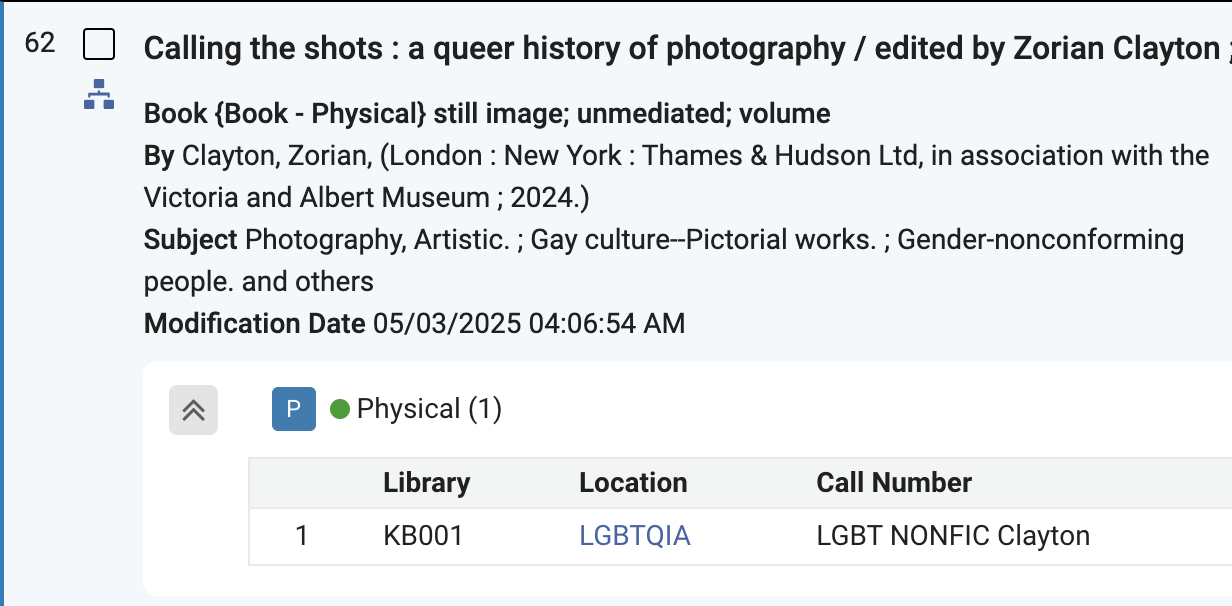
In traditional BISAC, the organization would have been based on the three-digit classification scheme discussed earlier in this article. It is in this sense that the project is more “BISAC-curious” than “BISAC-serious.”
We settled on the following call numbers for each browsing collection:
| Collection | Organization System | Rationale |
|---|---|---|
| LEIS | LEIS Author GRAPHIC Author MANGA Series Title TRAVEL Location | The first and simplest, because the space is so limited |
| NEW | LC Classification (mostly) | Same organization system as stacks titles |
| JUV | JUV Fic Author JUV Bio Subject JUV LC Class | Fiction and biographies are shelved alphabetically by author/subject, nonfic in LC classification |
| HOLO | HOLO FIC Author HOLO NONFIC Author | Browsability more important than research |
| LGBTQ | LGBT FIC Author LGBT Drama Author LGBT Poetry Author LGBT Fantasy Author LGBT Romance Author LGBT Graphic Author LGBT BIO Subject LGBT NONFIC Author | The (relatively) large space allowed us to create the closest ideal to our collection |
As one can see, there were numerous considerations we took into account when making a decision about which call numbers to use: availability in terms of space, whether or not browsability or research was the intended purpose of the collection, whether or not it made sense to keep LC classification in some instances, etc. The Holocaust Collection, for example, was too haphazardly thrown together to work as an effective research collection; we thereby settled on just two call number types, the better to maximize browsability. As previously mentioned, the LGBTQ collection was the pinnacle of this experiment, and we felt that it warranted the most complex and BISAC-inspired scheme. And because we had enough space to accommodate this, and we wanted to ensure that students found the exact types of books they wanted, we felt that a large number of genre divisions was both feasible and desirable.
How do we avoid reshelving confusion?
In terms of our LMS, we tried our best to use to our advantage Alma’s built-in capabilities. Call numbers are marked as “other” using the 8 first indicator in the holdings record. Sublocations are marked in the $$k field, known as the call number prefix and also found in the holdings record.
While these hyper-specific call numbers went a long way in helping circulation staff avoid confusion, what we found exceedingly helpful in differentiating separate collections was adding visual cues in the form of genre stickers. A bright pink sticker immediately identifies a book as belonging to the children’s literature section, for example.
Speaking of genre stickers: you can have too much of a good thing. Frankly, we have found them to be something of a mixed blessing. Our early work with leisure books convinced us that using too many (i.e., providing a sticker for every genre, from science fiction to memoirs) was unsustainable in terms of workload. And they quickly start to look sloppy. We instead found that merely using a juvenile sticker for JUV books and LGBTQ sticker for the LGBTQ books was sufficient for circulation staff and patrons.
The only section in which we might have found a use for a broad array of genre stickers was the LGBTQ collection. As already indicated, this collection had the most subsections, which could potentially have led to some confusion for circulation staff. Is such-and-such book a romance or a thriller? A thrilling romance? Besides the use of the hyper-specific call numbers, already mentioned, we found the best way around this problem was to use signage while also spreading out the collection to maximize the use of the space. In the end, the patron and circulation staff would be looking at something that very closely resembles a bookstore; everyone is familiar with the basic layout, where romance titles are on a distinct shelf and are further indicated by a poster that features some typical romantic signifiers (hearts, flowers, the color red). Signage like this, however, is less needed in collections where there are fewer call numbers.
How do we communicate all these specifications to our vendors?
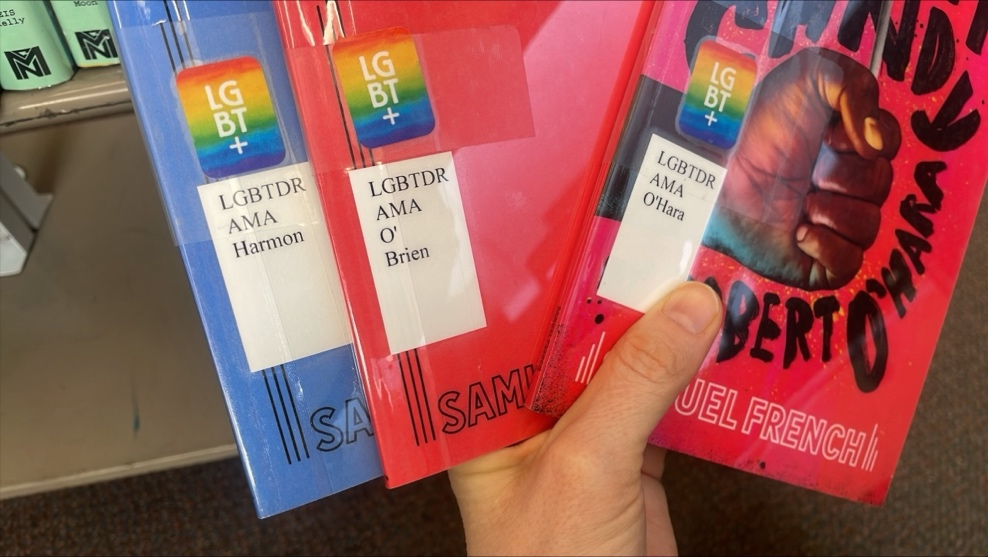
Kingsborough does not have the staffing capabilities to process books ourselves. Furthermore, we feel strongly about the advantages of attractive and sturdy book covers for both browsing collections and stacks titles. Therefore, we work with vendors to provide shelf-ready materials for our library. The last question we had to answer was how to communicate our many specifications to our vendors, who do the bulk of our processing (including spine labels). First, our subscription collection (LEIS books) does provide pre-processed materials, complete with spine labels. The leisure collection still has the simplest spine label conventions, and we have not needed to adjust them yet. However, the situation is very different for LGBT, JUV and HOLO collections, which all have specific and differing genre stickers and spine label conventions. ProQuest, our previous vendor, was able to process books using a pre-defined format for each location, which made it fairly easy to indicate which sections needed custom call numbers. Rialto, ProQuest’s marketplace within Alma, even allowed you to enter the custom call number yourself. Even when you can provide the custom call numbers yourself, the spine labels do not always turn out as desired, as pictured below:
 Given that ProQuest discontinued book sales in 2026, we have transitioned to GOBI, who also provides excellent processing services. GOBI requires separate subaccounts for each location, with individual instructions for each subaccount listed in our technical specifications document.
Unfinished Series
As is most likely clear from the “Tell-All Biographies” and “Graphic Novels” section, we have made many mistakes during the process of implementing our browsing collections. Perhaps the most glaring issue is that some collections need to be further subdivided. For example, the leisure section, which has only four groups (by author as well as TRAVEL, MANGA, and GRAPHIC), would ideally more closely reflect the schema used in the LGBTQ section. Once given the space, we plan to incorporate an organization system even more inspired by BISAC, because the general leisure collection will have more genre differentiation than the LGBTQ collection (for example, cookbooks and crafting books are more likely to be found in the general leisure section as opposed to LGBTQ).
Furthermore, we are less enthused with the stickers for the new books, which, by their very nature, are transient. Too often, circulation staff restoring the books to their permanent locations would forget to remove the temporary sticker. Additionally, without any information on arrival dates, it can be very confusing to determine when to remove the book from the NEW section in the first place. This has prompted us to reconsider the ways in which we use the NEW stickers: one of the peer reviewers for this article has helpfully suggested different color stickers for different months—a system we will be implementing in 2027.
There are also considerable issues in terms of spacing. When we began the project, we had what seemed like an unlimited amount of shelving for our modest purposes. As the collections have grown however, space has become a rarer commodity. Or to be precise, we struggle to find attractive shelving units we can repurpose for browsing collections. We may have many empty shelves in the reference collection, but the metal shelving units used for reference collections are immovable and unattractive. We need more shelves, and, just as importantly, areas in which we can place these shelves. This requires consideration, discussion, and funding that has yet to materialize. We may have to consider moving some collections as we continue to grow. On the other hand, we still have many opportunities for creativity and collaboration as we perennially work to make these collections useful to our user base.
Deciding on a scheme for call numbers continues to be a challenge. We have often decided on a scheme only to later regret our decision. This has led to a considerable amount of work when fixing said call numbers. Even in the cases where we have settled on a definite scheme, there are still longstanding issues. Most egregiously, vendor-generated spine labels often still have errors. Sometimes the call numbers are illegible, mushed together nonsense; other times the schemes we provided are entirely ignored. Our leisure subscription vendor declined to incorporate genres into their spine labels at all. And as many librarians across the country are sure to know, some major library vendors are no longer selling physical books beginning in 2026. Workload, once again, becomes a serious consideration: are we really capable of printing all of these custom spine labels ourselves?
These collections are entirely dependent on the existence of our funding sources: the grant we received from an LGBTQ organization as well as the money our institution is allocated from city and state budgets. Will these continue to exist at similar levels in the future? It is our wish that this article provides substantial enough reasoning for why this funding is critically important for not only us, but for academic libraries across the country. We hope more academic libraries may come to recognize the importance of leisure reading and subsequently decide to create browsing collections of their own. Our profession faces various political and cultural headwinds—right-wing political movements, rampant AI usage—but as we hope this article proves, academic librarians are still able, with a little innovation, to foster an environment in which reading for pleasure can continue to exist.
Self-Help
Our experiences, though not always successful, have taught us a number of lessons in the creation and maintenance of browsing collections in academic libraries. These are insights that may come as no surprise to public librarians but may be useful to academic librarians with little experience in these areas.
To begin with, we have found that these collections are by their nature far more temporary than the typical stacks books we purchase. Moving any book from stacks to one of our browsing collections means that the title goes from a long-term possession to a short-term one. The most obvious reason for this is that unused materials should be discarded in a browsing collection, but additionally, these materials are more heavily used than most of our circulating collection and wear out more quickly. We have found it useful to be ruthless. In creating a browsing collection, we believe it’s essential to create a plan to weed titles on a frequent basis.
This relates to our second major lesson, which is that workload issues should be considered in the creation of these collections. We discussed the problems lack of institutional support caused in our Holocaust collection in terms of purchasing new titles. But the need for support goes deeper than that. Once the decision is made to create or reinvent a browsing collection, stakeholders must decide how the collection will be maintained in addition to who is going to physically set up the shelves. A few examples of some of the short- and long-term tasks we were surprised to encounter follow. As a note, we mostly found these tasks to be a pleasure but occasionally struggled to fit in these responsibilities with our other areas of academic librarianship.
- Who is setting up the shelves: When we moved the juvenile books, every title needed to be relabeled in the catalog and on the book itself. Furthermore, initial display setup and shelf labeling was also time-consuming.
- Who is selecting and buying: The book selector’s experience in selecting titles for student researchers doesn’t necessarily translate to finding the right books for a browsing collection. Selectors may need to become far more familiar with popular titles through book reviews, podcasts and bestseller lists. This may be a welcome challenge for many librarians but should be considered in the decision to set up a browsing collection.
- Who will keep it pretty: These collections get such frequent use that we have also needed to set up a regular inventory as well as plan for straightening the spines to keep the shelves looking attractive.
- Can you make changes without causing chaos and confusion? In cases where we tried to adapt organization systems after they had been initially set up, we regularly found the circulation staff to revert to the original organization system, despite having adjusted the labels according to new protocols. It’s best to decide on a plan and stick to it, but if changes are needed, proactive communication and frequent spot-checking may be necessary.
Finally, we encourage librarians to embrace the iterative process. In our presentation, we joked that the term iterative was merely a fancy way of saying we kept changing our minds. In truth, however, we adjusted organization, spine label conventions, and even physical locations based on a number of factors. These include direct feedback from users, staffing changes, streamlining workflows, circulation statistics, and the eye test. Overall, the project has been a delightful exercise in collaboration, creativity, and making the library an even more welcoming space for our users.
References
Armstrong, S. L., & Stahl, N. A. (2017). Communication across the silos and borders: The culture of reading in a community college. Journal of College Reading and Learning, 47(2), 99-122. https://doi.org/10.1080/10790195.2017.1286955
Bateman, S. (2013). Dewey or don’t we? Incite, 34(8), 16-17. https://search.informit.org/doi/abs/10.3316/informit.561488511909475?download=true
Beezley, S. A. (2019). Dare to be “Deweyless”: An evaluation of BISAC-based headings in public libraries [Master’s thesis]. Carolina Digital Repository. https://cdr.lib.unc.edu/concern/masters_papers/vh53x0438
BISG. (n.d.). Complete BISAC Subject Headings list. https://www.bisg.org/complete-bisac-subject-headings-list
Camargo-Rojas, L. (2024). Recreational reading promotion and academic libraries mission. A systematic review. Ocnos, 23(1). https://www.revistaocnos.com/index.php/ocnos/en/article/view/388/742
Clark, C., & Rumbold, K. (2006). Reading for pleasure: A research overview [White paper]. National Literacy Trust. https://eric.ed.gov/?id=ED496343
Dalton, M. (2013). Undergraduate students still experience difficulty interpreting Library of Congress call numbers. Evidenced Based Library and Information Practice, 8(4), 139–141. https://doi.org/10.18438/B8C32Z
Duncan, S. (2010). Understanding reading for pleasure for emerging adult readers [White paper]. National Research and Development Centre for Adult Literacy and Numeracy. http://discovery.ucl.ac.uk/id/eprint/10016527/
Emmerton, R. W., Camilleri, C., & Sammut, S. (2024). Continued deterioration in university student mental health: Inevitable decline or skirting around the deeper problems? Journal of Affective Disorders Reports, 15. https://doi.org/10.1016/j.jadr.2023.100691
Fister, B. (2010, May 20). The Dewey Dilemma. Library Journal. https://www.libraryjournal.com/story/the-dewey-dilemma
Friedman, H. H. (2018). How the creation of too many academic departments stifles creativity, encourages a silo mentality, and increases administrative bloat [Unpublished manuscript]. SSRN. http://dx.doi.org/10.2139/ssrn.3095370
Gallik, J. D. (1999). Do they read for pleasure? Recreational reading habits of college students. Journal of Adolescent & Adult Literacy, 42(6), 480-488. https://www.jstor.org/stable/40014062
Gauder, H., Giglierano, J., & Schramm, C. H. (2007). Porch reads: Encouraging recreational reading among college students. College & Undergraduate Libraries, 14(2), 1–24. https://doi.org/10.1300/J106v14n02_01
Gilbert, J., & Fister, B. (2011). Reading, risk, and reality: College students and reading for pleasure. College & Research Libraries, 72(5), 474-495. https://doi.org/10.5860/crl-148
Gold, J. (2024, December 12). As children’s book bans soar, sales are down and librarians are afraid. Even in California. Los Angeles Times. https://www.latimes.com/california/story/2024-12-12/book-bans-succeed-schools-libraries-buy-fewer-books-on-lgbtq-race#:~:text=Librarians%20say%20they%20are%20afraid,with%20race%20or%20LGBTQ%2B%20themes.
Horowitch, R. (2024, October 1). The elite college students who can’t read books. The Atlantic. https://www.theatlantic.com/magazine/archive/2024/11/the-elite-college-students-who-cant-read-books/679945/
Kirk, C. M., & Lewis, R. K. (2013). Sense of community on an urban, commuter campus. International Journal of Adolescence and Youth, 20(1), 48–60. https://doi.org/10.1080/02673843.2013.763833
Kisner, J. (2024, January 22). The unthinkable mental health crisis that shook a New England college. The New York Times. https://www.nytimes.com/2024/01/22/magazine/worcester-polytechnic-institute-suicides.html?unlocked_article_code=1.P00.4IAY.Qyp_y60lIT6Y&smid=url-share
Krashen, S. (1985). The input hypothesis: Issues and implications. New York: Longman.
Krashen, S. (1989). We acquire vocabulary and spelling by reading: Additional evidence for the input hypothesis. The Modern Language Journal, 73(4), 440-464. https://doi.org/10.1111/j.1540-4781.1989.tb05325.x
Krashen, S. (1993). The power of reading: Insights from the research. Englewood, CO: Libraries Unlimited.
Levine, S. L., Cherrier, S., Holding, A. C., & Koestner, R. (2020). For the love of reading: Recreational reading reduces psychological distress in college students and autonomous motivation is the key. Journal of American College Health, 70(1), 158–164. https://doi.org/10.1080/07448481.2020.1728280
Liu, Y. (2024). A study of the effects of four reading styles on college students’ mental health and quality of life based on positive psychology: A first-of-its-kind study. PLoS ONE, 19(8). https://doi.org/10.1371/journal.pone.0308475
Martínez-Ávila, D., San Segundo, R., & Olson, H. A. (2014). The use of BISAC in libraries as new cases of reader-interest classifications. Cataloging & Classification Quarterly, 52(2), 137-155. https://doi.org/10.1080/01639374.2013.846284
Mowreader, A. (2024, August 19). Survey: Getting a grip on the student mental health crisis. Inside Higher Ed. https://www.insidehighered.com/news/student-success/health-wellness/2024/08/19/experts-weigh-college-student-mental-health-crisis
Murphy, J., Long, D., & MacDonald, J. B. (2013). Students’ understanding of the Library of Congress call number system. The Reference Librarian, 54(2), 103–117. https://doi.org/10.1080/02763877.2013.755418
Salaba, A., & Chan, L. M. (2023). Cataloging and classification: An introduction. Rowman & Littlefield Publishers.
Seashore R., & Eckerson, L. (1981). The measurement of individual differences in general English vocabularies. Journal of Educational Psychology, 31:14-38.
Walsh, J. D. (2025). Everyone is cheating their way through college. New York Magazine https://nymag.com/intelligencer/article/openai-chatgpt-ai-cheating-education-college-students-school.html
Whitten, C., Labby, S., & Sullivan, S. L. (2016). The impact of pleasure reading on academic success. The Journal of Multidisciplinary Graduate Research, 2(4), 48-64. https://jmgr-ojs-shsu.tdl.org/jmgr/article/view/11
Zarowski, B., Giokaris, D., & Green, O. (2024). Effects of the COVID-19 Pandemic on university students’ mental health: A literature review. Cureus 16(2). https://pubmed.ncbi.nlm.nih.gov/38348205/