Celia Hagey
Instruction and User Services Librarian
University of Idaho Library
Abstract
This article details an instructional academic librarian’s experience designing and teaching a mystery-themed information literacy workshop entitled “Mystery at the U of I Library.” The workshop is a form of game-based teaching known as a serious game. Serious games have been documented in scholarly writing since 1970 and implemented in educational settings ranging from elementary schools, high schools, and universities, using creative designs such as role-play games, card games, and video games. Educators in the fields of mathematics, science, and healthcare have published case studies on their use of mystery-based serious games, but representation of mystery-based games to teach information literacy is sparse. This article contributes insights on the value of creating a mystery-based information literacy workshop for undergraduate students at a mid-size public university, describing the author’s design process, experience teaching the workshop, and professional growth throughout the whole process. Other instructional librarians will find recommendations and advice for implementing their own mystery-based workshop. Overall, the workshop engaged students and revealed areas where students continue to struggle with information literacy skills, while stretching the author’s imagination and instructional ability.
Introduction
The mystery genre, at its core, is about the human desire to make sense of the entropy of the world. Its golden age took place during the post-World War I period as European and American society grappled with mass trauma and changing social norms (Rowland, 2010). P.D. James, in Talking About Detective Fiction, describes golden-age mystery novels as infused with a “confident morality”: by solving a given mystery, fictional detectives restore order and invoke nostalgia for an innocent pre-war world (James, 2010, p. 66). A murder is discovered—the surrounding characters panic, their worlds thrown into chaos—then a detective, rational and clever, fits every puzzle piece neatly into place. As Sherlock Holmes famously says in A Study in Scarlet, “There is nothing new under the sun. It has all been done before.” Mysteries assure their audiences that, even amid the destabilization of social change, the workings of the world do not have to be incomprehensible.
As an academic librarian charged with teaching information literacy to undergraduate students, I feel I am often engaged in similar work. Not solving clues and catching killers, but rather, helping students learn to make sense of the world around them. Our contemporary world is also destabilized by social and technological change: with social media, artificial intelligence, endless web content, and rapid breaking news, students take in massive amounts of information every day. My role as an instructor is to help students evaluate this information like a detective. I aim to teach them to sort out where information came from, who created it, and what their motives may have been.
This article outlines the design of a mystery-themed information evaluation workshop that aims to take advantage of these underlying similarities. My inspiration for this project came when I realized that the process of information evaluation can fulfill many of the same functions as solving a mystery. When skillfully practiced, it reduces feelings of information overload, and it helps make the chaos of searching and browsing feel more manageable. With a personal love of detective fiction fueling me, I was excited to explore a creative method of teaching core information literacy skills to students.
The article will discuss my process of designing a mystery-themed workshop, as well as the findings and insights I gained from teaching it to students. It will provide other library practitioners with recommendations for creating their own mystery workshop, and it will detail important considerations when engaging in creative instruction practices. Overall, the process of designing and teaching this workshop proved valuable to my growth as an early-career library instructor.
Literature Review
A moderate amount of literature has been published on the use of mystery, detective, and crime-based games as a teaching strategy, although educators have only just begun to explore its application to libraries and information literacy. Such games fall under the wider umbrella of game-based learning and serious games. This literature review will describe the background of serious games as well as survey the landscape of mystery-based games that have been documented in case studies. It will also provide an overview of scholarship regarding lateral reading, which is the information evaluation technique used in the design of “Mystery at the U of I Library.”
History and Efficacy of Serious Games
The term “serious game” was coined by Clark Abt in 1970. Designed to unite thought and action to simulate a social process, serious games allow students to apply abstract ideas in a tangible, active way (Abt, 1970). In this era, games were primarily played with analog materials, including paper elements, playing cards, boards, physical movement, and role-play.
Since their birth and popularization, serious games have been found to effectively engage students and improve learning outcomes when compared with traditional classroom instruction, although much of this assessment has been qualitative rather than quantitative. In their early era, Abt recommended assessing the effectiveness of games by considering whether students engaged actively and learned more rapidly than with other methods (Abt, 1970). More recently, Bakhuys Roozeboom et al. (2017) found that students self-reported higher learning outcomes and increased self-efficacy after playing a serious game, but data from knowledge tests was found to be inconclusive. Bakhuys Roozeboom et al. (2017) maintain that positive impact on student engagement and confidence is clear, but additional research is needed to explore methods of measuring objective learning gains.
Concerning the application of serious games to information literacy, library instructors have primarily used digital games. A scoping review by Urban (2019) finds that a variety of digital games have been created to teach information literacy, while little focus has been directed towards analog or offline games. Dent and Schneiderman (2020) also found that most past examples of serious information literacy games have been digital. They note the prevalence of financial barriers to creating digital games and argue that “whether digital or analog, game design can transform the information literacy classroom” (p. 126). Their own analog information literacy game, in which students answer trivia questions and compete in a mock gameshow, successfully increased student agreement with the statements “I am comfortable asking a librarian for help” and “I can search for information on larger ideas connected to my topic” (p. 136). “Mystery at the U of I Library” helps to fill this gap as it is primarily an analog game played with paper cards, though it incorporates some digital elements such as presentation slides.
Mystery-Based Serious Games
Mystery-based serious games have most commonly been applied to teach science, mathematics, and healthcare topics. Multiple science and mathematics educators have published on their use of mystery games: Cloft (2018) developed a murder mystery in which the process of solving clues allows students to practice math skills, and Leavy and Hourigan (2016) used a mystery game to teach statistical literacy. Similar games have also been used abundantly to teach biochemistry and introductory chemistry topics, drawing upon this field’s natural relation to forensics. Many educators have developed mystery games where the completion of lab experiments provides data which students analyze to determine the mystery’s solution (Childs-Disney et al., 2010; Hill and Harmer, 2023; Kumar, 2023; Testa et al., 2018; Vulcu and Heirwegh, 2015).
In healthcare, murder mystery games have been applied to teach interviewing skills to pharmacy students. Students practiced interviewing suspects to gain case information, which taught skills required to effectively interview patients about their medical history (Folz et al., 2023). Additionally, murder mystery games have been useful to teach professionals who encounter real violence and death in their work. Games have been used as a way for pharmacy students to practice determining reasons for a patient’s death (Kavanaugh et al., 2022) and for healthcare professionals to practice responding to emergency scenarios (Liping et al., 2024).
Analog mystery games have also been applied in libraries. Many libraries have developed mystery games as a method of orienting new students to the library. In these cases, mysteries were used to introduce library materials and services and increase student awareness of the library’s offerings. These mystery-based orientations have occurred in the 2000s (Boykin & Willson-Metzger, 2005; Kasbohm et al., 2006); the 2010s (Smith and Baker, 2011; Giles, 2015; Pate & Malone, 2018; Davis, 2019); and the 2020s (Jackson, 2022), demonstrating the longevity of mystery as an engaging orientation style for new students.
This literature review located fewer examples of libraries using mystery games specifically to teach information literacy. Some libraries have utilized escape rooms which, while not identical to mystery games, involve many overlapping processes of finding and using clues. At Fresno State University, librarians designed an escape room in which students must use research skills to solve clues and escape (Pun, 2017). Koelling and Russo (2020) designed a similar escape room titled The Mystery Room (Koelling & Russo, 2020). Outside of escape rooms, this review located one example of a middle school librarian using a murder mystery to teach students to evaluate information provided in clues, the crime scene, and suspect statements (Ertelt, 2025). Of the examples of mystery-based games that this review located, Ertelt’s game design is the most similar to the design of “Mystery at the U of I Library.” Thus, while mystery games are not new to libraries, most examples have focused on orientation and introduction to library spaces and services. “Mystery at the U of I Library” engages the mystery genre in a distinct way by teaching information literacy skills to students who have visited the library building before.
Lateral Reading as an Information Evaluation Technique
Information literacy instruction at the University of Idaho, including “Mystery at the U of I Library,” uses the information evaluation technique known as lateral reading. Researchers have described lateral reading as “leaving a site after a quick scan and opening up new browser tabs in order to judge the credibility of the original site” (Wineburg & McGrew, 2019). In their study of the efficacy of fact-checking strategies, Wineburg and McGrew found that participants who read laterally by seeking outside information about a source drew more warranted conclusions about the original source’s credibility. Conversely, those who looked only at the content of the original website were more easily misled by manipulated features such as official-looking logos. Lateral reading has been employed successfully in the college classroom: Brodsky et al. (2021) found that students exposed to lateral reading instruction more accurately assessed the trustworthiness of online content (Brodsky et al., 2021), and Fendt et al. (2023) found that first-year undergraduate students and graduate students both saw gains in their ability to discern truthful news from fake news after lateral reading instruction (Fendt et al., 2023).
Prior to this uptick in enthusiasm for lateral reading in the late 2010s and early 2020s, other information evaluation techniques were employed in information literacy curriculums. One such technique is the CRAAP test, which instructs students to assess the currency, relevance, authority, accuracy, and purpose of a source. This method was created in 2004 by Sarah Blakeslee and has remained extremely popular for years since. However, the CRAAP test (and other tests which rely on vertical reading) have more recently drawn criticism. Mary Kamela argues in her chapter on the history of information evaluation techniques that such tests have a “limited scope” and “fall short” in helping users effectively navigate the increases in complexity that the online information environment has undergone since 2004 (Kamela, 2024, p. 49). She advocates for instructors to move towards lateral reading to better meet the demands of the contemporary information landscape.
While its benefits are widely noted in literature, lateral reading has drawn criticism as well, and scholars recognize its limitations. Bull et al. (2021) have critiqued lateral reading as being too reliant on “reactive” strategies that focus on an original source as a starting point. They advocate instead for the Proactive Evaluation Approach which seeks to address the fact that information often finds users—rather than users finding information—through means such as algorithm suggestions and search engine bias. Research demonstrates that students already view information as having agency and ability to follow them, find them, and subversively influence their thinking (Haiter & Sundin, 2020; Head et al., 2020).
To teach lateral reading, educators have primarily employed direct instruction in a traditional classroom setting. A review of lateral reading teaching interventions by McGrew (2024) found that most interventions involved face-to-face or virtual teacher instruction, which began with a lecture or modeling of skills, then transitioned to allow students to practice skills. Some educators have designed instructional modules or video games to teach lateral reading (McGrew, 2024). A small amount of lateral reading instruction has taken place outside of traditional classroom settings: McGrew’s review found examples of one-on-one tutoring and a pop-up message on a library website (McGrew, 2024).
Findings from Walsh-Moorman & Pytash (2022) also emphasize direct instruction and modeling. In their study, they found it most effective to directly model the steps and tools used to perform lateral reading. They found that students used those same steps and tools if an instructor modeled them beforehand. McGrew and Byrne (2022) similarly found that emphasis on a correct lateral reading process matters significantly. Students and teachers frequently encounter a pitfall of focusing on the content of the original source rather than information from other browser tabs (McGrew & Byrne, 2022). As such, demonstrations of a real-time lateral reading process made the biggest difference for students in Walsh-Moorman and Pytash’s study to avoid this pitfall. McGrew and Byrne (2022)’s findings underscore the importance of avoiding classroom conversations that focus on content or details from the original source, as this technique bears more similarity to the CRAAP test than to lateral reading.
These direct instruction strategies provide a strong foundation for students to learn lateral reading fundamentals. However, few educators have explored the use of less traditional methods to provide engagement with lateral reading. “Mystery at the U of I Library” seeks to do so by offering a creative way for students to encounter lateral reading. Instructors should be aware that while space remains for creative lateral reading instruction strategies to be explored, current literature supports grounding these experiments in direct instruction and modeling.
Summary of Literature Review
To conclude, this literature review has shown that while serious games have been represented in literature since 1970, their application to library instruction has been primarily digital and leaves room for the efficacy of analog games to be further explored. Additionally, the use of mystery-based games has been most heavily documented in science, mathematics, and healthcare, while opportunity exists to expand application to libraries and humanities. The “Mystery at the U of I Library” workshop addresses these under-explored areas by adding to representation of mystery-based games in libraries and by embracing a blend of analog and digital elements. It also utilizes an information evaluation technique shown to improve student information literacy and better address current concerns when compared to previously popular techniques, although opportunities remain to further innovate the way we teach information evaluation skills.
Institutional Background
The “Mystery at the U of I Library” workshop was designed and taught at the University of Idaho, a mid-sized, public, R1 Carnegie classified university in the Inland Northwest. The university serves approximately 8000 undergraduate students and 2000 graduate students and is the state’s land grant institution. The University of Idaho Library is the largest library in Idaho, supporting the research activity of the university’s students and faculty.
Students attended “Mystery at the U of I Library” after receiving initial instruction from the library’s First Year Experience Team, or FYE Team. FYE librarians are embedded into the English department’s ENGL 1102 course, a required introductory composition course, where each course section attends two class periods of library instruction during a single week with their assigned librarian. These sessions introduce students to lateral reading and essential library research skills in a traditional classroom context.
After completing these core sessions, students must attend an additional workshop outside of class time, titled Information Landscape Workshops (ILWs). These workshops differ from the traditional instruction provided during the previous instruction sessions. ILWs aim to present lateral reading skills in practical, non-academic, and fun settings, with students choosing from workshop topics including travel planning, podcasting, the origins of swear words, and moon landing conspiracy theories. These workshops allow students to connect information literacy to their broader lives beyond a single class or assignment. Each ILW incorporates lateral reading to these fun or everyday settings, underscoring that the technique has value outside of the classroom.
“Mystery at the U of I Library” was one of fifteen creative workshop designs offered in the Spring 2026 semester. Each workshop was taught multiple times, culminating in 35 total instruction sessions across March and April 2026. The workshops are conducted in-person to a maximum of thirty students per session. Over 500 total students attended a workshop in Spring 2026.
“Mystery at the U of I Library” Workshop Design
To design my “Mystery at the U of I Library” Information Landscape Workshop, I began by developing a mystery storyline. I knew that I wanted a storyline with an inciting incident, evidence, suspects, and a solution in which the perpetrator was revealed. The storyline had to be appropriately scoped for a 50-minute session. It also had to be interesting enough to capture attention and provide a moderate challenge, while not being so difficult that students could not effectively complete the activity.
I developed a storyline in which the library’s mascot, King Spud, is kidnapped1King Spud is a clay model of a large potato who has a face and wears a crown. The original King Spud was used as a trophy awarded to the winner of basketball games between the University of Idaho and Idaho State University. The King Spud currently housed in the library is a replica, as the original King Spud has been missing for decades.. I begin the workshop by presenting an overview of basic facts about the kidnapping—it happened overnight, circulation student workers discovered him missing, and his glass display case was unlocked with a key (Figure 1). I tell students that detectives need the help of expert information evaluators to narrow down suspects in the case. Their job will be to use lateral reading to evaluate information that each suspect presents in their alibis. I explain that they will need to locate information sources that prove or disprove suspect claims, and that I will require them to defend the relevance and reliability of these sources, joking that they must “hold up in court.”
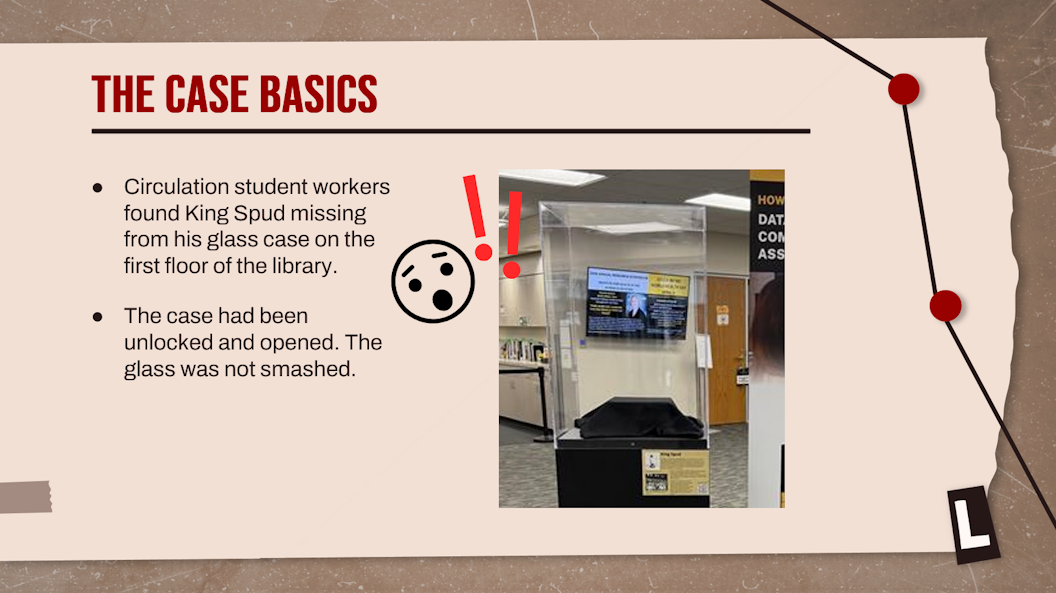 Figure 1: Presentation slide describing mystery premise to students
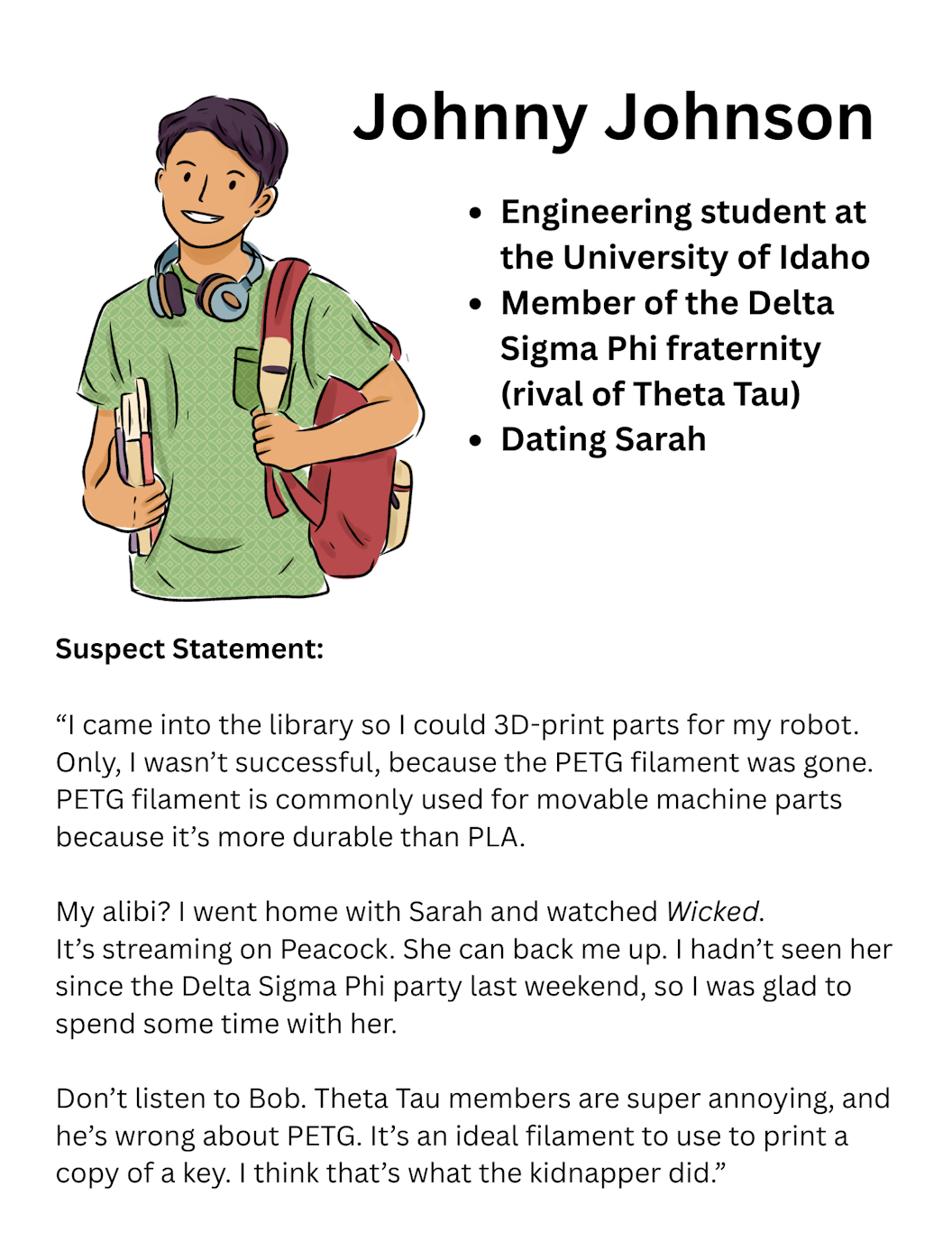
The bulk of the workshop time is spent with students evaluating the information presented in suspect alibis. After presenting the initial case information, I tell students we will transition into working to solve the case (Figure 2). I split students into groups of two to four, then give each group a set of laminated cards containing each suspect’s profile, description, and alibi statements (Appendix A). I wrote these statements so that the guilty suspect presents disinformation in their alibi. Students can disprove the alibi by searching for sources that contradict the suspect’s claims—for example, that a certain type of 3D printing filament is too brittle to be used to create a key to unlock King Spud’s glass case, when online sources reveal that this filament type is in fact known for being especially durable. Innocent suspect alibis contain information that can be verified as true through the same lateral reading technique. I emphasize that students should use lateral reading to ensure any sources they use as evidence are reliable and relevant to the situation—presentation of a poor source will be less likely to convince me that a suspect is guilty or not guilty.
While students work in their groups, I periodically move around the room and check on their progress. I ask each group if they have questions, and I also ask my own questions about what they are currently doing. This often looks like saying “tell me about what you’ve found so far,” or “What’s your game plan? Do you think you can defend that source when we present our evidence?” I continue allowing students to work in their groups until fifteen minutes of workshop time remains. Then, I gather student attention and transition into the “accusation” portion of the workshop.
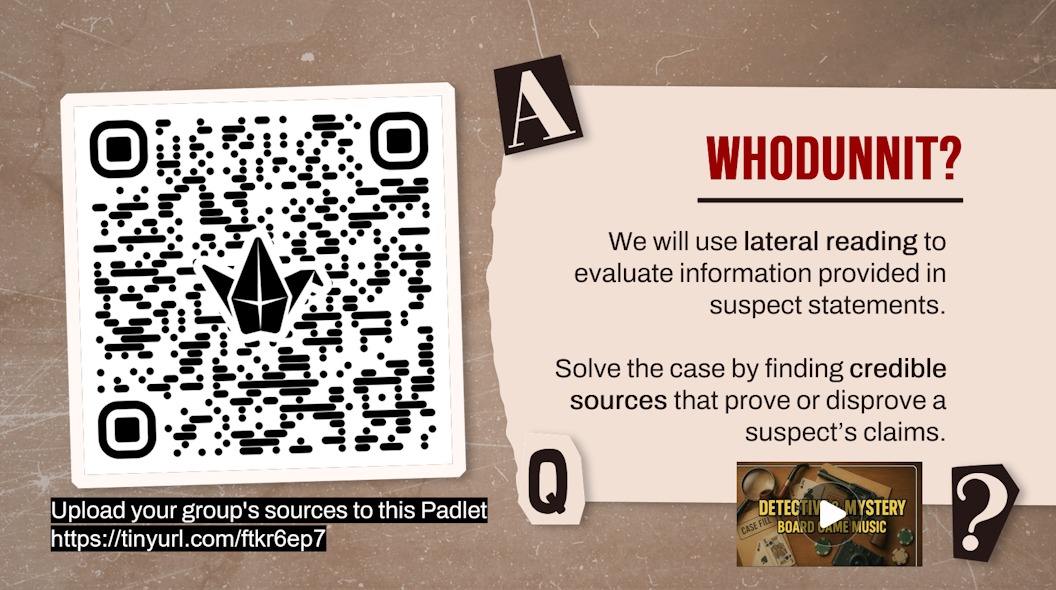 Figure 2: Presentation slide instructing students to evaluate suspect statements with lateral reading
During the accusation portion of the workshop, I ask students to vote for the suspect they believe is guilty. I then prompt each group to justify their vote, asking them to provide reliable sources that demonstrate the suspect’s guilt. I press them on their source’s quality and relevance by asking about its creator, origin, context, and why they believe it is a strong source. This process allows me to assess whether students practiced lateral reading successfully and can explain what they learned. Then, after each group gives their reasoning, I reveal the solution to the mystery. I also ask students not to spoil the storyline to others who may attend a future session.
After completing my initial workshop design, I conducted a pilot workshop with my colleagues as participants. The pilot workshop aimed to test whether the mystery storyline made sense, was appropriately scoped, and taught lateral reading skills effectively. I then revised the “suspect cards” to add details that my colleagues suggested would make the storyline clearer. The overarching structure of the workshop remained as I originally designed it.
I taught the workshop three times over the course of a single month of the Spring 2026 semester. The first session had low attendance with six students, the second had higher attendance with thirteen students, and the third had fifteen. After each session ended, I asked students to fill out a feedback survey about the workshop. This practice ensured that I was able to track student sentiment and provide data when my performance is reviewed.
Discussion
Teaching the workshop yielded new insights into the benefits and challenges of its designs. It engaged students and pushed me to grow as an instructor, as well as exposing sticking points and critical areas for student learning. While I approached the initial design with lots of intentionality, teaching in the classroom nonetheless revealed new insights and opportunities to improve upon my initial lesson plan.
High engagement, but continued struggles with lateral reading
I observed higher student engagement during the mystery workshops compared with the prior library week instruction they had received. In these previous sessions, it was sometimes challenging to motivate students to speak to their neighbors or to me. Conversely, while working to solve the mystery, students became invested in the characters and talked more freely with their small group. They shared their thoughts and findings with other group members and showed enthusiasm when uncovering the guilty suspect’s lies. Not all student groups were this excited, but seeing engagement from even roughly half of a class felt positive when keeping student attention is a continued challenge.
However, teaching the workshop revealed that even with high engagement, students still required guidance to practice lateral reading successfully. A primary takeaway is that determining the guilty suspect was not actually the most challenging or valuable part of the workshop. All students correctly guessed the guilty suspect, but only a few could provide substantive reasoning for why their evidence was relevant and reliable. The mystery is ultimately a vehicle for students to practice finding information and articulating its value. So, when students struggled to do so, I immediately identified this as an area for improvement.
When providing evidence to support their accusation, students typically offered a description of a website and stated why they believe that it discredits the guilty suspect’s claims. They often offered vague reasoning such as “it sounds reliable” or “it looked good.” This outcome aligns with the pitfall identified by McGrew and Byrne (2022): Students struggled to move beyond discussion of the content and details of the original source. To encourage engagement with other sources, I pressed them to expand, asking things like “what looks good about it?” or “what makes it sound reliable to you?” Students struggled to answer these questions and needed more support to look beyond surface-level observations of a webpage’s appearance. As such, the process of “showing your work” offered more space for critical thinking and learning than merely arriving at the correct answer.
Observing this outcome changed my thinking about what matters most about the workshop design. Rather than focusing all my concern on the design of the storyline, it became more important to effectively support students in providing strong justifications for their accusations.
Affordances of ILW series format
To accommodate the high volume of students attending an ILW, I taught “Mystery at the U of I Library” three times within a single month. This format allowed me to iterate on the way I taught it each time. After the first session, I reflected and identified that students struggled most with providing substantial justifications. I then tweaked my teaching plan to address this concern. Originally, I simply asked students to describe the sources they had found out loud to me. To revise the teaching plan, I added a Padlet for students to use while they search for sources to prove or disprove suspect claims. I provided each student group with a column within the Padlet interface and instructed them to upload their sources along with a brief sentence about its significance. I also included an example which I uploaded myself to model success (Figure 3.) This strategy increased accountability and allowed me to more effectively assess the sources students located. Instead of asking them to describe their source, I opened it on the display screen for the entire class to assess together, asking the student why they chose the source and what makes it strong. With this change implemented, discussion of sources became richer.
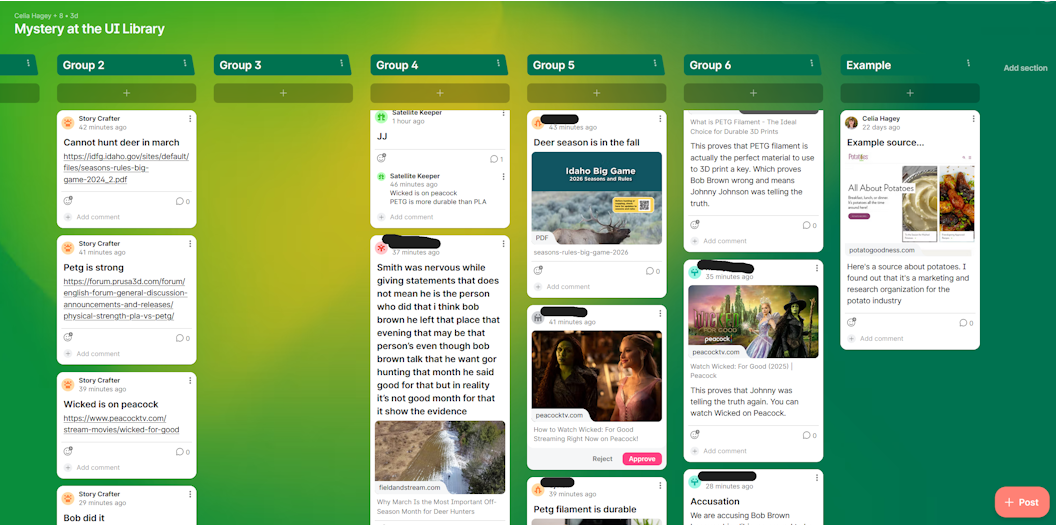 Figure 3: The Padlet implemented after the first workshop session
This second session took place only one day after the first. The nature of the Information Landscape Workshop series enabled me to make quick changes to my teaching and assess the result nearly immediately. Experimenting and iterating quickly offered an opportunity that other common teaching experiences did not. Rather than presenting once to a class, then setting the lesson aside for a semester or longer, I could move quickly from reflecting to acting. As such, implementing a workshop series where instructors provide the same content multiple times within a few weeks affords teaching librarians with more opportunity to exercise creativity and flexibility on the fly.
Recommendations for library instructors
The design of “Mystery at the U of I Library” is very specific to the University of Idaho context. Nonetheless, other libraries could easily adapt the format to suit their own needs.
Your own library or school mascot could become the kidnapping victim rather than King Spud. Alternatively, librarians could design an entirely different crime and storyline. As identified above, the exact details of the storyline did not turn out to be the most significant portion of the workshop design—although the storyline should certainly be logical and appropriately difficult to solve, as it does important work to secure student engagement. What matters most is to design a storyline that facilitates deep engagement with lateral reading.
I would recommend playing with story elements that involve special parts of your campus and library. In my design, our makerspace (the MILL) plays an important role—the guilty suspect uses one of their 3D printers to aid in their crime. Other libraries could incorporate services or programs, features of your building, or anything that makes your library special. Connecting the story to local places or things helps give a fictional story some grounding and reduces the need to engage in world-building work. It also may subtly advertise your library’s wonderful offerings.
As discussed above, I found it very valuable to teach the workshop multiple times within a short period. If other libraries can facilitate the workshop as a part of a series, or otherwise offer it multiple times, you will likely get more out of the experience. Trying things multiple times or in different ways helps substantially when working with a new type of teaching plan. As much as we encourage students to embrace recursive processes in their research, we should apply these concepts to our own work as well. However, if a series cannot be facilitated, a similar workshop design could also succeed as a stand-alone workshop or as part of a credit-bearing, semester-long information literacy course.
It may also help to practice with pilot sessions. My pilot session with my colleagues was helpful to solidify the storyline and the workshop structure; however, it did not reveal student difficulty with justifying their answers (my librarian colleagues were simply too good at it). To gain an even stronger understanding of how the workshop may go with students, you could potentially conduct a pilot workshop with student workers at your library or another population of volunteer students.
It is notable that my workshop was taught almost exclusively to first-year students enrolled in an introductory composition course. Attending a workshop is part of their course grade, and so most participants had not chosen to attend voluntarily, although they did select the specific workshop theme from our array of options. Other libraries adopting this workshop design may have differing experiences depending on the demographic of attendees. These libraries would need to consider how the workshop may change if more advanced students attend, or if the students choose to attend solely based on intrinsic motivation. In these cases, it would likely be necessary to increase the level of difficulty to meet the needs of more experienced or motivated students.
Conclusion
What started as an ambitious plan—to write and design my own mystery—became much more than the crafting of motives and the planting of clues. Creating “Mystery at the U of I Library” opened a window for me to see both the power of innovative teaching strategies and the necessity of the core skills they aim to foster. It excited students, brought some life to the end of a semester, and uncovered areas where further support is needed. While it was not the first lesson plan I ever created, it was easily the most experimental, and stepping into a pedagogical unknown pushed me to think deeply about what was working and why—or why not.
Going forward, “Mystery at the U of I Library” will undergo revisions before the beginning of the Fall 2026 semester. These revisions will seek to address student difficulty with justifying the value of online sources through increased scaffolding, explicit demonstration, and modeling, in line with the findings of McGrew (2024) and Walsh-Moorman & Pytash (2022) regarding effective lateral reading instruction strategies. Even though students received traditional lateral reading instruction during their prior “library week” class sessions, continued need exists to bolster their ability to apply the technique. The University of Idaho FYE team will work together to plan better support in this area across all our instruction.
I encourage other library instructors to take what is useful from this article and make it your own. Dream big as you concoct your fictional crime scene, then circle back to practical thinking about how to best enable students to practice information evaluation successfully. View your creativity as a conduit for practical skills and remain flexible throughout the whole process. I can attest that, even if you do not solve the entire mystery of information literacy, you will learn and have fun along the way.
Author Bio
Celia Hagey is the Instruction and User Services Librarian at the University of Idaho Library. She is a First Year Experience instructor and coordinates and staffs the library’s reference desk. She obtained a Bachelor of Arts in English Writing from Whitworth University in 2023 and an MLIS from the University of British Columbia in 2025. When not at the library, she enjoys running and hiking in the northwest, cooking new vegetarian meals, and (of course) reading detective fiction.
Acknowledgements
A big thanks to the U of I Library “writing circle” who provided feedback and encouragement throughout the drafting of this article.
Thank you to the FYE team for letting me run with this idea—listening to my grand plans, attending the pilot session, and helping to fine-tune my mystery storyline.
Declaration of Generative AI Use
No generative AI was used to research or write this paper
References
Abt, C. (1970). Serious Games. The Viking Press.
Boykin, A. W., & Willson-Metzger, A. (2005). A Murder in the Library. Virginia Libraries, 51(4), Article 4. https://doi.org/10.21061/valib.v51i4.990
Brodsky, J. E., Brooks, P. J., Scimeca, D., Todorova, R., Galati, P., Batson, M., Grosso, R., Matthews, M., Miller, V., & Caulfield, M. (2021). Improving College Students’ Fact-checking Strategies Through Lateral Reading Instruction in a General Education Civics Course. Cognitive Research: Principles and Implications, 6(1), 23–18. https://doi.org/10.1186/s41235-021-00291-4
Bull, E. C., MacMillan, M., & Head, A. (2021). Dismantling the Evaluation Framework. In the Library with the Lead Pipe. https://www.inthelibrarywiththeleadpipe.org/2021/dismantling-evaluation/
Childs-Disney, J. L., Kauffmann, A. D., Poplawski, S. G., Lysiak, D. R., Stewart, R. J., Arcadi, J. K., & Dinan, F. J. (2010). A Metabolic Murder Mystery: A Case-Based Experiment for the Undergraduate Biochemistry Laboratory. Journal of Chemical Education, 87(10), 1110–1112. https://doi.org/10.1021/ed100243x
Cloft, K. (2018). Engaging Mathematicians With a Murder Mystery. The Mathematics Teacher, 111(5), 344–351. https://doi.org/10.5951/mathteacher.111.5.0344
Davis, R. C. (2019). Introducing First-year and Transfer Students to a College Library with a Historical Mystery from the Special Collections. College & Undergraduate Libraries, 26(4), 278–300. https://doi.org/10.1080/10691316.2019.1695034
Ertelt, T. (2025). Murder Mystery: Teaching Research Skills Through Game Theory. School Library Journal, 71(4). https://www.slj.com/story/Teaching-Research-Skills-Through-Game-Theory-Murder-Mystery
Folz, H. N., Black, J., & Thigpen, J. (2023). Evaluation of a Murder Mystery Activity to Teach Patient Communication Interviewing Skills. Currents in Pharmacy Teaching and Learning, 15(6), 581–586. https://doi.org/10.1016/j.cptl.2023.06.006
Giles, K. (2015). No Budget, No Experience, No Problem: Creating a Library Orientation Game for Freshman Engineering Majors. The Journal of Academic Librarianship, 41(2), 170–177. https://doi.org/10.1016/j.acalib.2014.12.005
Haider, J., & Sundin, O. (2022). Information Literacy Challenges in Digital Culture: Conflicting Engagements of Trust and Doubt. Information, Communication & Society, 25(8), 1176–1191. https://doi.org/10.1080/1369118X.2020.1851389
Head, A. J., Fister, B., & MacMillan, M. (2020, January 15). Information Literacy in the Age of Algorithms: Student Experiences with News and Information, and the Need for Change, Project Information Literacy Research Institute. https://projectinfolit.org/publications/algorithm-study
Helbing, R. R., Lapka, S., Richdale, K., & Hatfield, C. L. (2022). In-person and Online Escape Rooms for Individual and Team-based Learning in Health Professions Library Instruction. Journal of the Medical Library Association, 110(4), 507–512. https://doi.org/10.5195/jmla.2022.1463
Hill, A. M., & Harmer, N. J. (2023). A Murder Mystery Gamification Session to Consolidate Analytical Biochemical Techniques Learning. Journal of Chemical Education, 100(11), 4514–4524. https://doi.org/10.1021/acs.jchemed.3c00279
Jackson, H. (2022). Using Existing Fandoms to Create Your Own Library Stories: How a Harry Potter-inspired Murder Mystery Introduced First-year Students to the Library. In Once Upon a Time in the Academic Library: Storytelling Skills for Librarians (pp. 133–155). Association of College and Research Libraries.
James, P. D. (2009). Talking About Detective Fiction. The Bodleian Library.
Kamela, M. (2024). Cut the CRAAP: Replacing Vertical Evaluation With Lateral Reading. New Directions for Teaching and Learning, 2024(180), 49–58. https://doi.org/10.1002/tl.20608
Kasbohm, K. E., Schoen, D., & Dubaj, M. (2006). Launching the Library Mystery Tour: A Library Component for the “First-Year Experience.” College & Undergraduate Libraries, 13(2), 35–46. https://doi.org/10.1300/J106v13n02_03
Kavanaugh, R., Pape, Z., LaTourette, B., & Lehmier, S. (2022). Who Killed Mr. Brown? A Hospital Murder Mystery in a Pharmacy Skills Course. Medical Teacher, 44(10), 1151–1157. https://doi.org/10.1080/0142159X.2022.2071690
Kumar, K. (2023). Reflections on Teaching an Engineering Course Through Murder Mysteries. Journal of Technology and Science Education, 13(3), 646–656. https://doi.org/10.3926/jotse.2014
Leavy, A., & Hourigan, M. (2016). Crime Scenes and Mystery Players! Using Driving Questions to Support the Development of Statistical Literacy. Teaching Statistics, 38(1), 29–35. https://doi.org/10.1111/test.12088
Liping, L., Xiaoxia, F., Yu, Z., & Yiwei, W. (2024). Enhancing Emergency Competencies in Healthcare Professionals Via Murder Mystery Games: An Innovative Gamification Learning-based Approach. International Emergency Nursing, 77, 101510-. https://doi.org/10.1016/j.ienj.2024.101510
McGrew, S. (2024). Teaching Lateral Reading: Interventions to Help People Read Like Fact Checkers. Current Opinion in Psychology, 55, 101737-. https://doi.org/10.1016/j.copsyc.2023.101737
McGrew, S., & Byrne, V. L. (2022). Conversations After Lateral Reading: Supporting Teachers to Focus on Process, Not Content. Computers and Education, 185, 104519-. https://doi.org/10.1016/j.compedu.2022.104519
Pate, J., & Malone, D. (2018). Beyond Reinventing the Library Scavenger Hunt: Teaching Library Literacy to FYE Students Using an Escape Room. LOEX Quarterly, 44(4). https://commons.emich.edu/loexquarterly/vol44/iss4/4
Pun, R. (2017). Hacking the Research Library: Wikipedia, Trump, and Information Literacy in the Escape Room at Fresno State. The Library Quarterly (Chicago), 87(4), 330–336. https://doi.org/10.1086/693489
Rowland, S. (2010). The “Classical” Model of the Golden Age. In A Companion to Crime Fiction (pp. 117–127). Wiley‐Blackwell. https://doi.org/10.1002/9781444317916.ch8
Smith, A.-L., & Baker, L. (2011). Getting a Clue: Creating Student Detectives and Dragon Slayers in Your Library. Reference Services Review, 39(4), 628–642. https://doi.org/10.1108/00907321111186659
Testa, S. M., Selegue, J. P., French, A., & Criswell, B. (2018). Permanganate Oxidation of DNA Nucleotides: An Introductory Redox Laboratory Framed as a Murder Mystery. Journal of Chemical Education, 95(10), 1840–1847. https://doi.org/10.1021/acs.jchemed.8b00079
Vulcu, F., & Heirwegh, M. (2015). Dr. Earl N. Meyer, in the Lab, with a Scalpel: A Murder Mystery as a Biochemistry Recruitment Tool. Biochemistry and Molecular Biology Education, 43(1), 20–27. https://doi.org/10.1002/bmb.20830
Walsh-Moorman, B., & Pytash, K. E. (2022). Guiding Their Thinking: A Formative Study of Digital Source Evaluation. Journal of Adolescent & Adult Literacy, 65(6), 469–479. https://doi.org/10.1002/jaal.1225
Wineburg, S., & McGrew, S. (2019). Lateral Reading and the Nature of Expertise: Reading Less and Learning More When Evaluating Digital Information. Teachers College Record (1970), 121(11), 1–40. https://doi.org/10.1177/016146811912101102
Appendix A
Example suspect card provided to students