by Jean Bossart
Engineering Librarian
University of Florida
George A. Smathers Libraries
jean.bossart@ufl.edu
Abstract
Although makerspaces have been around for nearly 20 years, they are continually evolving to incorporate new technologies and practices in support of the creativity of their patrons. With the goal of identifying unique or emerging trends in makerspace offerings, a mixed methods investigation of current makerspace technologies was conducted at peer institution academic libraries which included online reviews of makerspace websites, site visits, and interviews with makerspace managers. Since there are over 6000 colleges and universities in the U.S., library makerspaces at universities with top ranked engineering programs were identified for this study. Eight makerspaces in eight different US states were visited. For comparison, four were library makerspaces and four were engineering department makerspaces. To keep making on an innovative trajectory and provide access to newly emerging technologies, interviews with makerspace managers were conducted and included questions regarding trends and innovative new makerspace tools and technologies. Incorporating the arts to foster creativity alongside technical skills was identified as a path to inclusivity and equitable access to maker education.
Introduction
Makerspaces are collaborative, hands-on learning environments where makers can design, and test their creations using a variety of tools and technologies. Makerspaces foster creativity, problem-solving, and collaboration (Ketchum, 2016). In the 20 years since makerspaces first began appearing in libraries, many tools and technologies have changed. While makerspaces can be found in almost all university engineering departments, academic libraries quickly adopted the idea to become the most common place for a makerspace on campus. By the year 2019 makerspaces could be found in 110 academic libraries across 214 institutions (Melo et al., 2023).
In academic library makerspaces, 3D printers are now ubiquitous, while other popular equipment includes sewing machines, laser cutters, and hand tools. As advanced fabrication tools become more common, makerspace managers began asking what is next? What are the emerging trends for makerspaces? To explore these questions, a matrix of makerspaces and their resources at peer academic institutions was developed using on-line research of institutional websites.
In-person site visits to both library makerspaces and engineering school makerspaces were conducted to compare what tools and technology were available to their patrons. Library makerspaces are typically limited in size and budget while engineering school makerspaces often have more elaborate space designs and advanced equipment. A goal of the site visits to both types of makerspaces was to provide a perspective on their differences and offerings.
Makerspace managers and staff are on the front line of making. Their interactions with patrons allow them to hear what the latest requested technologies are. Interviews with makerspace managers provided insight into the state of makerspaces and the future of making.
Literature Review
The start of the maker movement in libraries can be traced back to 2006 when the first Maker Faire was held in San Mateo, California (Mann, 2019). As technological horizons have expanded, libraries have been at the forefront and embraced changing responsibilities by becoming more proactive, engaged and creative. The maker movement took off when academic and public libraries began offering 3D services (Hudson et al., 2016). Taking it to the next level, academic libraries began increasing the breadth of their services, offering educational resources to enhance the 3D learning experience (Gonzalez & Bennett, 2014; Pryor, 2014) and from there, the makerspace was born. The inclusion of 3D printing services in libraries seems natural because of the unique space, tradition of collaborations, and accessibility (Ketchum, 2016). Case studies at academic and public libraries have shown the need for makerspaces (Moorefield-Lang, 2014; Nowlan, 2015).
Makerspaces go beyond tinkering; they are a path to innovation. Students using makerspaces “learn through creation and interaction” (Research Planning and Review Committee, 2024). Hand fabrication tools are common in most library makerspaces. Many libraries also include digital fabrication equipment, such as 3D printers.
Many of the top engineering programs at colleges and universities have their own makerspaces that are open only to engineering students, while library makerspaces are open to all students, faculty, and staff and sometimes even the general public. Library 3D printing services provide access to every student and community member in comparison to oftentimes more restricted department-based services (Chen, 2012). Academic libraries are teaching 3D workshops and classes to students to expand the 3D community beyond engineering students (Gonzalez and Bossart, 2018). 3D printing in libraries enables patrons to learn new technology and reinforces learning with hands-on projects. A goal of makerspaces is to foster collaboration by attracting students from across disciplines. Having a makerspace in a library is ideal because it offers students a place to explore and experiment in addition to reflect and question (Bieraugel, 2017).
Academic library makerspaces should define their mission based on the needs of their library and institution, ensuring technologies and services align with their mission (Johnson, 2017). In an academic library, makerspaces, combined with introductory workshops, offer college students the opportunity to learn new skills that can aid them in their education and future careers. Students working in makerspaces develop not only technology specific skills but also higher-level, cross-disciplinary competencies (Wallace, 2021). Makerspaces provide a positive experience of learning new technical skills as well as soft skills such as collaboration, communication, and creativity and applies to all students even those without strong technical backgrounds (Pallaris et al., 2024).
Academic libraries provide a mixture of space, technologies, and literacy skills, all important ingredients for students to explore and develop their creativity, as well as sharpen their technical skills. To stay relevant, makerspace resources must keep pace with evolving tools and technologies. Librarians are well positioned to operate in a technologically changing landscape and to help make makerspaces accessible, diverse, and inclusive (Rogers, 2016). However, it is also a constant challenge for librarians to know what the latest tools are, what the emerging trends are, and which tools the students are interested in learning to use. To meet these challenges, academic library makerspaces must “foster experimental scholarly communications” and promote campus partnerships (Fletcher, 2021). Accordingly, this study explores university makerspaces to identify any new technologies for potential implementation at other university library makerspaces, as well as to gain a deeper understanding of how these peer institutions makerspaces are managed and operated.
Methods
An analysis of current makerspaces at peer institution libraries was conducted using both on-line research and in-person site visits. Since there are over 6000 colleges and universities in the U.S., the analysis was narrowed to focus on those with engineering programs ranked in the top fifty, as determined through the U.S. News and World Report 2022/2023 survey (USNWR, 2022).
Focusing on these top fifty programs, the online review of these schools identified those with and without academic library makerspaces. From this review eight makerspaces in eight different US states were randomly identified for site visits. Of these eight makerspaces, four were library makerspaces and four were engineering department makerspaces. The intended outcomes from these site visits were to identify new technologies for potential implementation at our university library makerspace, as well as to gain a deeper understanding of how these peer institutions makerspaces are managed and operated.
Prior to conducting the site visits, University of Florida (UF) Institutional Review Board (IRB) approval was obtained. The IRB application entitled, “Innovations for Academic Library Makerspaces” (Protocol #: ET00019348) was approved as exempt research on June 20, 2023.
The makerspace site visits focused on collecting information on the size and layout of the space, equipment access (self-service or staff managed), repair and replacement protocols, production throughput, and funding. The types of equipment in each makerspace were of particular interest. Another consideration was student access, i.e., whether the makerspace is open to the entire student population or just engineering students and whether the students pay for use of the equipment or for supplies.
Also of interest was makerspace staffing, whether the makerspaces were run by dedicated staff members or if they were operated by student workers or volunteers. Funding for the makerspace and the equipment were discussed with the makerspace managers and whether funding came from the provost, department budgets, or grant money. To keep making on an innovative trajectory and provide access to newly emerging technologies, interviews with makerspace managers included discussion regarding trends and innovative new makerspace tools and technologies.
Results
Online search of makerspace websites
Table 1 provides a summary of the top engineering programs and whether they have a library makerspace. The table is organized by engineering school ranking. Of the top fifty engineering schools, twenty have makerspaces in their libraries. Another six libraries have 3D printing only with no other makerspace services offered.
Table 1. Matrix of library makerspaces at peer institutions.
| USNWR Ranking | University | State | City | Library Makerspace? | Library Name |
| 1 | MIT | MA | Cambridge | N | – |
| 2 | Stanford | CA | Stanford | Y | Lathrop |
| 3 | UC Berkeley | CA | Berkeley | Y | Moffitt |
| 4 | Carnegie Mellon | PA | Pittsburgh | Y | Hunt |
| 4 | Purdue | IN | West Lafayette | N | University Library* |
| 6 | UT Austin | TX | Austin | Y | Fine Arts |
| 7 | CalTech | CA | Pasadena | N | – |
| 7 | Georgia Tech | GA | Atlanta | N | – |
| 9 | Michigan | MI | Ann Arbor | Y | Shapiro |
| 10 | Texas A&M | TX | College Station | N | – |
| 10 | UC San Diego | CA | La Jolla | N | – |
| 10 | U Illinois Urbana-Champaign | IL | Urbana | Y | Grainger |
| 13 | Columbia | NY | New York | N | – |
| 13 | Cornell | NY | Ithaca | Y | Mann |
| 15 | USC | CA | Los Angeles | Y | Sci. & Eng. Library |
| 16 | Johns Hopkins | MD | Baltimore | N | – |
| 16 | UCLA | CA | Los Angeles | Y | UCLA Library |
| 18 | Northwestern | IL | Evanston | N | Mudd* |
| 18 | U Pennsylvania | PA | Philadelphia | N | – |
| 20 | Princeton | NJ | Princeton | Y | Princeton U Library |
| 21 | Harvard | MA | Allston | N | |
| 21 | U Maryland | MD | College Park | Y | STEM Library |
| 23 | Colorado | CO | Boulder | N | – |
| 24 | Duke | NC | Durham | N | Lilly* |
| 24 | Washington | WA | Seattle | N | – |
| 26 | NCSU | NC | Raleigh | Y | Hill |
| 27 | Rice | TX | Houston | N | – |
| 27 | UC Santa Barbara | CA | Santa Barbara | N | – |
| 29 | Wisconsin | WI | Madison | Y | Wendt |
| 30 | Ohio State | OH | Columbus | N | – |
| 30 | Virginia Tech | VA | Blacksburg | Y | Newman |
| 32 | Penn State | PA | University Park | Y | Pattee |
| 33 | NYU | NY | Brooklyn | N | – |
| 33 | Northeastern | MA | Boston | N | Snell* |
| 35 | Boston University | MA | Boston | N | – |
| 35 | UC Davis | CA | Davis | N | – |
| 37 | U Virginia | VA | Charlottesville | Y | Clemons |
| 38 | UC Irvine | CA | Irvine | N | Science Library* |
| 38 | Yale | CT | New Haven | N | – |
| 40 | Arizona State | AZ | Tempe | Y | Hayden |
| 41 | U Florida | FL | Gainesville | Y | Marston |
| 41 | U Minnesota | MN | Minneapolis | Y | Walter |
| 43 | Vanderbilt | TN | Nashville | N | – |
| 43 | Rensselaer Polytech | NY | Troy | N | – |
| 45 | Case Western Res. | OH | Cleveland | N | – |
| 45 | U Delaware | DE | Newark | N | – |
| 45 | U Rochester | NY | Rochester | N | – |
| 48 | Iowa State | IA | Ames | N | – |
| 48 | U Dayton | OH | Dayton | N | – |
| 48 | Notre Dame | IN | South Bend | N | Hesburgh* |
| 48 | Pittsburgh | PA | Pittsburg | Y | Hillman |
| 48 | Washington St. Louis | MO | St. Louis | N | – |
*3D printing and/or scanning only
2023 US Engineering School Rankings, U.S. News and World Report (USNWR)
https://www.usnews.com/best-graduate-schools/top-engineering-schools/eng-rankings
Makerspace site visits
Using the list of makerspaces developed in Table 1, eight makerspaces in eight different states were visited as shown in Table 2. Of these eight makerspaces, four were library makerspaces and four were engineering department makerspaces to compare the equipment and services offered.
Table 2. Makerspace site visits.
| Engineering School Ranking | University | Engineering Department Makerspace? | Library Makerspace? | Makerspace Name/Link |
| 7 | Georgia Tech | Yes | No | Invention Studio |
| 9 | U of Michigan | Yes | Yes | Workshop |
| 21 | U of Maryland | Yes | Yes | Graves Makerspace |
| 26 | North Carolina State U | Yes | Yes | Makerspace |
| 27 | Rice U | Yes | No | Maker Bar |
| 30 | Virginia Tech | Yes | Yes | Prototyping Studio |
| 33 | NYU | Yes | No | Design Lab |
| 48 | U of Dayton | Yes | No | Makerspace |
https://www.usnews.com/best-colleges/rankings/national-universities
Table 3 provides a summary of observations during each of the eight site visits. Although all the makerspaces had common equipment such as 3D printers, each space was unique and catered to the specific needs and interests of their student population.
Table 3. Summary of makerspace features observed during site visits.
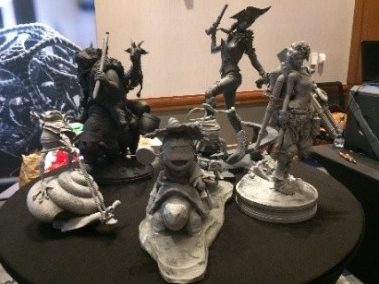 |
Georgia Tech – Flowers Invention Studio (campus-wide space) is a 7,000 square foot facility. Staffing: Student run makerspace Equipment: The Studio offers Ultimakers and Formlabs resin 3D printers, a woodshop with both horizontal and vertical bandsaws, a lathe, drill press, grinders, and both metal and wood computer numerical control (CNC) mills, a separate welding shop, a paint booth with ventilation, and a bike repair area. The Studio also has sewing and embroidery machines, vinyl cutters, and button makers. Access/costs: Use of all the equipment is free and open to all faculty, staff, and students regardless of major. There is an on-site store that sells materials at cost. |
 |
University of Michigan – Design Lab Workshop (in Shapiro undergraduate Library) is a combined 1500 square foot space. Staffing: Staff run makerspace with student assistants Equipment: The Workshop offers 3D printers, a laser cutter, letter press, die cutters, soldering stations, sewing machines, and engraving machines. Adjacent to the Workshop are studios for audio and video production and post-production. Uniquely, the library has a computer and video game archive with a vast selection of video games and the vintage controllers used to play the games. Access/costs: The Workshop is available to all students, faculty, and staff and there is no cost for equipment use. On-line training and reservations are required to use the Workshop spaces. |
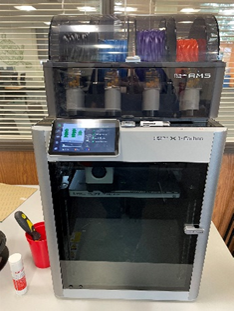 |
University of Maryland – John and Stella Graves Makerspace (in STEM Library) is a 720 square foot facility. Staffing: Staff run makerspace with student assistantsEquipment: The Makerspace offers 3D printers (Prusa i3 MK3S+, Creality Ender-5 S1, and a Bambu Lab X1-Carbon) and scanners, a Glowforge Plus laser cutter, vinyl cutter, soldering stations, tool kits, VR equipment, and an AR sandbox. Access/costs: The Makerspace is open to the university community and provides free 3D printing for up to a 12-hour print. There is no charge for using any of the equipment or for the supplies. The primary source of funding for the makerspace is from an endowment. |
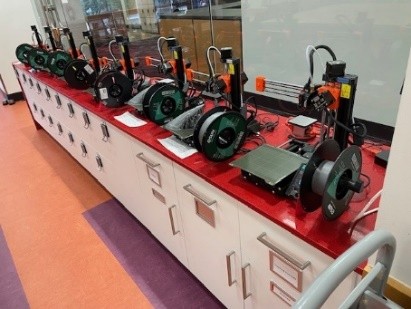 |
North Carolina State University – Makerspace (in Hill Library) is an approximate 900 square foot space. Staffing: Staff run makerspace with student assistants Equipment: The Makerspace is home to Prusa 3D printers, with six of the Prusas reserved for class assignments and eight Prusas are open for all patrons. Other makerspace equipment includes sewing machines, button makers, soldering stations, circuit makers (Silhouette), and a laser cutter/engraver that performs high-speed cutting, marking, and engraving. Access/costs: The makerspace is open to the NCSU community. Student tech fees fund the makerspace equipment and materials. |
 |
Rice University – REA Maker Bar (in Oshman Engineering Design Kitchen (OEDK) is a 20,000 square foot space. Staffing: Student run makerspace Equipment: The Maker Bar equipment includes 3D printers, resin printers, laser cutters, CNC machines, drill press, lathes, band saw, hand tools, vinyl cutters and sewing machines. Dust and emissions are vented to the outside air. Access/costs: Open to students majoring in engineering, mathematics, computer science, materials science, and statistics. |
 |
Virginia Tech – Prototyping Studio (in Newman Library) is a 2450 square foot space. Staffing: Staff run makerspace with student assistants Equipment: The Studio includes a laser cutter, a CNC machine, a vacuum forming apparatus, and equipment for clay modeling, metal printing, and screen printing. The 3D printers include multiple Lulzbot Taz 6, Prusa i3 MK2, Prusa i3 MK3, and FormLabs 2 resin printers, as well as a Markforged 3D printer that prints in metal. The studio also offers a Trotec Speedy 400 laser engraver and cutter and the Formech 450DT that vacuum-forms plastic over 3D printed molds, A CNC machine, the Laguana Smart Shop SUV, can cut an entire 4 foot by 8-foot sheet of plywood into intricate pieces including furniture and is connected to an outside exhaust system. The studio also provides two pod casting booths. Access/costs: Use of all the equipment is free and open to all faculty, staff, and students regardless of major. |
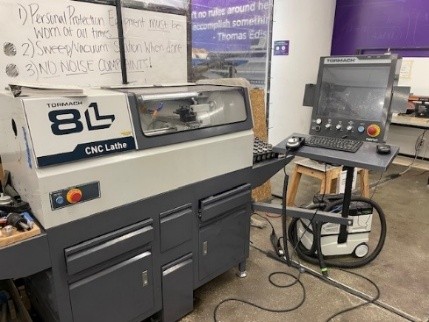 |
New York University (NYU) – Design Lab at NYU Tandon School of Engineering in Brooklyn is an approximate 10,000 square foot space. Staffing: Staff run makerspace with student assistants Equipment: The Design Lab includes a mix of fabrication equipment, from sewing and embroidery machines, button makers, and Silhouettes to more complex computer-controlled equipment such as CNC machines (Tormachs and ShopBots) and laser cutters. 3D printers include Ultimakers, FormLabs, and elaborate Stratasys models. The DesignLab has electronic equipment for building circuit boards and 3D printing waste filament recycling equipment (Noztek). Access/costs: Use of all the equipment is free and open to all faculty, staff, and students regardless of major. |
 |
University of Dayton – Makerspace (in the Kettering Laboratories) is an approximate 9,000 square foot space. Staffing: Staff run makerspace with student assistants Equipment: The 3D printers in the Makerspace include Stratasys, Makerbot and FLSUN printers. The Full Spectrum CO2 laser can cut and engrave a variety of soft materials including wood. The Makerspace also has a machine shop, metal shop, and a welding shop for advanced applications. All shops have ventilation to the outside. Access/costs: The Makerspace located within five interconnected rooms is open to all students, faculty, and staff. The Makerspace charges $4 per cubic inch for Stratasys filament but use of all other printers is free. Training is required to use the equipment in the specialty shops. |
Photos taken by J. Bossart.
Table 4 provides a comparison of the equipment provided in each of the visited makerspaces. The primary difference between the engineering school makerspaces and the library makerspaces was that the engineering school makerspaces were larger and contained more complex equipment such as that for welding and metal fabrication, which required dedicated space, custom ventilation, and higher voltage power supplies.
Table 4. Equipment and services offered at each university makerspace visited.
| Library Makerspace? | 3D printers-FDM | 3D printers-SLA | Audio/video production | Circuit making | CNC | Laser cutting | Sewing | Soldering | Welding | Woodworking | |
| Georgia Tech | No | X | X | X | X | X | X | X | X | X | |
| U of Michigan | Yes | X | X | X | X | X | |||||
| U of Maryland | Yes | X | X | X | X | ||||||
| NC State U | Yes | X | X | X | X | ||||||
| Rice U | No | X | X | X | X | X | X | X | X | ||
| Virginia Tech | Yes | X | X | X | X | X | X | X | X | X | |
| NYU | No | X | X | X | X | X | X | X | X | ||
| U of Dayton | No | X | X | X | X | X | X |
CNC computer numerical control
FDM fused deposition modeling aka FFF (fused filament fabrication)
SLA Stereolithography
Operation of complex equipment found in many engineering school makerspaces required extensive training before the students were permitted to use it. Most of the engineering school makerspaces required their students to complete an on-line training course that focused on safe use of the equipment and where to get help. Conversely, the library makerspaces were generally smaller and more user-friendly, supporting creative projects such as sewing and crafting.
A unique library makerspace resource was a videogame archive curated at the University of Michigan Shapiro Library. This archive supported a university program in videogame development. The archive included thousands of videogames, the oldest dating to the 1970’s, and the makerspace maintained a collection of vintage computers and controllers to run them. The Shapiro Library makerspace also placed a priority on audio-visual production facilities, including podcasting studios, as well as a green-screen video production capability.
Those makerspaces with forced-air ventilation to the outside were able to offer woodworking tools, which generate dust, and tools that could mold and cut plastics. Welding was offered in some engineering makerspaces but not library makerspaces. Some makerspaces offered paint booths. Other makerspaces offered bike repair areas and tools for use in the makerspace. Podcast recording booths were available at some library makerspaces.
Interviews with makerspace managers
Interviews were conducted with makerspace managers to identify what items and services are most popular with their patrons and what trends do the managers foresee for the future of makerspaces.
What equipment is most popular in makerspaces?
3D printers and sewing machines were by far the most used equipment in makerspaces. All makerspaces visited had 3D printers and, in most cases, the printers were enclosed and connected to outside ventilation or had inside filtration systems. Sewing machines were available in most makerspaces for in-house use. A few makerspaces checked out sewing machines to their patrons. Embroidery machines were available in several makerspaces. Most makerspaces offered workshops to help users develop new skills and become proficient with more advanced tools. Podcasts were sometimes used to showcase educational aspects of making.
How do these makerspaces operate?
Most makerspaces were operated by paid student workers with a staff oversight position. Funding was provided through endowments, department budgets, student fees, grants, private donations, or the provost’s office. Most makerspaces had free 3D printing for their students within reason, and no charge for filament. Some makerspaces limited the number of free prints per semester while others charged students for 3D printing based on the final weight of the printed object. Other makerspaces allowed students to bring in their own filament, but they cautioned that it worked best with an approved list of filament brands as some inexpensive filament brands caused jams and breakage of the 3D printers. Students were encouraged to bring their own materials for sewing, such as cloth, but threads and needles were provided at no cost. The Virginia Tech Library makerspace had the most robust funding through both student fees and grants and had the most sophisticated fabrication equipment for a library makerspace, including the capability to 3D-print titanium and CNC mill full-sized plywood sheets.
What equipment and services would they like to offer in the future?
An expansion of existing services with more up-to-date equipment was the main response to what equipment and services would makerspace managers like to offer in the future. Multi-colored 3D printing and 3D printing with different filament types, such as metal and wood was another popular response. Several makerspace managers mentioned a desktop laser engraver as a future purchase. Operating a more sustainable makerspace was another response for the future. Two of the makerspaces were experimenting with recycling equipment for filament and one makerspace had recently begun using filament spools made of 100% recyclable cardboard that are both lightweight to ship and locally recyclable.
What training and workshops would makerspaces like to offer more of?
Most makerspaces offered workshops on both 3D printing and modeling with some makerspaces offering a much larger selection of both technical and creative workshops. The types of workshops offered were split into two areas: technical and creative. In technical workshops, students learn new technical skills and tools to bring their project ideas to life and also skills to highlight on their resumes. Offering training tailored to users’ skill levels, ensures even beginners can safely operate machinery. Workshops covered Rhino, Photoshop, and Illustrator as well as technical skills such as soldering, Raspberry Pi, and Arduinos. In creative workshops, students were encouraged to engage in new experiences and build skills on machines such as sewing and embroidery, how to knit and crochet, and Silhouette paper and vinyl cutting.
What do you see as future trends for makerspace?
Makerspace managers were asked, if funds were available, what new equipment or services would they like to add to their makerspace. Based on research and discussion with makerspace managers, the following five trends and innovations were identified for the future of makerspaces:
- Sustainability initiatives: Emphasis on eco-friendly practices for makerspaces, such as using recycled materials, energy-efficient equipment, and promoting sustainable design principles.
- Community collaborations: Enhanced focus on community engagement and collaboration, with makerspaces hosting events, hackathons, and group projects.
- Artificial Intelligence (AI) integration: Incorporating AI for design assistance, predictive maintenance of makerspace equipment, optimization of resources, and notification for equipment failures.
- Gaming: Virtual and augmented reality for immersive design experiences and virtual prototyping, supporting gaming and e-sports by hosting events and working with students to make props and game pieces and devices.
- Podcasting: Podcasting provides students the opportunity to share their voices widely. It is an engaging tool that students can use to deliver content to a wide audience in short, meaningful segments and to showcase educational aspects of making.
Discussion
Currently, 3D printing remains a dominant service around which many university library makerspaces are configured. This probably reflects both that 3D printers were a pioneering makerspace tool and that student demand for using these printers continues to be strong. In addition to 3D printers, the range of equipment supplied in university library makerspaces appears to have matured, with availability of laser cutters, sewing machines, and soldering as the most prevalent newly added tools. While each makerspace visited had its own particular priorities that reflected the needs of its patrons, similar mixes of tools were common.
Makerspace operations point to a dynamic and promising future with several key trends and opportunities emerging. Discussions with makerspace managers revealed a drive to promote equitable access to maker education, ensuring participation among students with diverse majors, not just those with a strict STEM focus. This drive emphasized accommodating the arts into makerspace resources, fostering creativity alongside developing technical skills.
One of the more exciting new trends for makerspaces is global collaboration. Encouraging international partnerships and knowledge exchange enriches maker education practices worldwide. As all librarians know, assessment and evaluation are critical for any new initiatives. Developing robust frameworks to assess the impact of maker education on learning outcomes and skills development is necessary (Ioannou & Gravel, 2024). Encouraging waste reduction practices like reusing materials, minimizing waste, and hosting repair cafés and restart parties to fix and repurpose items are sustainable initiatives for makerspaces. Loaning tools to patrons so they can repair instead of replacing is another way makerspaces are promoting sustainability.
Strengthening ties with local communities to create meaningful, culturally relevant maker projects is important to bringing making to all communities. Traditional arts and crafts is a prime example. Activities like pottery, weaving, carving, and jewelry making help preserve cultural heritage and identity. Costume making using sewing and embroidery machines is popular in makerspaces. These costumes can be used in storytelling, where participants share myths, legends, and historical narratives that are integral to a culture’s identity. Often the costumes are created for festivals and rituals such as the medieval faire, a popular event among college students. Celebrating cultural festivals and rituals bring communities together and reinforce cultural values. The importance of community engagement and cultural practices is essential in fostering a productive and inclusive environment in a makerspace. These trends suggest a future where maker education not only enhances technical skills but also promotes creativity, inclusivity, and global collaboration.
References
Bieraugel, M., & Neill, S. (2017). Ascending Bloom’s Pyramid: Fostering student creativity and innovation in academic library spaces. College & Research Libraries, 78(1), 35-52. https://doi.org/10.5860/crl.78.1.35
Chen, A. (2012). 3-D printers spread from engineering departments to designs across disciplines. Chronicle of Higher Education, September 17, 2012. http://chronicle.com/article/3-D-Printers-Arent-Just-for/134440/
Fletcher, C. (2021). A case for scholarly making in the library: Makerspaces, innovation labs, and the evolution of scholarly communications. College & Undergraduate Libraries, 27(2-4), 339-353. https://doi.org/10.1080/10691316.2021.1899881
Gonzalez, S. R., & Bennett, D. B. (2014). Planning and implementing a 3D printing service in an academic library. Issues in Science and Technology Librarianship, 78, 1-14. https://doi.org/10.5062/F4M043CC
Gonzalez, S. and Bossart, J. (2018). Teaching 3D: Developing learning-by-doing experiences. Construct 3D, October 6-7, 2018, Atlanta, GA. https://www.construct3dconf.com/other-presentations
Hudson, N., Alcock, C., & Chilana, P. K. (May 2016). Understanding newcomers to 3D printing: Motivations, workflows, and barriers of casual makers. Proceedings of the 2016 CHI Conference on Human Factors in Computing Systems.
Ioannou, A., & Gravel, B. E. (2024). Trends, tensions, and futures of maker education research: a 2025 vision for STEM+ disciplinary and transdisciplinary spaces for learning through making. Educational Technology Research and Development, 72(1), 1-14. https://doi.org/10.1007/s11423-023-10334-w
Johnson, E. D. M. (2017). A future for academic library makerspaces: As the core of a “Center for Public Scholarship”. International Journal of Academic Makerspaces and Making. https://assets.pubpub.org/zv2go9y1/71585584685509.pdf
Ketchum, D. (2016). Makerspaces in Libraries. Journal of Academic Services. https://doi.org/10.1080/15367967.2016.1208017
Mann, L. (2019). Making a place for makerspaces in information literacy. Reference & User Services Quarterly, 58(2), 82-86. http://dx.doi.org/10.5860/rusq.58.2.6927
Melo, M. M., Hirsh, K., & March, L. (2023). Makerspaces in libraries at US public colleges and universities: A census. portal: Libraries and the Academy, 23(1), 35-43. https://preprint.press.jhu.edu/portal/sites/default/files/05_23.1melo.pdf
Moorefield-Lang, H. (2014). Makers in the library: case studies of 3D printers and maker spaces in library settings. Library Hi Tech, 32(4), 583-593. https://doi.org/10.1108/LHT-06-2014-0056
Nowlan, G. (2015). Developing and implementing 3D printing services in an academic library. Library Hi Tech, 33(4), 472-479. https://doi.org/10.1108/LHT-05-2015-0049
Pallaris, G., Zaphiris, P., & Parmaxi, A. (2024). Mapping the landscape of makerspaces in higher education: an inventory of research findings. Interactive Technology and Smart Education, 21(1), 1-20. https://doi.org/10.1108/ITSE-01-2022-0013
Pryor, S. (2014). Implementing a 3D printing service in an academic library. Journal of Library Administration, 54(1), 1-10. https://doi.org/doi:10.1080/01930826.2014.893110
Research Planning and Review Committee, A. (2024). 2024 Top trends in academic libraries: A review of the trends and issues. College & Research Libraries News, 85(6), 231. https://doi.org/10.5860/crln.85.6.231
Rogers, A. S. (2016). The Librarian’s Role in Academic Makerspaces. Proceedings of the 1st International Symposium on Academic Makerspaces (ISAM). https://assets.pubpub.org/m1ebmva9/29%20Rogers%20The%20Librarian’s%20Role%20in%20Academic%20Makerspaces-61691084906428.pdf
Wallace, M. K. (2021). Who, what, and why: Contextualizing maker literacies for academic libraries. In K. M. Peery (Ed.), Maker literacies for academic libraries: integration into curriculum. ALA Editions. https://alastore.ala.org/makerliteracies
U.S. News and World Report (2023). 2022-23 Best engineering schools, https://www.usnews.com/best-graduate-schools/top-engineering-schools/eng-rankings, accessed May 10, 2023.
One thought on “Creative library spaces: The future of the academic library makerspace”
Comments are closed.