by Karen Harag
Health Sciences and Human Services Librarian
Cushwa-Leighton Library
Saint Mary’s College
and
Jennifer Juszkiewicz
Director, Writing & Tutoring Center and Writing Proficiency Program
English Department
Saint Mary’s College
Introduction
The purpose of this article is to trace an evolving, responsive, and integrated approach to developing the research and writing skills of nursing students. Our central and likely unsurprising claim is that an integrated approach to supporting students’ composing processes is most effective when all contributors have a clear sense of their spheres of responsibility and maintain open lines of communication.
Within this broad idealization, we advocate for reframing the pedagogical environment for nursing students’ research-based writing as an allyship within and outside health sciences disciplines. Contributors should include research librarians, writing specialists, disciplinary faculty, and the student writers (Luthy et al., 2006). Such an allyship facilitates a student-led approach. This can be helpful for more advanced nursing students in bachelor’s programs and those in graduate programs, even though students may be reluctant, especially if they lack confidence or experience in writing at an advanced level in their discipline. However, creating an integrated network of support enables the students to learn and then design an individualized process that will better prepare them for evidence-based practice (EBP) and disciplinary knowledge-making.
In our conclusion, we will offer two specific heuristics that will help scaffold the skills necessary for students to successfully complete research-based writing. The first comes from within the field and practice of librarianship and has been modified by Karen Harag concerning the Socratic research consultation. The second is a transitional instrument—a research synthesis grid—informed by writing studies and designed by Jennifer Juszkiewicz. Its purpose is as a form of cognitive scaffolding that will help students control their reading process and move into their more formal writing, without the stressor of composing disciplinary prose early in the drafting process (Cromley & Azevedo, 2005).
While both the consultation and the grid have been effective for our students in the health sciences working on multi-stage writing assignments with literature review components, they originated outside this context and can certainly be further modified for other applications, especially for students who struggle with lack of confidence, less developed individual writing processes, or general assignment anxiety. This may be particularly the case when working with students who may have less enculturation in or comfort with academia, broadly speaking, but all students—and, frankly, all writers—may find use in both Socratic research consultations and the research synthesis grid.
Institutional Context
Our institution is particularly suited for a flexible, collaborative environment due to its long-standing commitment to Writing Across the Curriculum (WAC). Saint Mary’s College has had a first-year WAC program and upper-level Writing in the Disciplines (WID) component for more than five decades. Having a WAC/WID program isn’t necessarily unusual (Agnihotri et al., 2022; Kilmer et al., 2023; Luthy et al., 2006) for institutions that offer nursing degrees, and it has the added benefit of encouraging faculty from across the disciplines—even those who do not teach first-year writing—to have an investment in writing for all students. In our institution’s case, this includes some health sciences faculty sharing in the labor of reviewing first-year writing courses’ portfolios. This service benefits those faculty, in that they become part of an on-the-ground training in writing pedagogy at our institution. This has also established faculty bonds with research librarians, who are also regular contributors as portfolio readers. Interdisciplinary alliances are also evident in the work Jennifer does as the director of the College’s Writing Proficiency Program and the Writing and Tutoring Center. Karen, as a research librarian specializing in the health professions, supports multiple departments. Significantly for this article, both of us support Bachelor of Nursing Science (BSN), Master of Nursing Science (MSN), and Doctor of Nursing Practice (DNP) students.
We have developed approaches that help students at all of these levels know when they should call upon the various resources available. This begins from their first weeks on campus, when they come for a tour, and we run scenarios with them, asking them to consider at which point in their writing process they will likely be working independently; consulting with a faculty member; coming to work on research with a librarian; or engaging with a tutor in outlining, drafting, or revision.
This article follows much of the same logic we present to students in these tours, beginning with the research and then moving into the writing process, a process that parallels the logic of nursing scholarship: working from evidence to articulation, often via practice. If librarians and writing specialists work in concert with the faculty, then this practice will continue as students advance in their program, with all educators emphasizing the library and writing resources available as students work on advanced research as upper-division or graduate students.
Generic Context
Two of the most challenging moves in academic knowledge-making are synthesis and intervention (Long & Beck, 2017). These are the moments when writers need to come to terms with how ideas intersect. Perhaps even more daunting is that the writers must then use their understanding of those intersections to advocate for change. Significantly for our purposes, Malenke (2023) studied how her institution’s health professions faculty perceived students’ skills: the faculty saw their students struggle to understand and integrate sources, especially within the nursing disciplinary conventions (pp. 109-110). This was evident in literature reviews, which Long and Beck (2017) hold up as the “signature writing genre” of nursing.
The literature review, as with any genre of writing, is a “pragmatically evolving [way] of doing work in different social contexts” (MacDonald, 1994, p. 7-8). The necessary pragmatism of the health sciences in particular means that individual instructors and writers frame literature reviews based on their individual perception of their discipline and context. Thus, a literature review assignment will differ for undergraduate and graduate students, as they will be expected to have different relationships to research in the field. However, Long and Beck’s definition is sufficiently general to hold for many nursing courses: literature reviews in nursing “[identify] a phenomenon, [synthesize] the state of nursing knowledge, and [derive] implications for nursing practice or research” (p.16). Thus, these require an advanced level of research, which is why student writers may be directed or seek out the support of the research librarian. The support of a research librarian is particularly instrumental if advanced research skills haven’t been integrated at a curricular level, such that the learner would have recent or regular familiarity with the practices. Once they reach a point in their research where they are ready to move into the writing, though, these students have to articulate their work at synthesizing and intervening in the conversation for an advanced disciplinary audience.
There are numerous pedagogical elements to consider. Nursing—as a profession-centered discipline—is necessarily also audience-centered toward discrete primary, secondary, and tertiary audiences. Students at all levels see their faculty as their primary audience. Unlike some disciplines, which may have only fellow academic and practitioner audiences in mind as a secondary audience, nursing scholarship is also framed around the way in which the care or research described can have a direct impact on patients. This isn’t to say patients will read the work; but they will, ideally, be affected by it. After all, many of the writers of nursing scholarship are also practitioners and have experience translating scholarship to patients and fellow practitioners orally. Mitchell et al. (2021) describes the resultant competing discourses: “technical biomedical language that dominates the practice environment and another representing the relational-holistic discourse” with patients (p. 2). Many nursing students begin navigating this complex web of audiences early in their programs; they may be in clinical and research method coursework simultaneously even from their first years in their program.
The concept of EBP is one way the field tries to weave these two discourses together. In Long and Beck’s (2017) brief guide, Writing in Nursing, they note that a core competency for nursing students is to review “translational science” publications in which researchers suggest how providers and systems should adopt practices developed based on scientific study. The nursing students must then “[focus] on how health care workers and systems actually apply scientific evidence in their practice,” which is the aim of EBP (p. 3).
Nursing scholars who work on EBP are, by their very approach, translating evidence into interventions and noting the evidence driving existing interventions. Literature reviews are a logical steppingstone, then, in that they ask students to translate the research—potentially with an emphasis on particular types of quantitative study—and then pose an intervention. The introduction to this new type of research may involve search mechanics: keywords, Boolean operators, or controlled vocabulary. EBP research is often framed by a question built around variables of population, intervention, comparison, and outcome, called a PICO question. This form of inquiry requires that all resources inform every variable of the PICO precisely and in tight alignment —partial matches are inadmissible, making literature searching more difficult.
For nurses just beginning their careers, though, this can be a difficult exigency to embrace as BSN students beginning clinicals or as graduate nursing students who are often working full-time. As one student whom Mitchell et al. (2021) interviewed and described as having a typical viewpoint on writing notes, “At the end of the day I just want the A, which is sad [. . .] when I submit something, I want to know that my professor is going to like it when they read it” (p. 5). Thus, the motivation is external—pleasing the professor—and the stakes are high—wanting an A. This is not a context likely to ignite students’ intrinsic motivation, which will mean the entire process of researching and writing will be more challenging. That said, if the process focuses on improving writers’ confidence in their ability to successfully complete the project, in coordination with an assignment design that encourages them to choose a topic relevant to their interests, then the entire process will be more manageable.
Research Consultations
The first step in preparing for writing a literature review, once the writer identifies a general topic, is to research. Research librarians designate this as a time of information need, a central moment in information literacy development. Oftentimes, a person with an information need (such as needing to find directions or a recipe) is capable of finding the answer with few obstacles. However, some information needs are more complex. Not only do they need to find information, but they need to evaluate the quality of this information and determine whether it fills the gaps as they envisioned. Thus, while students may be information literate and have a set of skills that allows them to identify when they need information, pursue and access that information, and evaluate that information’s quality for their purposes, a research librarian can support this process, particularly when the information need is complex (Association of College & Research Libraries, 2016).
Research consultations are one-on-one instructional sessions (Lee, 2004) that serve as a complement to classroom instruction (Gale & Evans, 2007) and are esteemed in librarianship as “one of the best methods for teaching” (Faix et al., 2013). Novice researchers may think librarians’ work is to simply answer questions, consistent with the image of a historical, pre-internet library service. However, a reference interaction and a research consultation are different. The purpose of a reference interaction is closer to the novice’s assumed question and answer approach; a research consultation aims to teach, often with a focus on information literacy skills and enabling the researcher’s independent work in the future (Magi & Mardeusz, 2013). Reference interactions are less effective in assisting students with complex reference needs than individualized research consultations (Newton & Feinberg, 2020).
In librarian-led classroom instruction, the faculty and librarian base the learning outcomes on the needs they prioritize on behalf of the students (Newton & Feinberg, 2020). Individual research needs, therefore, may not be met in this group setting. However, individualized research consultations—especially those that use the Socratic questioning model—are better used to directly address a student’s specific, unique concerns. Individualized consultations can signal a power dynamic between librarian and pupil, but this is removed in the Socratic approach’s strategic profession of ignorance and inability to provide answers to the questions posed (Brickhouse & Smith, 2009). Instead, these Socratic questions guide the research inquiry and bring to light the information need of the novice researcher (Brickhouse & Smith, 2009). Mabry (2004) outlines a model of partnership between the librarian as the expert in search strategies and research evaluation alongside the student as the expert in their research needs. As with Jaeger’s (2016) Socratic adaptation for use in writing centers, the librarian is wise to modify the Socratic questioning approach away from aggressive debate-like tactics, instead selectively pulling from Socrates the core components that model a process and engage students in systematic reasoning with the aim of building confidence and autonomy.
Robinson (2017), a subject-specialist liaison librarian specializing in art and design, establishes a framework by which to understand the Socratic research consultation. She outlines the elements of empathy, encouragement, empowerment, and engagement as key. Each of these elements works in concert to support the librarian’s role as facilitator and research partner, no matter the discipline or previous research experience of the user. Informed through work as a health sciences librarian and through additional training in education, Karen Harag builds on and somewhat modifies Robinson’s work in this section to implement empathy-informed Socratic research consultations.
Empathy
The individual research consultation here works from the foundation of critical empathy. Empathy happens when a person imagines the circumstances and emotions experienced by another in an effort to better understand the other individual and their lived experience. As discussed in-depth by DeGenaro (2014), critical empathy works within the understanding that one person can never fully understand another, seeks greater context, and accepts that learning and growth inherently involve discomfort. Acceptance that discomfort can be a productive and useful experience in interpersonal dialogue leads to a grounded understanding of the other.
My commitment to empathy is evident in the way I establish the librarian-student dynamic as a partnership. Beginning with the first question of the research consultation, I work to develop a fuller understanding of the researcher as well as their research question. I begin the Socratic dialogue by asking “How are you feeling about your research?” Inquiring openly and directly about their emotions and experience in relation to the research process and how it is (or is not) progressing gives the student space and permission to recount success or to vent. For the librarian, students’ open responses can cut through to the core of the issue that a novice researcher may not otherwise pinpoint or fully articulate: confusion on where to start or what to do next, frustration with inadequate keywords, or hopelessness with a perceived lack of resources (Robinson, 2017). This also gives the librarian space to overtly show solidarity and critical empathy, asking additional questions for clarity and ultimately serving as a dialogue partner to summarize and reflect what is being presented. Librarians should validate students’ experiences, quickly establishing a shared sense of purpose and a plan to move forward together in partnership or alliance, thereby fostering what Robinson (2017) calls “a cooperative agenda” (Empowerment section).
Students require different levels of emotional buoying, and knowing the causes and levels of negative emotions can determine which issues are addressed first, using what methods, and with what level of encouragement. After all, there may be challenges outside of the research assignment or class influencing students’ emotional state and focus: other classwork, a job interview, or stress of a personal nature. By asking, the librarian gives the student the chance to disclose if they so choose. This information will inform how (and sometimes if or when) to proceed. Generously interpreted, this question is an initial move into Socratic questioning: a way to open the conversation, but also to start focusing dialogue on the specific student’s information need.
Engagement
The librarian continues to serve as facilitator and dialogue-partner, asking questions and providing direction within the librarian’s area of expertise. Guided questioning requires the novice researcher to think critically and aloud about their project (Brickhouse & Smith, 2009).[1] Active engagement within the Socratic questioning process works differently than passive reading and memorization learning because illuminating the why behind the process allows for the novice researcher’s deep thinking, deep learning, and ultimately mastery (Brickhouse & Smith, 2009). Robinson (2017) notes that while the Socratic approach results in more time-consuming research consultations, this is because “students are engaged, curious, and responding willingly” (Conclusion section). Additionally, Jaeger (2016) describes the Socratic approach to tutoring appointments, similarly emphasizing the necessity of the writer being engaged and reaching their own conclusions.
The librarian summarizes and synthesizes the student after hearing their description of their barriers (Robinson, 2017). The librarian confirms their understanding by asking pointed and open-ended questions, such as: “From what you’ve said, you’re concerned about your topic not having enough scholarly articles—is that correct?” If the librarian has familiarity with the assignment, they can also offer expertise with such questions as, “That’s a very interesting topic—can we check the assignment again to make sure it will work? I remember it having specific criteria, so let’s check before we get started.” When a librarian or tutor can ask a question that shows their deep familiarity with the assignment, the student can have greater awareness and confidence in the validity of the learning environment at the institution; they become aware of the allyship among those supporting the assignment.
Informed by empathy, the librarian shows investment and interest in the conversation, which serves to engage the student further. In turn, the novice researcher with real investment in the outcomes of the conversation deepens their engagement in a positive feedback loop with forward momentum. The novice researcher is then further engaged as they choose the path forward. The librarian is a guide and advisor on the technical aspects of searching, but even then, the student makes the final call. For example, when choosing a database, the librarian can explain the differences between and virtues of two or three subject-specific databases that may be useful for the search and then ask the student to choose which to use. Active participation propels the work forward with the novice researcher engaging in search mechanics: choosing keywords, search logic using Boolean operators, and controlled vocabulary. In understanding the why beneath their own decisions through a process of Socratic questioning, the novice researcher deepens understanding and engagement in their research.
Encouragement
The librarian and novice researcher’s dialogue is guided by the most pressing need described by the student and bounded by the requirements of the assignment. Once the direction of the research consultation is established, though, the librarian begins modeling and narrating the search process as part of the questioning dynamic, deliberately verbalizing their full thought process, demonstrating curiosity, wondering aloud, and openly showing any lack of subject-area knowledge (Robinson, 2017). In making the internal thought process behind searching explicit, the novice researcher is privy to the librarian’s internal dialogue and the novice researcher is thus encouraged to engage when they have thoughts and questions. On hearing the librarian’s musings, the novice researcher will (hopefully) feel more comfortable asking clarifying questions and perceived basic questions that may have been self-filtered in a less welcoming environment. The librarian’s goal is not only to emphasize their partnership with the novice researcher, but also to help the student craft a research process to use later as they move toward research independence.
When it is time to begin searching, I model the search on my computer, which has the advantage of having two screens, unlike most students’ single-screen laptops. This is similar to how tutors often focus on setting and recording learners’ goals during a tutorial, noting them while the learner talks so the learner can be freer to generate ideas and reach self-understanding, without also worrying about noting their ideas (Trupe, 2005). Similarly, as the librarian operating the computer during a consultation, I am busy with the work of typing and mousing, so the student is free to do the work of critical thinking. I am also able to leverage this as a model for organization, arranging browser tabs or designating a monitor for one task and the second monitor for another task. These two monitors make the research process more visible since more windows are active simultaneously instead of stacking them; the novice can reference back to other sources or moments because they are visible. The goal is to reduce confusion and support their agency. Having several research resource pages—such as the style guide website, our disciplinary LibGuide[2], or the assignment sheet—bookmarked also allows us to retrieve them as needed, teaching students how to toggle between sources as the research and draft. I can also quickly gather any URLs and send them to students at the conclusion of the appointment so they can recreate the workspace for themselves later.
Finding sources is more layered than solely the search process: it also requires teaching students some strategic reading skills. After we identify a potential source, I guide students to focus on abstracts, asking another series of questions. Again, I use a simple question to establish common footing. “Do you have any questions?” works well because we can then identify unfamiliar terms and look them up together. Prompting for questions and discussion encourages the student to express their thoughts and engage with the content. On occasion, I will independently model this by highlighting a word I do not know, saying “I don’t know what this means” and then Google its meaning. I then ask the student if there are any additional words or sections of the abstract that we need to look up. Whether I’m genuinely unsure or I’m using the statement to elicit the student’s understanding, this question gives an example of how to reflect on an abstract. This, then, gives the student permission to ask what may have otherwise appeared to be too obvious a question to ask.
Once the novice understands the abstract, I ask, “Is this interesting?” and if the answer is yes, I continue: “Does this fit the assignment criteria?” which often requires additional guidance. I regularly refer to the assignment sheet, highlighting on my screen where we can confirm that the article meets or does not meet the assignment criteria. Nursing assignments can have stringent limitations on source admissibility: restricting the year of publication, requiring a nurse to be one of the authors, limiting the type of research to a novel study (such as a control trial or cohort study). If it is an assignment guided by a PICO question, the student must also consider the population, intervention, comparison, and outcomes presented in the article. This can be deceptively difficult–a pediatric question does not consider birth through 19, but a narrower age range, perhaps 3-7 years old.
The search becomes more complex as it progresses, as the student researcher begins to actively curate which sources will fit together in response to the research question. Once they choose their first source, then, my questions become more layered: “Does this new source work in conversation with the other articles we already have?” Early on, this is an especially challenging question. If the assignment is not guided by the framework of a strict PICO, assessing if multiple articles work in conversation can be more challenging for the novice researcher. Once the novice researcher has assessed and selected the article, I set it aside by pulling the article’s browser tab to my second monitor, keeping this stack of articles at hand to refer back to as we continue searching. For complex assignments found in upper-division and graduate work, the novice researcher may also require support in how to stay organized, such as staying centered on their topic, what is needed to complete the assignment, and avoiding tangents or rabbit holes. Once articles are selected or we have collected a sturdy pile of “maybes,” I will direct attention here to reevaluate and recenter–what are we keeping; what do we still need to find? “Maybe” piles are more common when students are between two aspects of a topic; we often resolve this topic uncertainty by discovering what is available and interesting in the literature.
In some instances, we need to move beyond the abstract to determine an article’s fit. Therefore, I model a scanning form of reading, again walking the student through the process. I may verbalize my thought process openly, stating, “I am not sure how this study worked, so I’m not sure if it will work for this assignment; let’s look at the methodology to better understand how the study was designed…okay, see here where I’m highlighting, I saw the phrase “intervention group” so let’s read this section to find out what they did.” After reading, I turn back to the student to see if they have questions and continue the process of student-led article selection. These deeper checks to verify if the article meets the student’s information need are practical, concrete ways to help students recognize what qualifies as deeper understanding and research evaluation, a skill they could independently apply later (Robinson, 2017).
Overall, as we examine sources together, the student is welcomed into the rhythm of the source evaluation process as a whole: identifying search terms, generating potential sources, evaluating, narrowing, identifying gaps, and searching. This is not a rhythm we can expect students to know without such instruction, and it’s one that becomes more natural when shown in relation to their own project. As the consultation progresses, I can tell students are picking up this beat when they start to anticipate questions and eliminate sources based on previously discussed issues of the various research question parameters or assignment criteria. Encouraging this independence, I respond to their newfound confidence by omitting my verbal prompts and allowing students to take the lead. When they meet with success, I celebrate their victory; when there is an issue, I ask additional questions to guide their source evaluation. They know I am available to help guide, but as they become more practiced, I shift further into the background to allow them a safe space to try-out taking the lead.
I deliberately weave empathy throughout this process; I encourage the student to keep looking and I validate that searching the literature is hard work. Over time, experienced academics may forget that searching scholarly literature is not always as simple and straightforward as the outline above might indicate. Sometimes the keywords do not produce any relevant results, even after multiple iterations. Sometimes the results contain multiple false positives, which take time and effort to sort through. Sometimes researchers try multiple databases before finding one that supplies relevant articles. I make a conscious effort not to normalize the process so I can strategically introduce students to it as a learned skill. For example, when I encounter roadblocks during a consultation, I will acknowledge them, remarking “I see why you were having trouble,” or even more directly “Does it make you feel better that it’s not just you? I am struggling, too.” There are even times when we discover that there isn’t a clear way forward for a given research direction: the results are minimal or do not fill the assignment criteria. An advanced researcher may see this as an opportunity for future research, a gap they may want to fill by doing their own study. A novice researcher, however, sees it as a dead end. In instances where a topic does need to be altered, the novice researcher can find solace in the fact that more experienced researchers were not able to find the information either. In these moments, I encourage redirecting their research to more well-trodden paths. However, I am not their instructor for the course, nor am I the one writing the paper. Therefore, I explain my reasoning and give options for the student to consider, one of which is to touch base with their instructor for additional guidance. When students grow tired or just seem to need to hear positive affirmations, I give them praise for the efforts and progress they have made. My encouragement is not bluster; it is an opportunity to highlight their concrete steps forward, their achievements, and that they are capable of making further progress yet.
Empowerment
Encouragement naturally shifts and blends with empowerment as the novice researcher shifts from a place of uncertainty to confidence (Magi & Mardeusz, 2013). No longer adrift, the novice researcher now has a path and strategy for both the current and future research. Any consequent boost in confidence, however, may only be temporary as the novice researcher next shifts to writing. I reiterate that they can return to the librarian for additional assistance; doing so is welcome, encouraged, and often expected as a normal step in the ongoing research process. My goal is to provide clear direction about their options both during our consultation and as we wrap-up.
I ensure the student has access to all we’ve gathered during our consultation. While the student and I are working together, we’ve been organizing, prioritizing, and keeping track of links to sources. I let the student know that I will be sharing these with them, typically via email, and I encourage good source maintenance practices. This can be as simple as “next, download and read the articles.” I also emphasize the role of the instructor in this research process, encouraging them to meet with their professor to resolve any remaining questions we noted during our consultation. This is also a moment to check on their research confidence and learning within the session: do they feel ready to complete those next steps?
Encouragement and empowerment easily intertwine throughout the conclusion of the consultation process, underpinned by empathy. The verbal recap of all that was accomplished in the meeting is a moment when I can list the student’s achievements aloud–a source of pride for both of us. I will send a student forth from my office fully expecting that they will not return, at least not for this assignment, and I tell them as much. If we have done our job well, the student is prepared and ready to continue on their own. It is my sincere hope that the novice researcher has gained enough skill and aptitude to tackle the next steps of the assignment and, if faced with a need to return to research, is able to use the model that was taught to independently address the challenge.
Modification of the Socratic Consultation
Librarians’ pedagogical approaches are not always well understood by others in the higher education landscape. These approaches lean heavily on practices within the field of education, but individual institutions and librarians adapt their approaches to their context. Especially in the case of our institution, our librarians’ individual practices are informed by the disciplines with which they liaise. Since I liaise with the health sciences, social work, and education, my approach to research consultations is also my interpretation of the values of these fields (an emphasis on EBP logics and an awareness of writing for a general as well as specialized audience simultaneously, for example) blended with my own commitment to supporting researcher agency and the scaffolding of knowledge and skills. Therefore, while I am utilizing Robinson’s (2017) Socratic research consultation model from within library science, I have presented here a modification of the approach that she outlines. Robinson, after all, relied on her understanding of the Socratic questioning model taken from psychotherapy, and I interweave that with my knowledge of Socratic dialogue as articulated in my secondary field of study, education.
Most significantly, I begin with and center critical empathy over Robinson’s more general interpretation of empathy. In practice this means that where Robinson (2017) leads with empowerment, I have found empathy to be a stronger foundation. Where Robinson (2017) details a consultation design where throughout the dialogue students will naturally disclose feelings about their experience with the research process, I prefer the more direct route of simply asking. Beginning by—as Robinson (2017) advises—asking a student to identify their specific need, describe broadly what they know about the research process, or overview what they already understand about their topic can place undue pressure on students to deliver information to an unfamiliar audience (the librarian). Doing so may also undermine the librarian’s effort to develop a more grounded understanding of the student as a foundation to a valid critical empathy (DeGenero, 2014).
Knowing that I’m working with students in the health professions, who may have less experience with formal academic research and writing processes, reminds me that they may find the process particularly stressful (Madson, 2022, pp. 3-4). That said, I have found nurses to be responsive to empathy-centered engagement as it aligns with many of their own patient care approaches. In instances where students are unresponsive to being asked to describe their feelings about their research process, the librarian can shift and ask what such students will likely find more familiar: describe the work so far and what seems to be the problem or barrier to moving forward. Robinson (2017) uses this question as her consultation opener, putting forward that it empowers students to recount what they have achieved thus far. Even in this kind of question, though, the librarian can still opt to center empathy in their framing, phrasing the question in a manner that removes expectations and offers a promise of assistance.
Unsurprisingly, starting at a different angle from Robinson subtly shifts other steps in the process as well. Thus, encouragement through my empathy-informed Socratic consultation takes on a different tone. Robinson advocates opening lines of communication, facilitating dialogue about research as a skill and process, and allowing time for careful thought concerning the philosophical underpinnings of research. My primary focus is accomplishing the research task by teaching the skills necessary and instilling in the student that they are capable of learning and practicing these skills. This is a focus shared by the tutoring staff, as evident in their statement of philosophy and values: “We listen carefully to learners, respecting their ideas, concerns, hopes, and frustrations. We ask guiding questions and provide resources that prioritize organization, structure, and purpose. [. . .] When learners work with us, they will leave the tutorial with a set of concrete steps by which they can develop and revise their own work. [. . .] These plans help learners gain a sense of control over the project. plans—and our support—can also guide learners on future projects, especially if they experience anxiety, blocks, or confusion” (Saint Mary’s College Writing & Tutoring Center, 2021). Thus, both the tutoring staff and the library staff intentionally and collaboratively share the goal of encouraging students to develop the skills necessary to seek and use information.
In concluding the consultation with “extended engagement,” Robinson (2017) continues to rely on a strict questioning model, asking “how will you reach out if you need help?” I modify the concluding focus and process, instead providing clear direction. Robinson (2017) admits as much in practice in her work. In her subject specialty, the next step is often retrieving physical materials from the bookstacks, which she does alongside the student even though the research consultation has already effectively ended. We both ensure that the student has our notes from the session and send follow-up emails with links to resources found and discussed during the consultation. These actions are a supportive release and informed both by practicality and empathy.[3]
While we differ in the process to conclude the consultation, sometimes philosophically and sometimes to better cater to our student populations, this speaks to the flexibility of the Socratic research consultation. I use the same model for all levels of undergraduate, master’s and doctoral students, and, when appropriate, faculty. That Robinson applies this method to art and design while I find it applicable to health sciences speaks to the likelihood that the Socratic consultation model is applicable regardless of discipline.
Writing Appointments
The Challenges of Composing Research-based Assignments
One way to help writers envision their capacity to successfully complete a research-based writing project is to break it down into smaller, more precise steps. In their study of reading tutors, Cromley and Azevedo (2005) describe these tutors relying on “cognitive scaffolding,” by which they mean a tutor will “narrow the scope of a task or break it into sub-steps, focus students’ attention on a particular part of a problem or solution, remind students of relevant factual or procedural information, or elicit answers from students . . . it is sometimes used to frame a problem when the problem is first introduced” (p. 88). The research grid discussed here is one approach to such deconstruction. Like the librarians, writing tutors are providing a model for writers to move forward, rather than providing a one-size-fits-all approach. Students often report that research-based writing assignments are unfamiliar and overwhelming; they don’t have an established process to follow to complete them. Unsurprisingly, they have difficulty prioritizing and documenting important evidence, analyzing that evidence in order to explain what’s significant about it, and then synthesizing that evidence for the purposes of interpretation. All of these steps are intertwined with research and writing, but they are also in a conceptual phase of their own. The grid helps make that conceptual work visible and controllable for the novice writer.
Thus, the goal of the tutor at this moment is to help writers slow down and gain a sense of productivity even though they aren’t yet writing complete prose. Cromley and Azevedo (2005) may categorize casting the grid in this way as a form of “motivational scaffolding” as well. By helping writers document what they have and, increasingly, what they come to know, the tutor is facilitating the empowerment of the writer. That said, the writing tutor may not be a specialist in nursing science and will defer to the writer’s content knowledge during the tutorial, consistently affirming the writer’s ownership of their work, as does the librarian during their consultations.
The practice described in this section is also an alternative or addendum to that described in Long and Beck’s (2017) Writing in Nursing: A Brief Guide, wherein the authors note that organizing sources for a literature review can be difficult. They encourage sorting sources via keywords or printing them out and stacking them in labeled piles. That said, they note that organizing sources is “an iterative process. Some original piles may need to be combined, while other piles may need to be divided… the visual framework will help you organize many different research articles in various combinations until you find the structure that seems most congruent” (pp. 101-102). Here, even Long and Beck seem to be struggling with how to describe the intellectual organizational step of source usage; after all, a source may be needed for multiple subsections. If sources are kept in static piles, synthesis is harder. The grid is built with this reality in mind: one source may be used in multiple areas. With the grid, students realize this before drafting formal prose, bypassing the complex intermediary step of recognizing and retaining multipurpose texts. The grid helps students pin down moments of synthesis in advance. Overall, using the grid helps writers work through their sources in an organized fashion, but it also helps them begin the drafting process in a low-stakes way, sustaining their momentum.
Preparing the evidence grid
Admittedly, the above description sets up this grid as a kind of cure-all, such that the appearance of the chart above may be somewhat anticlimactic. However, this chart is intentionally unimpressive, intentionally mundane. A writer could easily scrawl a chart like this on a blank sheet of paper and begin completing it. In fact, some writers do recreate the grid for themselves. Below are the steps by which we teach writers to use these grids. These steps were designed and redesigned in coordination with Karen since the ideal process is one where the research and writing processes dovetail, rather than simply butting up against each other.
Figure 1: The Research Grid (See this PDF document.)
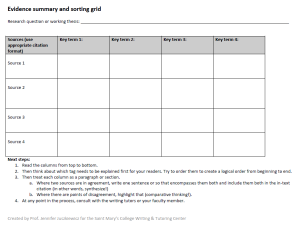
Step 1: Centering the topic and establishing the sources
By the time the writer works with the tutor, they have already determined their research inquiry and identified their sources, likely supported by the librarian. Ideally, they have also read their sources, perhaps adding some notes to their grid already using it as a kind of writing guide. Whatever the case, when they come to work with a tutor; that tutor will encourage them to write their topic or research inquiry at the top of the grid, if it isn’t there already. The goal here is to keep the writer’s idea literally centered on the page, rather than allowing it to become distanced from the overall project.
The writer then lists their sources, in proper citation format, in the left-hand column. In our experience, many students may want to defer the challenge of formatting their citations until the end of their project. They then panic about whether the citation style is correct and may overestimate the accuracy of online citation generators. By completing the citations earlier, once the sources are chosen, they will have the assurance of a tedious task completed, potentially creating an initial momentum. They will also have time to double-check any citations when they work with the tutor or consult with their faculty member.
Step 2: Key terms
Identifying key terms could initially appear simplistic or limiting; however, reminding writers of the terms they used in topic generation and database research can be a starting point for organizing sources and then ideas. Once writers have the terms, they enter them in the top row. Students may be initially tempted to include terms like “methodology” or “credibility” in the top row. If the student plans to write an entire section about comparative methodologies or sample sizes, terms related to those can work. However, since many literature reviews in nursing practice are focused on interventions that can be made by nurses in the field (Long & Beck,2017, p. 104), and interventions in research methodology tend to be done by nursing researchers, those terms tend not to give writers the necessary traction, especially if the writer is at an undergraduate level. Rather, key terms from the topic that lean toward an interventional arc tend to work better: terms that reference comparative settings or populations, typical symptoms or causes, forms of existing interventions, and so on. The key terms in the grid are most effective when they reference such specific, non-evaluative information from the sources.
Once or as writers complete that top row of terms, tutors often encourage them to talk through their ideas, perhaps by summarizing their sources, “remind[ing] students of relevant factual or procedural information” that the students already know because they’ve added it to their chart, but that they may not have yet articulated and assembled for an external audience (Cromley & Azevedo, 2005). Tutors listen for the themes in the research and moments when the writer is most enthusiastic or articulate. While writers often express that they don’t know where to start, this conversational exchange can surface the writer’s commitment and growing expertise on the topic (Trupe, 2005). The tutor, like the librarian, checks what they heard for accuracy, and then often transcribes the writers’ exact words or phrases onto scratch paper. Unlike the librarian, they are funneling that knowledge directly toward writing: asking writers to confirm whether a word is a key term, for example.
Step 3: Annotating
Long and Beck (2017) note that there are three central steps in source integration: reading, condensing, and representing (p. 175). The first step, reading, is generally completed by learners before they arrive at the appointment, although a tutor can help guide learners’ reading by helping them identify the key terms and then by using those key terms to filter annotations. The grid helps writers shift from annotating on the text into a separate document, figuratively and literally moving the writers’ ideas beyond those of one specific or several separate sources into one document the writer will use to organize. Once the key terms are set at the top of the grid, the writer uses those to complete the central boxes, providing brief notes about what each source offers regarding that key term. Not all sources will cover all key terms, of course, so some boxes may remain blank.
These boxes are small to promote the second move in Long and Beck’s structure: condensing. The small boxes encourage note taking and paraphrasing rather than copying and pasting from the original text. Admittedly, if a writer is using the grid electronically, the boxes will expand, or the writer can size down their font, but the boxes likely expand onto another page, which can be annoying, and the tiny font is less readable. This productive constraint pushes writers into pulling more concise and focused articulations of the source’s information.
Step 4: Recursive research and identifying gaps
Once a writer has a complete or near-complete grid, they can determine what key words either haven’t been covered or haven’t been sufficiently covered by their existing sources. That may take them back to do additional research, or they may decide to refine their topic or research question. They may need to touch base with the research librarian again or with their faculty member. Even with the support of the grid, learners may not realize where the gaps exist until they actually start working with paragraphing and transitions.
Tutoring and the evidence grid
At this point, the writer has reached the most challenging point in the process: the drafting of sentences and paragraphs that put these sources into conversation. Long and Beck (2017) note that many novice nursing writers struggle here, simply stacking or patchworking sources rather than finding connections between them (p. 103). Writers using the grid aren’t trying to identify those connections at the same time they are drafting sentences because the grid uses the key words as the linking structure. Therefore, students already have a starting point for potential organization, and they have already represented the articles in their own words via the annotations, so they know what they are linking and why.
This modulates some of the pressure of the drafting process, but this is not always obvious to the writers, who don’t always realize how much work they’ve already completed until we sit down to discuss moving from the chart into the draft. These appointments often require us to toggle between three documents, similar to what the student experienced with the librarian. In this case, the documents are the grid, the assignment sheet, and a drafting document. Jennifer Juszkiewicz asks questions that guide the student into an outline: Does the assignment ask for information first, second, last? Does the assignment require subheadings? Is there a sample paper that could be used as a guide? The goal is to have the writer use the assignment sheet and their grid to plan.
These tutorials are also an opportunity for the writer to begin voicing their knowledge aloud. Echoing questions Karen described in her section, because our writing tutors are generalists, they often acknowledge their own ignorance and ask the writer to explain the project to them: “I don’t know much about this topic. Could you give me a brief overview?” The tutor can take notes as the writer speaks, and then the tutor can try to re-voice what they heard back to the writer. This can help the writer identify what needs to be in the background or introductory section of their assignment. Tutors may follow up with more nuanced questions: “You have five sources here. Which one did you like best? Why?” While this kind of question seems to be merely about identifying preferences, the answer is often more about how clearly written and useful the source was to the writer’s project, which is the tutor’s goal.
If the writer needs additional prompting, though, the tutor can point to one of the boxes on the grid and ask what the specific note means and how other sources in that column relate to it. One strategy writers in our center have found helpful is using the key terms as subheadings or paragraph topics, at least temporarily, in their literature review drafts. So, if the student is writing an essay about how to prevent healthcare-associated infections (HAI) in a rural emergency department (ED) setting, the key terms may be key causes of HAIs, rural ED setting, and nursing interventions. The tutor will guide the writer to consider the arc of the argument — again, perhaps by consulting the assignment sheet as a guide — likely beginning with the broadest considerations (such as setting) before moving into the more specific causes and ending with nursing interventions. That said, the writer may decide to organize differently and their articulation of why they want to do so can help them refine their understanding of their claim and their audience (Bean & Melzer, 2021, p. 40). Tutors also often draw attention to these moments of reflection as organizational opportunities: for example, if a writer explains why they want to move from one point to another to the tutor, they should also make their reasoning evident to their reader with transitions.
Throughout the conversation, the writer is explaining the source, and the tutor is taking brief notes and often revoicing the writer’s ideas back to them. If the writer gains steam, the tutor often gestures to the drafting document and encourages them to write down their ideas, consulting the tutor’s bare-bones notes as a guide if need be.[4] As the conversation develops, the tutor often weaves in motivational scaffolding: repeatedly pointing out how the writer clearly understands the sources and the way they interact—they just needed some distance from their research and a chance to talk through their ideas with a curious, generous listener like a tutor (Cromley & Azevedo, 2005). The rhythm of this conversation is likely familiar to many who have tutored or worked with tutors. In this case, the back-and-forth is facilitated by the organizational heuristic of the grid. When a writer brings their drafted grid to a writing tutorial that grid and their explanations of it are clear, material evidence of their knowledge. When they explain the grid to the tutor—toggling between sources, notes, and drafts—they are shifting from documenting knowledge for themselves (writer-based drafting) in the grid to articulating that to the tutor as an audience (reader-based prose) (Trupe, 2005; Ryan & Zimmerelli, 2016) The grid serves as a surprisingly flexible frame by which students continue to develop the necessary skills in order to improve their critical thinking and linguistic fluency. It becomes a kind of study guide for their own project, something to which they can refer back as they continue to draft. Did they miss something? Did they misrepresent something? This tool also helps with empowerment; the writer may come to better trust their own research and reflection process as they use the grid they created.
Takeaways
Writing assignments are historically a primary way in which we assess a student’s learning and thinking. Research-based writing assignments are ways we assess particular types of learning and thinking with sources in the context of a particular discipline. Faculty and academic support services are concerned not only with the specific assignment, though; we should also aim to provide students the time, space, and support needed to become more reflective about their writing process: what resources help them, what steps work for them, how they want to sound to their audience. This process differs for every person. However, it is clearly a process that needs to be taught, and that teaching can happen effectively via one-on-one conversations with students, conversations where the questions are motivated by empathy and designed to engage, encourage, and empower writers.
As has been noted in writing studies scholarship, faculty should not presume students’ literacy skills in the areas of research, information, writing, digital tools, or even awareness of resources generally (Newton & Feinberg, 2020). Teaching all these literacy skills may appear overwhelming for an individual faculty member; however, they need not be conceived as an individual faculty member’s task alone. When viewed more holistically, the steps from research to writing articulated in this article are an arc of skills that faculty and academic resource services can collaboratively address through scaffolded approaches to student learning, together working from a position of empathy and encouragement with the students.[5]
This all requires open communication between instructional faculty and student support services. In conversations with faculty, those faculty can articulate disciplinary terms, assessment values, and standards of source credibility. This is why Faix et al. (2013) strongly advocate that librarians and faculty discuss research assignment expectations in advance. Doing so benefits faculty regarding their own teaching as well: such discussions can help them practice articulating and defining the requirements of the assignment prior to introducing it to the students. Primarily, though, having these conversations in advance can help librarians and tutors prepare. They can then more deliberately guide developing researchers and writers who often have difficulty expressing their information needs. Whether in a consultation with a librarian or in a writing tutorial, an informed support person has the necessary context to advise the writer within the instructor’s guidelines (Magi & Mardeusz, 2013; Newton & Feinberg, 2020). Magi and Mardeusz (2013) found that, in addition to resource navigation and search support, students use librarian-led research consultations to gain understanding and clarity of the assignment. This is also true of writing consultations. Even when students bring assignment sheets and other materials with them to the appointment, they may not yet be confident in interpreting those materials in the context of the course. Conversations among all constituents in advance help close the circle and create a sense of coherence and trust among all involved.
Faculty who fully engage in this collaborative model are also able to defer to the expertise of the librarian and tutors, with all working as complements to the other and dividing the labor. For example, rather than modeling research and information literacy techniques, instructional faculty can instead focus their efforts on discipline-specific knowledge and support. In distributing the workload of student support between faculty, librarians, and writing specialists, each focusing on their niche skill, all of these supports essentially divide the workload and so can help more students and reduce their potential for overwork or burnout, all without sacrificing assignment rigor.[6]
Conclusion
A great deal of collaboration is already happening at many institutions between librarians, writing specialists, and faculty. While our focus is on the benefits for the health sciences, such collaboration can be fruitful across the disciplines, especially when constituents are aware and supportive of each other’s differing and overlapping pedagogical approaches. This collaboration can also lead to revisions in pedagogy more widely: seeing how librarianship adapts Socratic questioning and writing tutors teach scaffolding has certainly helped both authors here refine our own practices. These conversations have also led to more informed referrals between faculty, librarians, and tutors, creating and reflecting a sense of cohesion, solidarity, and trust in each other’s specialization and in the broader, integrated nature of higher education.
References
Agnihotri, Sarah K., Chan, Tracey, Haldane, Neal, Lalinsky, Caleb, & Weaver, Jennifer. (2022). “Semi-embedding” writing center specialists in a Master’s-level nursing course to improve perceptions of writing support. In Michael J. Madson (Ed.), Teaching writing in the health professions: Perspectives, problems, and practices (pp. 80-91). Routledge.
Association of College & Research Libraries. (2016). Framework for information literacy for higher education. American Library Association. https://www.ala.org/acrl/standards/ilframework
Bean, John C., & Dan Melzer. (2021). Engaging ideas: The professor’s guide to integrating writing, critical thinking, and active learning in the classroom (3rd ed.). Jossey-Bass.
Brickhouse, Thomas C., & Smith, Nicholas D. (2009). Socratic teaching and Socratic method. In Harvey Siegel (Ed.), The Oxford handbook of philosophy of education (pp. 177-194). Oxford University Press.
Cromley, Jennifer G., & Azevedo, Roger. (2005). What do reading tutors do? A naturalistic study of more and less experienced tutors in reading. Discourse Processes, 40(2), 83-113. https://doi.org/10.1207/s15326950dp4002_1
DeGenaro, William. (2014). “Where did all the white girls come from?”: Difference and critical empathy in and out of the service learning classroom. Open Words: Access and English Studies 8(1). https://wac.colostate.edu/openwords/archive/v8/
Faix, Allison, MacDonald, Amanda, & Taxakis, Brooke. (2014). Research consultation effectiveness for freshman and senior undergraduate students. Reference Services Review, 42(1), 4-15. https://doi.org/10.1108/RSR-05-2013-0024
Gale, Crystal D., & Evans, Betty S. (2007). Face-to-face: The implementation and analysis of a research consultation service. College & Undergraduate Libraries, 14(3), 85-101. https://doi.org/10.1300/J106v14n03_06
Hewett, Beth L. (2015). Postscript: Toward a theory of conference-based teaching: 2015 update. In Beth L. Hewett, The online writing conference (pp. 169-173). Bedford/St.Martin’s.
Jaeger, Gary. (2016). (Re)examining the Socratic method: A lesson in tutoring. Praxis 13(2). https://www.praxisuwc.com/jaeger-132
Kazan, Tina S., Behm, Nicholas N., & Cook, Peg. (2021). Writing faculty and librarians collaborate: Mapping successful writing, reading, and information literacy practices for students in the post-truth era. Pedagogy 21(2), 311-328. https://doi.org/10.1215/15314200-8811500
Kilmer, Michele, Bradley, Callie, Raines, Anne, & Blair, Dana. (2023). Integrating writing throughout the curriculum in Doctor of Nursing Practice programs: A collaborative model for success. Journal of Nursing Education 62(4), 241-248. https://doi.org/10.3928/01484834-20230208-06
Lee, Deborah. (2004). Research consultations: Enhancing library research skills. The Reference Librarian, 41(85), 169-180. https://doi.org/10.1300/J120v41n85_13
Long, Thomas Lawrence, & Beck, Cheryl Tatano. (2017). Writing in nursing: A brief guide. Oxford University Press.
Luthy, Karlen E., Peterso, Neil E., Lassetter, Jane, H., & Callister, Lynn C. (2009). Successfully incorporating writing across the curriculum with advanced writing in nursing. Journal of Nursing Education, 48(1), 54-59. https://doi.org/10.3928/01484834-20090101-07
MacDonald, Susan Peck. (1994). Professional academic writing in the humanities and social sciences. Southern Illinois University Press.
Mabry, Celia H. (2004). The reference interview as partnership: An examination of librarian, library user, and social interaction. The Reference Librarian, 40(83–84), 41-56. https://doi.org/10.1300/J120v40n83_05
Madson, Michael J. (2022). Introduction: Writing in the health professions: An emergent interdiscipline for teachers. In Michael J. Madson (Ed.), Teaching writing in the health professions: Perspectives, problems, and practices (pp. 1-9). Routledge.
Magi, Trina J., & Mardeusz, Patricia E. (2013). Why some students continue to value individual, face-to-face research consultations in a technology-rich world. College & Research Libraries 74(6), 605-618. http://crl.acrl.org/content/74/6/605.full.pdf+html
Malenke, Lucy Bryan. (2023). Context matters: Identifying strategic opportunities to support health literacies through writing interventions. In Michael J. Madson (Ed.), Composing health literacies: Perspectives and resources for undergraduate writing instruction (pp. 105-136). Routledge.
Mitchell, Kim M., McMillan, Diane E., Lobchuk, Michelle M., & Nickel, Nathan C. (2020). Writing activities and the hidden curriculum in nursing education. Nursing Inquiry, 28, e12407. https://doi.org/10.1111/nin.12407
Newton, Lauren, & Feinberg, Daniel E. (2020). Assisting, instructing, assessing: 21st century student centered librarianship. The Reference Librarian, 61(1), 25–41. https://doi.org/10.1080/02763877.2019.1653244
Robinson, Shannon M. (2017). Socratic questioning: A teaching philosophy for the student research consultation. In the Library with a Lead Pipe. https://www.inthelibrarywiththeleadpipe.org/2017/socratic-questioning/
Ryan, Leigh, & Lisa Zimmerelli. (2016). The Bedford guide for writing tutors (6th ed.). Bedford/St.Martin’s.
Sikora, Lindsey, Fournier, Karine, & Rebner, Jamie. (2019). Exploring the impact of individualized research consultations using pre and posttesting in an academic library: A mixed methods study. Evidence Based Library and Information Practice, 14(1), 2–21. https://doi.org/10.18438/eblip29500
Trupe, Alice L. (2005). Organizing ideas: Focus is the key. In Ben Rafoth (Ed.), A tutor’s guide: Helping writers one to one (2nd ed., pp. 98-106). Boynton/Cook.
Notes
[1] In my experience before, during, and after the pandemic, I’ve found that Socratic research consultations work best via in-person meetings, although they can work (if less fluidly) via chat. Chat reference requires time for the participants to reflect and compose written responses. This feels like it takes more time than a verbal dialogue, even if it doesn’t actually take longer. During chat, then, the librarian needs to be even more strategic about which and how many questions to pose. In-person, embodied conversations allow for a wider range of expression and tone with fewer delays throughout. To see more about conversational strategies in online consultations, refer to Hewett, Beth L. (2015). Toward a theory of conference-based teaching: 2015 update. In The Online Writing Conference (pp. 169-173).
[2] A LibGuide is both the proprietary name and informal term for the content management platform for library pathfinders and the pathfinder itself. LibGuides point users to resources most relevant to the discipline, course, or assignment. These pathfinders are curated by individual librarians for their library in conversation with the disciplinary faculty and aim to provide a starting point for research in an environment with an overwhelming number of unfamiliar choices. LibGuides typically include recommended library databases and web resources, as well as instructional content: screen-capture video tutorials, instructions with screenshots, and support materials.
[3] The differences in our practices express a difference in approach akin to the debate between non-directive and directive practices in writing tutoring. Non-directive tutoring, a form of which is called “minimalist tutoring,” positions the tutor primarily as a questioner guiding the student. Directive tutoring positions the tutor as the director, giving specific feedback about what should happen next in the drafting process. Most practitioners and scholars today agree that a contextualized mix of both approaches is best, but the individual tutor’s comfort with each can reflect how they envision how much guidance a tutor should offer in order to respect the learner’s agency and authority with regard to their project.
[4] Tutors have anecdotally noticed that these moments are when writers often ask if they can “just sit here and write for a little while” because the ideas have crystallized for them. The tutor will then step back and work on their own tasks, checking back in as the writer needs them.
[5] This also creates the potential for student empowerment. After all, as Sikora et al. (2019) found, students “appreciate the new knowledge they have acquired after meeting with a librarian”. This is true across many fields. Sikora et al.’s study assessed the impact of individual research consultations in health sciences, including nursing science, and found an increase in students’ applied search abilities as well as their information retrieval skills. Another helpful model of collaboration between writing faculty and librarians can be found in Kazan et al.’s 2021 article “Writing faculty and librarians collaborate.”
[6] One timing note to consider, though: When faculty connect students with librarians and writing specialists, they should consider a just-in-time or point-of-need approach. If students are referred too late to the support service, they may become frustrated. However, there are also hazards if they are referred too early in their process. Students may not remember to consult the resource when they reach that step in their process, as they learned about the resources too early. Specificity is also key in referrals. When students are given a blanket direction to go to the library or writing center, they may be less likely to realize when they have reached a point where intervention would be constructive. However, when the instructor provides specific direction, students have greater clarity or direction and purpose; talk to the librarian about x or review these pages with the writing center to work on organizational strategies.