Joshua Finnell
Associate University Librarian
Director of Research & Scholarly Initiatives
Colgate University
A Brief History of Vending Machines
The Hellenistic Age is not often considered a golden era of automation, but inventors such as Archimedes, Heron of Alexandria, Ctesibius, Dionysius of Alexandria and Philon of Byzantium were some of the first inventors to ponder the development of a mechanized world. Some modern scholars have even revisited this time period to uncover Artificial Intelligence’s “ancient origins.”1 Fanti, Lucrezia, Dario Guarascio, and Massimo Moggi. 2022. “From Heron of Alexandria to Amazon’s Alexa: A Stylized History of AI and Its Impact on Business Models, Organization and Work.” Journal of Industrial and Business Economics 49 (3): 409–40. https://doi.org/10.1007/s40812-022-00222-4. Whereas Ctesbius invented the first self-regulated water clock, Philon of Byzantium developed the world’s first robot – a life-size servant that automatically poured wine into an empty cup placed in its left hand.2Rossi, Cesare. 2016. “The Beginning of the Automation.” In Advances in Robot Design and Intelligent Control, edited by Theodor Borangiu, 59–67. Cham: Springer International Publishing. https://doi.org/10.1007/978-3-319-21290-6_6. Perhaps the most surprising invention to emerge from this era is the vending machine. Credited to Heron of Alexandria, the world’s first vending machine dispensed water for ritualistic cleansing before entering temples in Egypt.
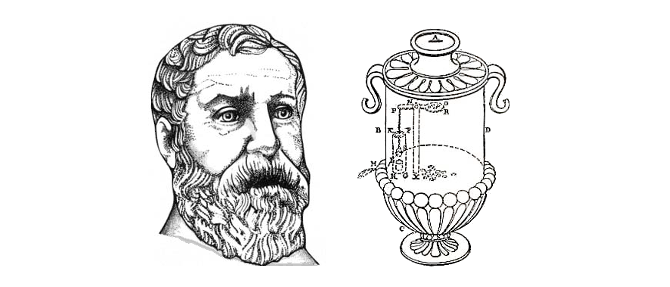 Heron of Alexandria and his coin-operated water dispenser
(image credit: https://www.vendtrade.co.uk/history-of-vending-machines-part-i/)
In Vending Machines: An American Social History, Kerry Seagraves points out that the vending machine was of little use until about the 17th century when Inn keepers in England used a coin-operated door (not unlike newspapers dispensers) to sell tobacco to patrons.3Segrave, Kerry. 2002. Vending Machines: An American Social History. McFarland. Curiously enough, it wasn’t candy or stickers that spurred the next iteration of vending machines – it was freedom of the press. In 1822, Richard Carlisle was a publisher and bookseller fighting for freedom of the press, religious freedom, and a critic of the Church of England. Facing legal action for publishing and selling radical authors such as Thomas Paine, Carlisle developed a vending machine that allowed someone to buy one of his books without having to interact with a person. This automated process, Carlisle presumed, would free him or any of his employees from any legal liability. The courts of England did not agree and he was jailed.4Bush, M. L. 2016. The Friends and Following of Richard Carlile: A Study of Infidel Republicanism in Early Nineteenth-Century Britain. Great Britain: Twopenny Press. Though vending machine culture would expand to dispensing everything from lottery tickets to stamps to energy drinks, it’s important to underscore the connection between the development of the vending machine and print culture. The long tail of Carlisle’s invention can be seen in Craig Small’s BIBLIO-MAT, a random book vending machine built to distribute $2 mystery titles to customers at Monkey Paw’s, an antiquarian bookstore in Toronto.
The Thomas Adams Gum Company is largely credited with developing the traditional gumball machine in the United States in the late 1800s.5Redclift, Michael. 2002. “Chewing Gum in the United States and Mexico: The Everyday and the Iconic.” Sociologia Ruralis 42 (4): 391–403. https://doi.org/10.1111/1467-9523.00223. Traditional gumball machines would populate grocery stores and sidewalks across America until vending machines evolved into small plastic capsule dispensers containing an assortment of toys. This type of vending machine is called a gashapon capsule machine, and it was developed in Japan in the 1960s by Ryuzo Shigeta.6“Gachapon: The Culture & History of Japanese Capsule Toys (blog). March 9, 2019. https://guidable.co/culture/gachapon-a-unique-japanese-culture-you-should-not-miss/. The term itself is onomatopoeic, referring to both the sound the hand crank makes when turned (gasha, gasha, gasha) and sound of the plastic capsule landing in the metal tray (pon). The Bandai toy company would eventually trademark gashapon in 1977 and distribute the machines and toys worldwide. Though less popular today in the United States, due to the decline of in-person shopping and the exchange of physical currency, these machines were the highlight of many children’s trips to the grocery store in the 1980s and 1990s.
Vending Machines Reimagined
With the closing of big-box retailers and malls across the United States in the early and mid-2000s, gashapon capsule machines were decommissioned and relegated to the antique stores, second-hand shops, and Craigslist postings. As inexpensive portable distribution systems, vending machines of all types have been repurposed by artists to create new ways for individuals to create free or inexpensive encounters and engagement with art outside the confines of a museum. In 1997, Clark Whittington transformed an old cigarette machine into an art dispenser for an art show at a local cafe in North Carolina. Instead of packs of unfiltered Pall Mall cigarettes, the machine distributed polaroid pictures mounted on wooden blocks for $1.00 each. After the show concluded, the cafe owner asked that the machine become a permanent fixture. Clark, along with a cohort of artists, used this as inspiration to launch Artists in Cellophane and develop over 200 Art-o-mat® installments across the country.7“About | Art-o-Mat®.” n.d. Accessed June 4, 2025. https://www.artomat.org/about/.
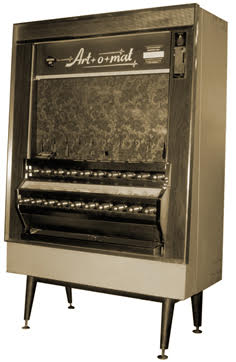 Art-o-mat by Clark Whittington (image credit: https://www.artomat.org/about/)
In collaboration with the 2022-2024 Visiting Writer Erin Dorney, The Adirondack Center for Writing (ACW) repurposed a number of gashapon machines to distribute poems and other writing throughout the Adirondack region. Created in eastern upstate New York in 1892 as one of the first Forever Wild Forest Preserves in the nation, the Adirondack Park is a unique wilderness area and a National Historic Landmark. At 6 million acres, it is the largest publicly protected area in the contiguous United States.
Inside the Poetry Machine are 10 different poems. Each features a unique style of poetry: haiku, cento, epistolary, list, ode, ekphrasis, prose poem, how-to, erasure, and cut-up. The machine featured work by the following poets:
- Julia Bloch – “Dear Kelly [p.43]”
- Erin Dorney – Erasure and cut-up poems
- Camille T. Dungy – “this beginning may have always meant this end”
- Ashley M. Jones – “Summer Vacation in the Subjunctive”
- Lillian Klein – “Quarantine Haiku”
- Laurie Kolp – “Carry Me”
- Steven Leyva – “Ode to Lando Calrissian”
- Kathleen Lynch – “How To Build An Owl”
- Sasha Pimentel – “The Kiss”
The repurposed Poetry Machine aligned with the mission of the Adirondack Center for Writing to inspire a love of writing, reading, and storytelling by building and maintaining a community of writers, readers, and listeners across disciplines, traditions, ages, and geographies. Also, the poetry machine fostered partnerships with diverse individuals, organizations, and schools to promote the craft of writing and the practice of reading in surrounding communities.
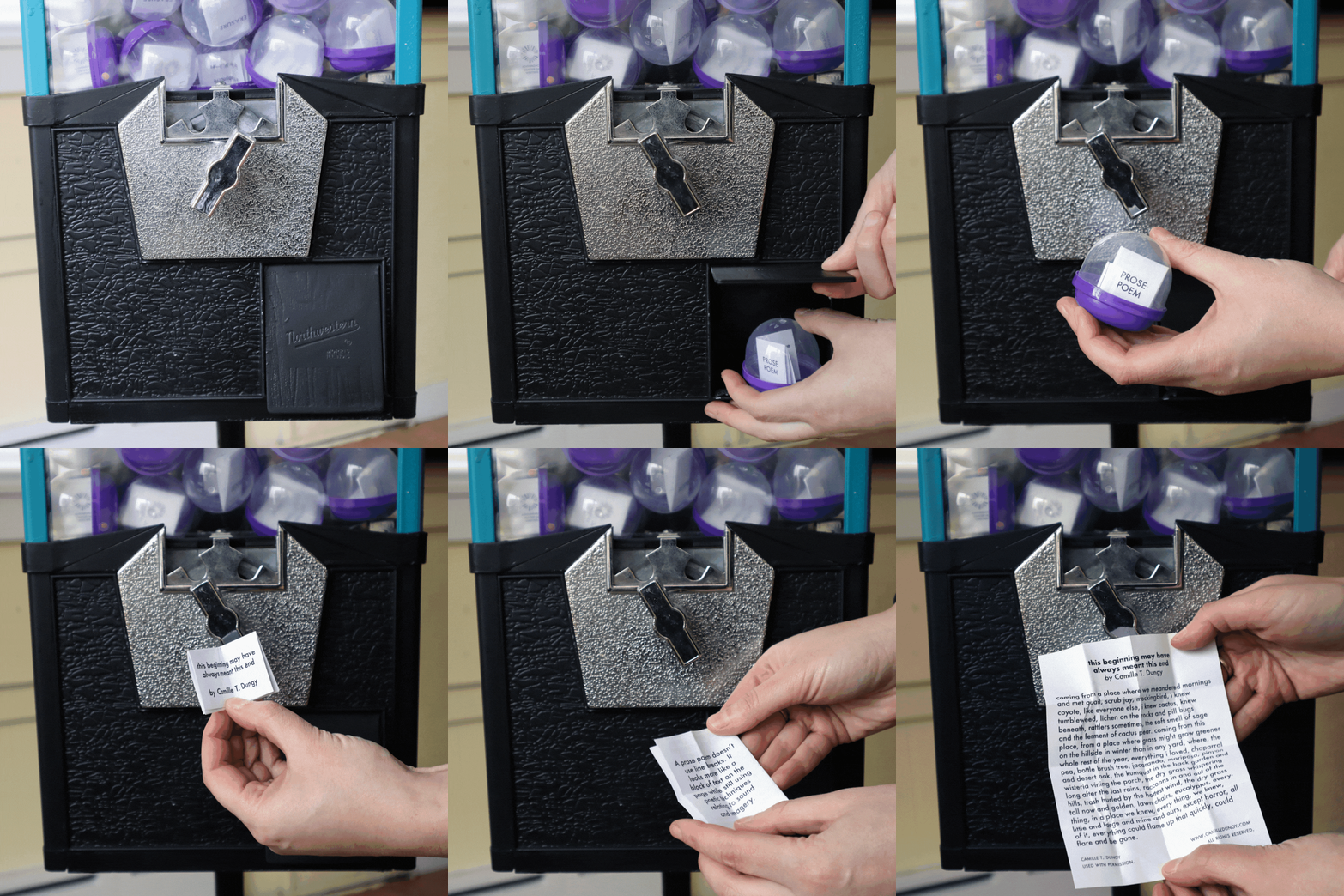 ACW Poetry Machine (image credit: https://adirondackcenterforwriting.org/machines/)
National Poetry Month and Colgate University Libraries
In April 1966, the Academy of American Poets created National Poetry Month to acknowledge and celebrate poetry’s integral role in the history and culture of the United States. Today, it is considered one of the largest literary celebrations in the world, with events and celebrations taking place in schools, bookstores, and libraries across the country in the month of April. The American Library Association has been active in marketing National Poetry Month in school, public, and university libraries for decades.
Colgate University Libraries has celebrated National Poetry Month in myriad ways, from mounting exhibits in the library to inviting faculty to read selections from their favorite books of poetry. Geographically, Colgate University and Hamilton, New York, are located in the lower foothills of the Adirondack mountains and are a symbol of leisure, adventure, research, wonder, and protection. The University’s connection to the Adirondacks and Upstate Institute partnership with the Adirondack Center for Writing, fostered a unique opportunity to bring the Poetry Machine to campus and to the surrounding community of Hamilton in April 2025 to celebrate National Poetry Month and the Adirondacks.8This project was funded by a grant from the Colgate University Upstate Institute and additional support from the Colgate University Libraries. By placing the poetry machine in a local coffee shop, local theater, the Hamilton Public Library, and at various points around campus during the month of April, community members experienced serendipitous interactions with poetry. Over 400 poems were distributed during a single month, and a companion exhibit of poetry chapbooks was displayed in the Case-Geyer Library at Colgate University to facilitate deeper discovery.
Magic, Serendipity, Discovery, and the Poetry Machine
The great experimentalists of the Hellenistic Age often conceived of their devices as theatrical performances that enacted the magical theater of the Gods. Though meticulously crafted by human hands, the goal was to dazzle and mesmerize individuals with their feats of engineering. Though developed in an attempt to avoid legal culpability, Richard Carlisle’s book vending machine was also carefully curated and stocked by human hands, but it also presented patrons with an opportunity to engage in a new transactional relationship and discover print culture without the presence of a human being. The first person to dispense water from Heron of Alexandria’s water vending machine in 70 CE and the first individual to obtain a book from Carlisle’s book vending machine in the 1800s probably happened upon these inventions by pure chance. A serendipitous discovery.
Serendipity is generally defined as the accidental discovery of something valuable while searching for something else. It’s also a hotly contested component of the library research process: is it a failure of library systems or facilitated by the physical design of libraries, the cataloging record, or the discovery layer?9Carr, Patrick L. 2015. “Serendipity in the Stacks: Libraries, Information Architecture, and the Problems of Accidental Discovery.” College & Research Libraries 76 (6): 831–42. Regardless, serendipitous discovery often feels like a magical act to an individual. From stumbling upon the perfect book in the library stacks to walking into a beautiful meadow while on a hike. Serendipitous discovery was a core component of the Poetry Machine project, and the ability for individuals to engage with the machine in anonymity (covertly looking left and right before cranking the handle) while also being surprised with a poem was pure magic to witness.
Joshua Finnell is the associate university librarian and director of research & scholarly initiatives at Colgate University. He is also a full professor in the University Libraries. He currently serves on the advisory board of the Colgate University Upstate Institute.
Additional Readings
- The Poetry Machine: Colgate and the Local Community Celebrate National Poetry Month
- Poetry Machine Comes to Campus, Hamilton