By Ralf Regener
Library, Open Access and Writing Consulting
Magdeburg-Stendal University of Applied Sciences
Magdeburg, Germany
ORCID-ID: http://www.orcid.org/0000-0001-7664-2956
Originally published as Ralf Regener: Open Access Green und ResearchGate. Wie sollten Bibliotheken damit umgehen?, in: Bibliotheksdienst 58 (2024), Heft 3/4, S. 194-205. https://doi.org/10.1515/bd-2024-0034
Published online: 2024-04-08
Published in print: 2024-04-25
© 2024 by the authors, published by Walter de Gruyter GmbH, Berlin/Boston
This translation was made by the author.
Abstract
ResearchGate is one of the most successful science communication websites. A key aspect is the provision of scientific publications by scientists themselves. The article advocates a better understanding of ResearchGate‘s success story in order to gain more insights for further improvements and optimization of our library services in the area of Green Open Access.
1. Introduction
Secondary publications (also known as self-archiving or Green Open Access) are an important component of Open Access. There are initiatives, such as Deep Green; subject-specific repositories are available, and almost every academic institution now has its own repository or is involved in a larger project.1 To a greater or lesser extent and with varying degrees of commitment the green variant is being pursued alongside other options. Scientists should publish their articles a second time, usually after the embargo period has expired, and make their research open access in this way.
However, if you look at secondary publications not only within the narrow institutional context, but also beyond, one quickly comes across ResearchGate. As part of a survey of publication data at the Magdeburg-Stendal University of Applied Sciences (h2) for the year 2022, it became clear that a not inconsiderable of the publications could also be found on ResearchGate, i.e. were made accessible there by the researchers parallel to the first publication.
This article analyses the aforementioned publication data, puts them in relation to the surveys conducted at h2 in 2019 and 2023, in order to pose the questions of what conditions are found at ResearchGate, why it is successful and what an institution should understand and learn from it.
ResearchGate as a general phenomenon of science communication2 will not be analyzed here. Individual aspects that are relevant to the Green Open Access topic are analyzed in more detail in the text. Other aspects, such as Open Review, the ResearchGate score, spam mails and automatically created and incorrect profiles3, are not dealt with, or only to a limited extent if they belong to the narrower context.
2. Surveys, data collection and findings on Green Open Access
Surveys on the topic of Open Access were conducted at Magdeburg-Stendal University of Applied Sciences in 2019 and 2023. The aim of the surveys was to evaluate the status of Open Access at h2. The key questions were: How high is the acceptance of open access? How high is the proportion of scientists who publish Open Access? What is the usage behavior and how do they publish? What support services are needed?4
In addition to the surveys, a publication overview for the previous year was also compiled for the first time in 2023. A total of 202 publications for the year 2022 were recorded from data sources at the university itself – the information provided by academics for the performance-oriented allocation of funds and publication overviews of employees on their university websites – as well as research on the internet, for example in the Saxony-Anhalt research portal.5
In addition to determining further steps, both in terms of improving the database, the re-utilisation of data, the efficient use of financial resources for Open Access and the establishment of new services, the surveys provided interesting insights into the topic of Green Open Access and the players in this field.
A comparison of the surveys initially shows that far more academics rate open access as very important in 2023 than in 2019, rising from 45 percent to 67 percent.
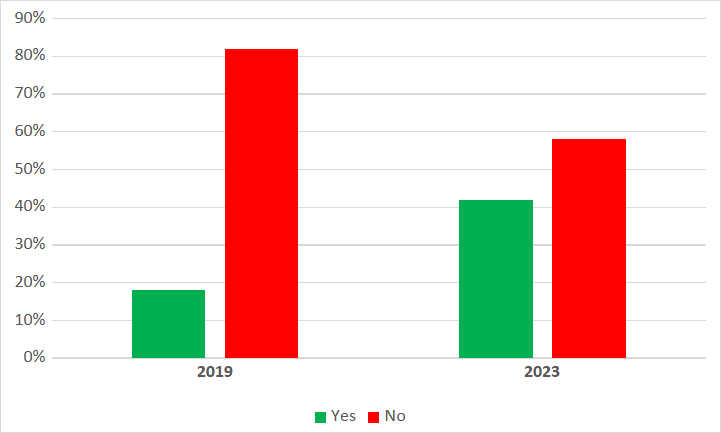
At the same time, the proportion of open access green publications also increased; whereas in 2019 only 18 percent had additionally and simultaneously published free of charge on the internet, by 2023 this figure had risen to 42 percent (Figure 1).
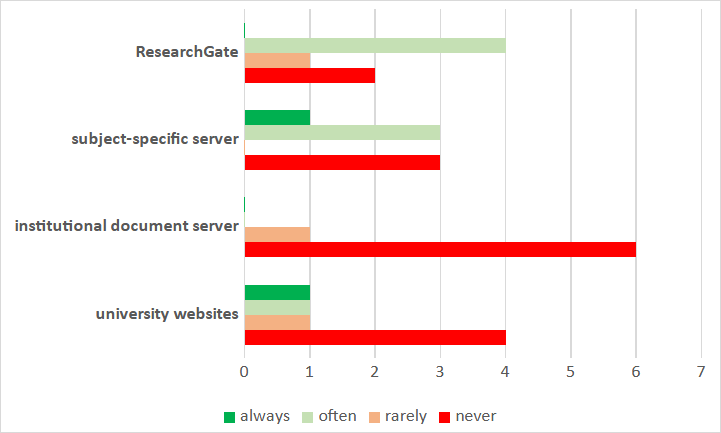
What has remained more or less the same, however, is the use of Open Access Green services in particular. It can be seen that the institutional document server was hardly used at all. A similar statement also applies to university websites. In contrast, there is a clear preponderance in favor of subject-specific document servers and ResearchGate (Figures 2 and 3).

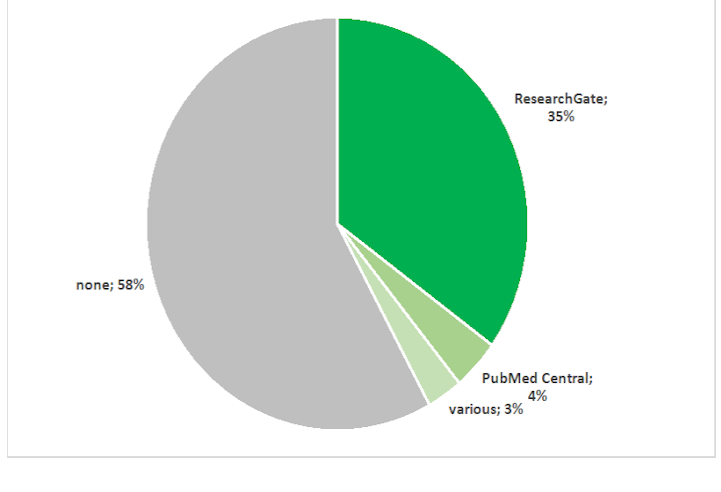
This statement is supported by the results of the survey for the publication year 2022. Thirty-five percent of publications were once again published via ResearchGate. PubMed Central still had a noticeable share of 4 per cent, followed by 3 per cent from other sources, including the Saxony-Anhalt state repository used by h2. The largest share (58 per cent) falls into the ‘no known secondary publication’ category (Figure 4).
3. Interpretations and deductions
These findings raise several questions. What makes ResearchGate so successful? What are the advantages and disadvantages? What can we learn from it and what can we as libraries do better?
3.1 What makes ResearchGate different and/or better?
First of all, it is important to realize that ResearchGate combines at least two things. On the one hand, it is a social network6, often referred to as “Facebook for scientists”.7 You introduce yourself and your research, maintain your profile and network with other scientists in various ways.8 In addition, ResearchGate offers a range of metrics for evaluation, from reads and citations to its own development, the ResearchGate score.9
On the other hand, you can make your own research results available in full text or upload a private copy.10 You can upload preprints as well as previously published papers or posters, presentations and data. More than 20 million researchers from over 190 countries now use ResearchGate.11
ResearchGate is initially successful because it combines these two aspects. But its success also stems from the fact that ResearchGate makes it as easy as possible for authors and scientists. The design is clear and easy to understand. The full texts are easy to find. Data can be uploaded with just a few clicks; often the metadata is already correctly extracted directly from the uploaded file. There are no complicated input fields, including questions that cannot be answered without background knowledge of open access or copyright in case of doubt. There are also no questions about a license.
ResearchGate takes a two-pronged approach with regard to information on copyright and the confirmation of personal rights. After you have uploaded a file, no more than three short sentences appear, which you have to tick: You confirm that the file has been checked and verified, that you have the right to share the file or create a private copy and finally that you agree to the upload conditions. These upload conditions can be displayed directly in a small box. There again, confirmation is required that you have the necessary rights to upload and that no third-party rights are being infringed. In addition, ResearchGate is granted the right to extract and display data. This function can be deactivated in the data protection settings.
If you have ticked the box at this point without further ado, you can go to the next step, where you can enter or correct some metadata and the publication is online.
But let’s go back a step to where the conditions need to be ticked. There you will find the “small print”. There you can find out more about copyright and ResearchGate by being redirected to a separate website.12 This page is very comprehensive. It explains or specifies the essentials, for example:
- ResearchGate was developed by scientists
- The difference between public and private copying
- The responsibility for the content you upload and share
- Publishing rights and the obligation to independently review content (there is a manageable list of five publishers to date as of January 2024)
- Information on the distinction between preprint, accepted manuscript and version of Record
- Copyright infringements and possible procedures
- Information and procedures in case of uncertainties about your own rights
- Blocking and removal of content
- Restriction or blocking of accounts
- Plagiarism reports
- Relationship of co-authors
In addition to the information that appears and can be accessed directly when a file is uploaded, there is also a separate guidelines page that contains a sub-category on copyright. It states that ResearchGate respects intellectual property rights and accordingly asks all others to comply when uploading documents. No rights are transferred to ResearchGate, but content can be blocked. Authors should check their rights carefully and, if in doubt, contact the publisher directly. The site also contains a contact person and extensive information on the procedure for complaints about content published via ResearchGate.13
A study of copyright compliance and infringement on ResearchGate showed by means of a random sample that of 500 English-language journal articles, as many as 40 percent violated applicable copyright law, i.e. breached publisher specifications. It is also interesting to note that secondary publication was not excluded per se by the publishers, but that the authors had often uploaded the wrong version of their article.14
3.2 What are the advantages and disadvantages?
Institutions that deal with secondary publications or offer corresponding services should know the advantages and disadvantages in contrast to their own developments and services and also be able to make the differences clear. In addition, you should ask yourself soberly what you can learn from ResearchGate in order to improve your own services.
It has to be said quite clearly that, as much as copyright is a difficult and tough area, libraries and institutional service providers cannot leave this topic out or hide it in the small print. On the one hand, as the operator of a repository, you could potentially harm yourself. On the other hand, it would be irresponsible towards the scientists who, in case of doubt, could be prosecuted by publishers.
In the past, ResearchGate has already been sued by the publishers American Chemical Society (ACS) and Elsevier due to allegations of mass copyright infringements. Other publishers later joined in; an initiative was even founded.15 As a result, ResearchGate had to remove 1.7 million articles or block public access.16 Publishers such as Wiley and SpringerNature, on the other hand, cooperate with ResearchGate and allow the continued use of some publications.17 A settlement was recently reached between ResearchGate on the one hand and ACS and Elsevier on the other. The specific terms are confidential, but it is said that a technical solution has been agreed that allows authors who have published research articles with ACS or Elsevier to share their work on ResearchGate in compliance with copyright law.18
It is also important to realize that ResearchGate is a commercial enterprise; sooner or later, the economic aspect will take priority. Various investors have participated in the past, including Bill Gates.19 Sources of income are advertising, a question-and-answer database, job adverts and conference advertisements.20
Even though it was founded in 2008 by Ijad Madisch, Sören Hofmayer and Horst Fickenscher with a great deal of idealism21, from an economic point of view, things are important as long as they can be utilized profitably. This can have a negative impact on long-term availability and sustainability. A company can pursue other strategies in the future, change hands – as happened with the takeover of Mendeley by Elsevier22 – or simply disappear. In contrast, institutions such as research organizations, universities and libraries are places where openness, sustainability, long-term availability and legal certainty are a natural concern.23 In addition, libraries in particular have a reputation for being trustworthy, not serving individual economic interests and therefore being a reliable partner on many levels.24
Whether there is a business interest behind it or not, whether copyright is properly respected or not, ResearchGate helps to make scientific research more accessible. It is one of the top sources for full-text files that can be found via Google Scholar.25 Secondary published texts in full text are therefore easy and uncomplicated to find and use on the Internet. Originally closed access articles are made readily available. This fulfills the core and basic objective of Green Open Access.
3.3 What can we learn from this and what can we do better?
These findings on the procedures at ResearchGate plus the results from the surveys allow the interpretation that there is a fundamentally positive attitude towards Open Access among many scientists and that corresponding services are gladly accepted if they fulfill the needs of the scientists and do not lead to more administrative work. Researchers want to increase the visibility of their publication and are at least intuitively aware that Open Access secondary publications can achieve this.26 However, there is very little willingness to deal with open access colors, the allocation and use of persistent identifiers such as DOI or archiving strategies and copyright. Multiple recording of one’s own publication with different input fields, and answering a wide variety of questions with changing formats is also not something one likes to do.
There is also the paradox that the handling of copyright described above is probably one of ResearchGate’s strengths. It can be assumed that not all authors have considered what rights they still have to their text and whether secondary publication is permitted at all.27
What can we learn from this for our own services? Certain aspects of ResearchGate cannot and should not be imitated. Copyright law is the way it is and we have to deal with it responsibly. Implementing an effective social network, including for researchers, is not a task for a single scientific institution.
However, if we take seriously the realization that open access is generally supported, but the associated work is rejected, we should consider what work is really necessary and how and by whom it should be done. A first basic assumption would be that the success of an institutional service can only be achieved if the researchers are given as little work as possible. If relevant publications and the corresponding conditions for secondary publication can be identified without the researcher’s effort, then one only has to ask whether a contribution can be deposited in the institutional repository in a legally compliant manner.
If further work by the researcher is necessary, then ask for as little information as possible – no questions that only librarians understand, no complicated input fields and only use specialized terminology if it is really necessary.
It is certainly advisable to approach authors who already have many publications to their name. They tend to have background knowledge of Open Access and an interest in the topic. A large number of publications can be more effective to process and, if it works, a presentable number is achieved; a fact that can help to convince other authors.
4 Conclusion
Is what is deposited on ResearchGate really Open Access? If you apply strict criteria, certainly not:28 No licenses are granted. Articles are not made available in a screened, standards-compliant and open archive.29 However, the important question in this article is not what is open access, but what we can learn from successful services.
Whatever you think of ResearchGate, you have to recognize its success. It’s a little reminiscent of Google or Wikipedia; services whose omnipotence, inadequacies and dangers are constantly warned about and yet which have a huge market share and an oversized reach. So it’s not about advertising for anyone, nor is it about imitating dodgy things because it promises success. It’s about understanding why something is successful, even if you disapprove of it from a certain perspective. It’s about learning to anticipate needs and do better with your own services.
The success of ResearchGate should lead us to initiate improvements in our own services; to take the good as an example and at the same time to inform researchers about the questionable.
References
1 The universities and colleges of the state of Saxony-Anhalt jointly use Share_it, the open access and research data repository of the university libraries in Saxony-Anhalt, https://opendata.uni-halle.de [accessed: 07/02/2024].
2 Cf. Böhme, Uwe; Tesch, Silke: Akademisch und vernetzt. In: Nachrichten aus der Chemie 64, 12
(2016), pp. 1180–1184, https://doi.org/10.1002/nadc.20164053034.
3 Cf. Van Noorden, Richard: Online collaboration: Scientists and the social network. In: Nature
News 512 (2014), pp. 126–129, https://doi.org/10.1038/512126a.
4 Cf. Hartmann, Lisa; Mey, Günther; Baumgarten, Kerstin; Schache, Christian: Ergebnisbericht zur Online-Befragung über Open Access an der Hochschule Magdeburg-Stendal im Zeitraum vom 23. Mai bis zum 7. Juli 2019, https://www.h2.de/fileadmin/user_upload/Ergebnisbericht_OA_Umfrage_HS_MD-SDL_2020.pdf [accessed: 07/02/2024].
5 Saxony-Anhalt Research Portal, https://forschung-sachsen-anhalt.de [accessed: 07/02/2024].
6 Cf. Manca, Stefania: ResearchGate and Academia.edu as networked socio-technical systems for scholarly communication: a literature review. In: Research in Learning Technology 26 (2018), pp. 1–16, https://dx.doi.org/10.25304/rlt.v26.2008
7 Cf. Böhme, Uwe; Tesch, Silke: Akademisch und vernetzt. In: Nachrichten aus der Chemie 64, 12 (2016), pp. 1180, https://doi.org/10.1002/nadc.20164053034.
8 Cf. Vgl. Van Noorden, Richard: Online collaboration: Scientists and the social network. In: Nature News 512 (2014), pp. 126–129, https://doi.org/10.1038/512126a.
9 Cf. Nicholas, David; Clark, David; Herman, Eti: ResearchGate: Reputation uncovered. In: Learned Publishing 29, 3 (2016), pp. 173–182, https://doi.org/10.1002/leap.1035.
10 Cf. Thelwall, Mike; Kousha, Kayvan: ResearchGate: Disseminating, communicating, and measuring Scholarship? In: Journal of the Association for Information Science and Technology 66, 5 (2014), pp. 876–889, https://doi.org/10.1002/asi.23236.
11 Cf. About ResearchGate, https://www.researchgate.net/about [accessed: 07/02/2024].
12 https://help.researchgate.net/hc/en-us/articles/14846037644817 [accessed: 07/02/2024].
13 https://www.researchgate.net/ip-policy [accessed: 07/02/2024].
14 Cf. Jamal, Hamid R.: Copyright compliance and infringement in ResearchGate full-text journal articles. In: Scientometrics 112 (2017), pp. 241–254, https://doi.org/10.1007/s11192-017-2291-4.
15 Cf. Coalition for Responsible Sharing, http://www.responsiblesharing.org [accessed: 07/02/2024].
16 Cf. Wirminghaus, Niklas: Wissenschaftsverlage gehen gegen Researchgate vor. In: Capital vom 14.11.2017, https://www.capital.de/wirtschaft-politik/wissenschaftsverlage-gehen-gegen-researchgatevor [accessed: 07/02/2024].
17 Cf. Verlage gewinnen Klage gegen Researchgate. In: Forschung & Lehre 09/03/2022, https://www.forschung-und-lehre.de/recht/verlage-gewinnen-klage-gegen-researchgate-4496 [accessed: 07/02/2024].
18 Cf. ACS, Elsevier, and ResearchGate resolve litigation, with solution to support researchers, https://www.researchgate.net/press-newsroom/acs-elsevier-and-researchgate-resolve-litigation-with-solution-to-support-researchers [accessed: 07/02/2024].
19 Cf. Van Noorden, Richard: Online collaboration: Scientists and the social network. In: Nature News 512 (2014), pp. 126–129, https://doi.org/10.1038/512126a.
20 Cf. O’Brien, Kevin: ResearchGate. In: Journal of the Medical Library Association 107.2 (2019), S. 284 f., https://www.ncbi.nlm.nih.gov/pmc/articles/PMC6466500 [accessed: 07/02/2024].
21 Cf. Graff, Bernd: Boah. In: Süddeutsche Zeitung 17/05/2010, https://www.sueddeutsche.de/kultur/nachrichten-aus-dem-netz-53-boah-1.571669 [accessed: 15/12/2023].
22 Cf. Van Noorden, Richard: Online collaboration: Scientists and the social network. In: Nature News 512 (2014), pp. 126–129, https://doi.org/10.1038/512126a.
23 Cf. Voigt, Michaela: Artikel bei ResearchGate und Co hochladen: Welcher Verlag erlaubt was? Und wie Open Access ist das eigentlich? TU Berlin, Blog der Universitätsbibliothek, 10.08.2016, https://blogs.ub.tu-berlin.de/publizieren/2016/08/artikel-bei-researchgate-und-co-hochladen-welcher-verlag-erlaubt-was-und-wie-open-access-ist-das-eigentlich/ [accessed: 07/02/2024].
24 Cf. Keller, Alice: Publikationsservices entwickeln. In: Praxishandbuch Wissenschaftliche Bibliothekar:innen. Wandel von Handlungsfeldern, Rollen und Perspektiven im Kontext der digitalen Transformation. Berlin 2024, pp. 194, https://doi.org/10.1515/9783110790375-021.
25 Cf. Jamal, Hamid R.: Copyright compliance and infringement in ResearchGate full-text journal articles. In: Scientometrics 112 (2017), pp. 241–254, https://doi.org/10.1007/s11192-017-2291-4.
26 Cf. Thelwall, Mike; Kousha, Kayvan: ResearchGate: Disseminating, communicating, and measuring Scholarship? In: Journal of the Association for Information Science and Technology 66.5 (2025), pp. 876–889, https://doi.org/10.1002/asi.23236.
27 Cf. Böhme, Uwe; Tesch, Silke: Akademisch und vernetzt. In: Nachrichten aus der Chemie 64, 12 (2016), pp. 1183, https://doi.org/10.1002/nadc.20164053034.
28 Cf. Blasetti, Alessandro; Golda, Sandra; Göhring, Dominic; Grimm, Steffi; Kroll, Nadin; Sievers, Denise; Voigt, Michaela: Smash the Paywalls: Workflows und Werkzeuge für den grünen Weg des Open Access. In: Informationspraxis 5, 1 (2019), p. 2, https://doi.org/10.11588/ip.2019.1.52671.
29 Cf. Voigt, Michaela: Artikel bei ResearchGate und Co hochladen: Welcher Verlag erlaubt was? Undwie Open Access ist das eigentlich? TU Berlin, Blog der Universitätsbibliothek, 10.08.2016, https://blogs.ub.tu-berlin.de/publizieren/2016/08/artikel-bei-researchgate-und-co-hochladen-welcher-verlag-erlaubt-was-und-wie-open-access-ist-das-eigentlich/ [accessed: 07/02/2024].