Mary Katherine Kearns, MLIS, CA
Assistant Librarian/Assistant Professor
Nicholls State University
Thibodaux, Louisiana
Abstract
What if a simple doodle could transform a library into a hub of creativity, community, and seasonal engagement? Doodletober is a low-pressure, participatory art initiative designed to engage students in imaginative expression within an academic library setting. Inspired by Inktober, students responded to weekly Halloween-themed prompts through doodling, enabling participation across skill levels. A high-visibility display encouraged participation and informal peer engagement.
Over four weeks, 68 participants contributed to the activity. Many additional library users engaged with the evolving display as viewers. This case study suggests that small-scale, playful programming can provide meaningful opportunities for student engagement and reinforce the library as a space for both research and informal creative expression.
Introduction
Halloween invites creativity, imagination, and play. Inspired by my participation in seasonal drawing challenges such as Inktober, I developed Doodletober to bring that creative energy into the academic library.
Doodling, though often dismissed as trivial, reflects a long-standing creative practice. As literary scholar Matthew Battles, who writes on the history of reading, marginalia, and material culture, argues, doodling reveals a persistent human impulse to create, appearing even in the margins of medieval manuscripts (Battles, 2004, p. 107). Framed this way, doodling becomes less a distraction and more a continuous form of expressive thought.
Doodletober emphasized process over product, allowing students to experiment without pressure to produce polished artwork. Each Monday in October, participants responded to two Halloween-themed prompts, contributing to a growing communal display. The activity was intentionally low-barrier, allowing participation across skill levels.
This initiative reflects evolving outreach practices in academic libraries. Silver and Trott (2014) note that librarian outreach increasingly focuses on connecting services to students in visible, meaningful ways. Rather than positioning creativity as separate from traditional library services, Doodletober demonstrates how informal programming can create additional points of connection with students. Small-scale activities may offer opportunities for engagement beyond traditional academic use.
Doodletober was implemented in Ellender Memorial Library at Nicholls State University, serving an institution with approximately 5,893 students (Nicholls State University Office of Institutional Research et al., 2025) Participation was voluntary, and no demographic data were collected, as the initiative focused on informal engagement rather than formal assessment.
Creativity Without Pressure: The Design of Doodletober
Creative expression begins early and continues throughout life. Doodling appears in everyday contexts, including notebooks, margins, and shared spaces, where it functions as an informal expression or reflection. As Battles (2004) notes, doodling reflects a persistent human impulse to create, appearing even in the margins of medieval manuscripts.
Doodletober was designed around the idea that creativity is most accessible when participation is voluntary and non-evaluative. Creativity researcher James C. Kaufman explains that individuals are often most creative when they engage in activities because they want to rather than because of external pressure (Kaufman, 2016, p. 26). Applying this concept to a library setting, Doodletober intentionally avoided grades, competition, or expectations of artistic skill. Because participation was voluntary, students could engage with the activity based on personal interest rather than external reward, making creativity the focus of the experience rather than performance.
This emphasis aligns with Kraft (2005), who notes that “creativity does not prosper under pressure” (p. 23). This principle informed a non-evaluative environment where students could contribute or observe without expectations.
The choice to frame the activity around “doodling” rather than drawing or art was also intentional. The word “doodle” suggests informality and experimentation, lowering the perceived barrier to participation. Schenk (2014) distinguishes between drawing practices associated with structured ideation and more spontaneous forms of visual expression, which aligns with Doodletober’s emphasis on exploration rather than performance.
Research also suggests potential cognitive benefits. Isis et al. (2024) found that doodling-based activities may support focus and reduce anxiety in short sessions. While not designed as an intervention, Doodletober shared an emphasis on accessible creative engagement.
Overall, Doodletober positioned the library as a space for informal expression alongside traditional academic use.
Designing a Shared Creative Space
Although digital sharing was considered, the program prioritized physical interaction to encourage spontaneous engagement. A physical display allowed students to encounter the activity naturally during their regular use of the library, creating opportunities for both participation and observation.
To reduce initial hesitation, I contributed my doodles early in the process. As the board filled, participation increased, gradually transforming the space into a collaborative gallery. Students paused to observe, comment, and occasionally respond to each other’s work, creating informal yet meaningful moments of connection.
This aligns with research on collaborative creativity. Sociologists Pachucki, Lena, and Tepper, who examine everyday creativity in social and cultural contexts, emphasize that creative expression often emerges through social environments where interaction shapes participation (Pachucki et al., 2010, p. 123).
Importantly, even low-maintenance initiatives can generate sustained engagement when they are visible and inviting.
Doodle It Out
Doodletober emerged from a personal tradition of participating in October drawing challenges. After receiving approval, I developed prompts designed to balance accessibility with creative openness.
For this initiative, a doodle was broadly defined as a small, informal drawing created in response to a prompt. Students were not given requirements regarding artistic style, complexity, or level of detail. Contributions ranged from simple sketches to more developed illustrations, reinforcing the idea that participation was based on creative engagement rather than artistic skill.
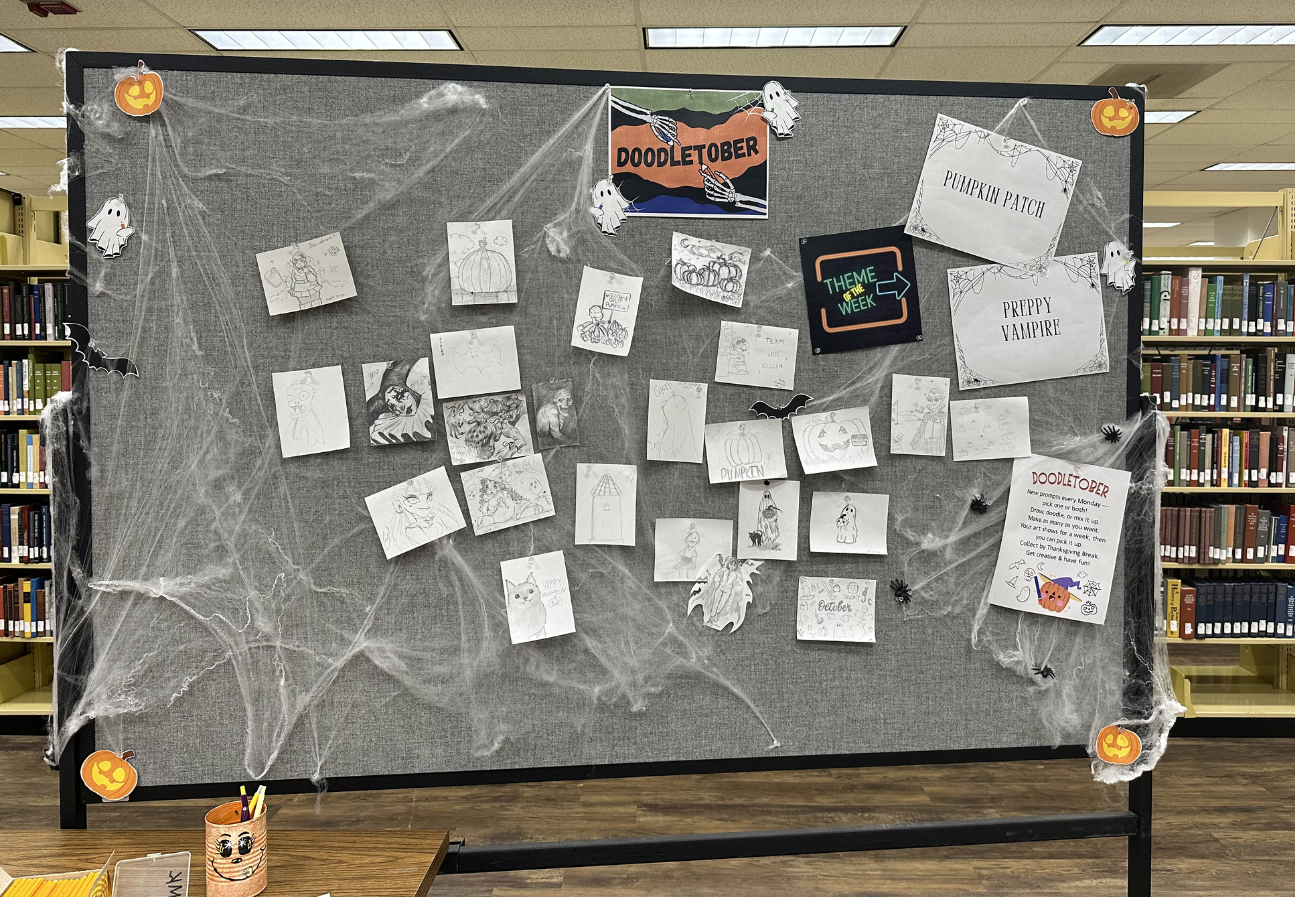
Each week featured two prompts, allowing multiple entry points for participation. Materials—including paper, pencils, and pushpins—were made readily available to encourage spontaneous involvement. Providing individual sheets of paper allowed students to create at their pace and contribute without needing to modify or replace existing work on the display. Participants were encouraged to interpret prompts in any way they wished and were reminded that the activity was open to all skill levels. The goal was not to produce polished artwork or evaluate artistic ability, but to contribute to a shared creative display. The pinboard was selected because it was an available and practical display option within the library space. Using individual paper contributions allowed students to remove and keep their drawings if they wished, while also allowing the display to grow organically without risking damage to previously submitted work. The format also facilitated a flexible gallery-style arrangement, enabling the addition of contributions throughout the month while preserving a shared visual space.
The display itself was decorated with Halloween-themed elements to reinforce the seasonal atmosphere.
Weekly prompts included:
- Week 1: Pumpkin Patch / Preppy Vampire
- Week 2: Cute Cryptid / Misunderstood Wizard
- Week 3: Lantern Bearer / Fred’s Skeleton Party
- Week 4: Favorite Horror Movie Villain / What Made the Noise?
Most students used the provided pencils and created doodles according to their preferences and comfort levels. Contributions were created on 5-by-4-inch sheets of paper, allowing the display to maintain a consistent format while still accommodating a range of drawing styles. Some contributions remained simple and minimal, while others incorporated more intricate details and shading. The open-ended format allowed participants to determine the level of complexity they wanted to contribute without expectations of artistic skill or a specific level of detail. Each participant was free to interpret the prompts in their own way.
Students who chose not to create a doodle still engaged with the display as viewers, often pausing to look through the contributions and observe the range of interpretations. In this way, the board functioned not only as a participatory activity but also as a small gallery space within the library. The structure provided consistency while still allowing for wide variation in interpretation.
Participation and Responses
Participation increased steadily as the display evolved, especially with the addition of more contributions. Students produced a wide range of interpretations, from simple sketches to more detailed and shaded compositions. Many reflected a “spooky cute” aesthetic, blending humor with light horror themes.
Some prompts generated particularly strong engagement. In Week 1, “Pumpkin Patch” was the most popular, with many students referencing It’s the Great Pumpkin, Charlie Brown, especially through repeated depictions of Snoopy. “Preppy Vampire,” by contrast, produced fewer but more stylized interpretations.
Week 2’s “Cute Cryptid” also drew strong participation. Mothman appeared frequently, often placed near glowing or illuminated environments, creating a recurring visual motif across submissions. “Misunderstood Wizard” resulted in more varied, narrative-driven interpretations.
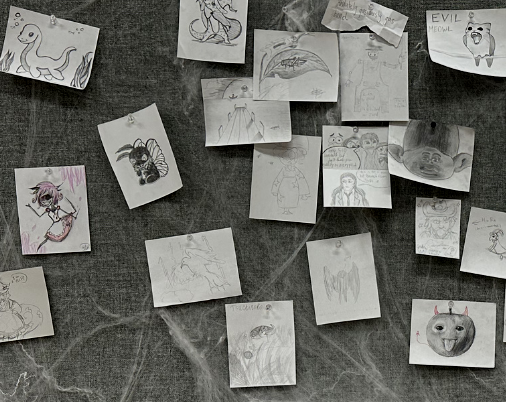
In Week 3, “Lantern Bearer” became an unexpected favorite. Several students depicted bears carrying lanterns, producing an unintentional but cohesive visual theme. “Fred’s Skeleton Party” contributed to a more conversational atmosphere, with some students building on the idea humorously.
Week 4’s “Favorite Horror Movie Villain” generated the highest response rate. Ghostface from Scream appeared most frequently, reflecting the influence of contemporary horror media. Some students combined this prompt with “What Made the Noise?”, adding narrative or suspense-driven elements to their drawings.
Beyond direct participation, the evolving display also encouraged informal interaction among library users. Students who did not contribute a doodle often stopped to view the collection, reacting to the variety of interpretations, humor, and Halloween-themed elements represented throughout the display.
Although Doodletober was designed around Halloween themes, the underlying structure can be adapted to other library contexts. Similar activities could incorporate seasonal themes, campus traditions, academic milestones, or student interests. The key components—simple prompts, accessible materials, visible display, and voluntary participation—can be adjusted to suit the needs and cultures of different institutions.
Limitations and Considerations
This case study reflects a single implementation of Doodletober in a single academic library setting and may not generalize to other institutional contexts. Participation was voluntary and informal, which limits the ability to capture comprehensive demographic or longitudinal data. Additionally, engagement was observed primarily through in-person interaction, meaning digital or indirect forms of participation may be underrepresented. Academic calendar factors, such as scheduled breaks when students were away from campus, may have also influenced participation. Future iterations could incorporate more structured data collection methods, such as brief participant feedback or reflective responses, to better understand students’ experiences and the factors influencing participation.
Why It Worked
Several factors appeared to support engagement with Doodletober, particularly its emphasis on visibility, low barriers to entry, and seasonal resonance.
Most importantly, the program centered on intrinsic motivation. Creativity researcher James C. Kaufman, who focuses on the psychology of creative behavior, notes that creativity flourishes when individuals engage in creative activity for personal enjoyment rather than external reward (Kaufman, 2016, p. 26). The level of participation suggests that the activity may have benefited from being approachable, playful, and self-directed.
The display’s physical visibility also appeared to encourage engagement. Positioned in a high-traffic area, the board functioned not only as an activity space but also as an evolving visual presence within the library. As participation increased, the display itself became a form of encouragement, potentially lowering hesitation for new contributors.
The initiative’s timing seemed to affect participation, but this case study alone cannot ascertain the relationship between theme and engagement. Similar doodle-based activities were implemented at other times during the academic year, including a Thanksgiving-themed version (“Turkey-Doodle-Do”) and a spring-themed version (“Spring Fling Doodle Thing”), all using the same general structure, materials, and display format. Participation during those periods was lower, possibly due to reduced library traffic during academic breaks, including Thanksgiving Break and Spring Break. While the stronger participation during Doodletober may suggest that seasonal context contributed to engagement, additional assessment would be needed to determine whether Halloween-specific themes were a significant factor.
Taken together, these observations suggest that engagement emerged from the interaction between accessibility, visibility, and cultural context rather than from any single design element.
Conclusion
Doodletober suggests that small, low-pressure creative interventions can provide meaningful opportunities for student engagement within academic libraries.
By providing space for informal expression, the program supported creativity, encouraged student engagement, and strengthened the library’s role as a community hub. As Miller (2015) notes, cultivating creativity requires environments that encourage curiosity and initiative (p. 26), a principle reflected throughout this initiative.
The success of Doodletober also points toward the value of continuing similar programming models that are simple, seasonal, and student-centered, particularly in academic library environments seeking low-barrier engagement strategies.
References
Battles, M. (2004). In praise of doodling. The American Scholar, 73(4), 105–108. http://www.jstor.org/stable/41221340
Isis, P., Bokoch, R., Fowler, G., & Hass-Cohen, N. (2024). Efficacy of a single-session mindfulness-based art therapy doodle intervention. Art Therapy, 41(1), 11–20. https://doi.org/10.1080/07421656.2023.2192168
Kaufman, J. C. (2016). The creative construct. RSA Journal, 162(5565), 24–27. http://www.jstor.org/stable/26204479
Kraft, U. (2005). Unleashing creativity. Scientific American Mind, 16(1), 16–23. http://www.jstor.org/stable/24997593
Miller, D. L. (2015). Cultivating creativity. The English Journal, 104(6), 25–30. http://www.jstor.org/stable/24484423
Nicholls State University Office of Institutional Research, Effectiveness, and Planning. (2025). Enrollment statistics: Fall 2025. Nicholls State University. https://www.nicholls.edu/irep/wp-content/uploads/sites/54/2025/09/Enrollment-Statistics-Fall-2025-1.pdf
Pachucki, M. A., Lena, J. C., & Tepper, S. J. (2010). Creativity narratives among college students: Sociability and everyday creativity. The Sociological Quarterly, 51(1), 122–149. http://www.jstor.org/stable/20697933
Schenk, P. (2014). Inspiration and ideation: Drawing in a digital age. Design Issues, 30(2), 42–55. http://www.jstor.org/stable/24266948
Silver, S. D., & Trott, B. (2014). Outreach activities for librarian liaisons. Reference & User Services Quarterly, 54(2), 8–14. http://www.jstor.org/stable/refuseserq.54.2.8